Introduction
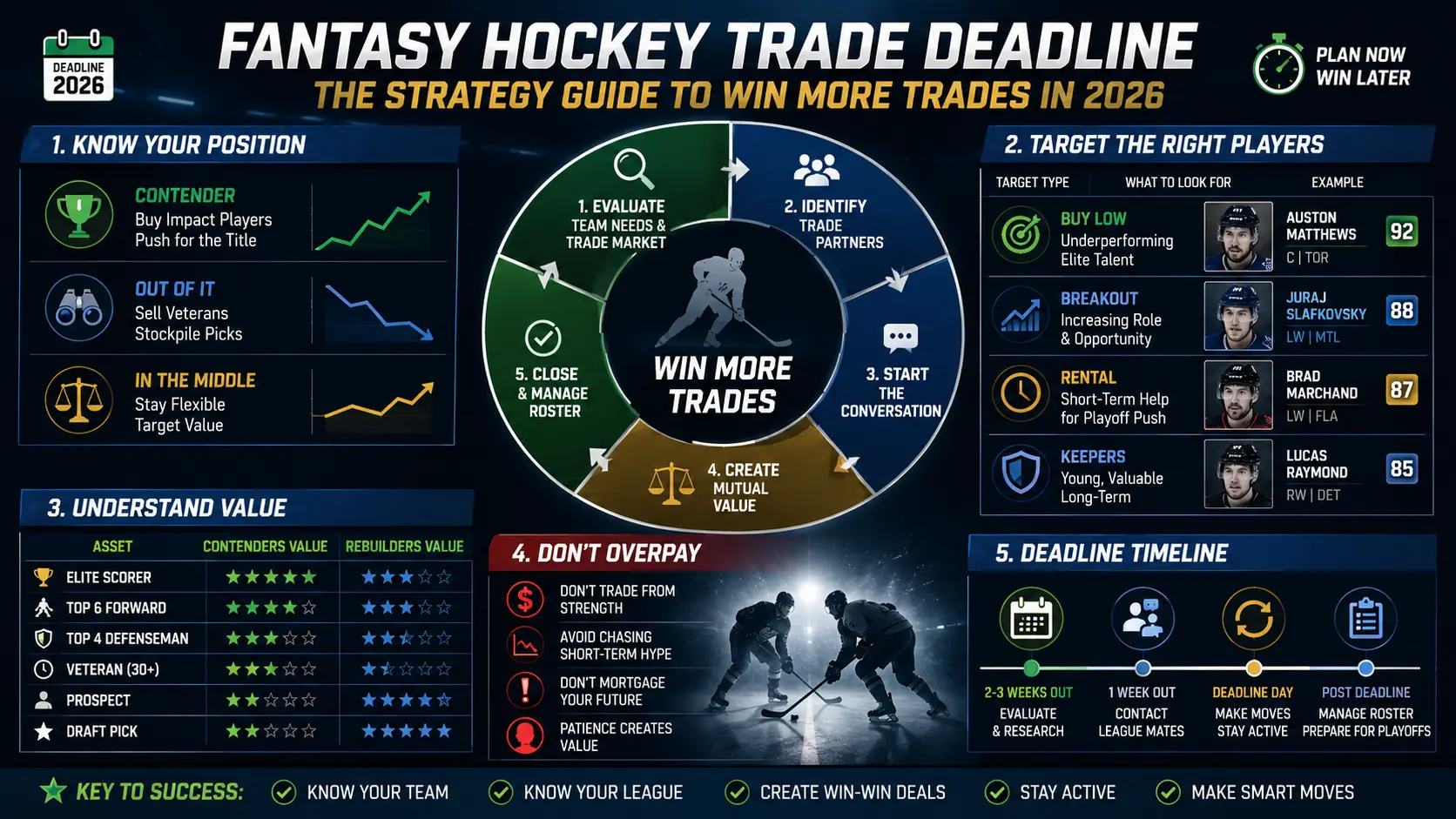
The fantasy hockey trade deadline is one of the most important moments of your fantasy season. Whether you’re fighting for a playoff spot or preparing for a championship run, every trade you make before the deadline can significantly impact your chances of winning.
Many fantasy managers focus only on star power, but successful players understand that schedule strength, category balance, NHL trade rumors, and league settings matter just as much. Trading the biggest name isn’t always the smartest move if another player offers a better playoff schedule or fills categories your team lacks.
Understanding your league’s fantasy hockey trade deadline, including Yahoo, ESPN, Fantrax, or custom commissioner settings, is essential because missing the deadline means your roster is locked for the remainder of the season.
In this guide, you’ll learn exactly when the fantasy hockey trade deadline occurs, how different platforms handle trade rules, which strategies consistently work, and how to avoid the costly mistakes that eliminate championship contenders.
Table of Contents
- What Is the Fantasy Hockey Trade Deadline?
- Why Fantasy Hockey Trade Deadlines Exist
- Yahoo vs. ESPN Fantasy Hockey Trade Deadline Rules
- How to Prepare Before the Fantasy Hockey Trade Deadline
- Schedule Density: The Hidden Advantage
- Fantasy Hockey Trade Targets & Players to Sell
- Trade Strategies for Different League Formats
- Advanced Tips
- Common Mistakes
- Recommended Tools
- Future Trends
- FAQs
TL;DR
- The fantasy hockey trade deadline is the final day you can make trades before playoffs.
- Yahoo and ESPN use different default deadline settings.
- Schedule density often matters more than player rankings.
- Buy players with favorable playoff schedules and stable roles.
- Evaluate trades using deployment, opportunity, and category production not just total fantasy points.
What Is the Fantasy Hockey Trade Deadline?
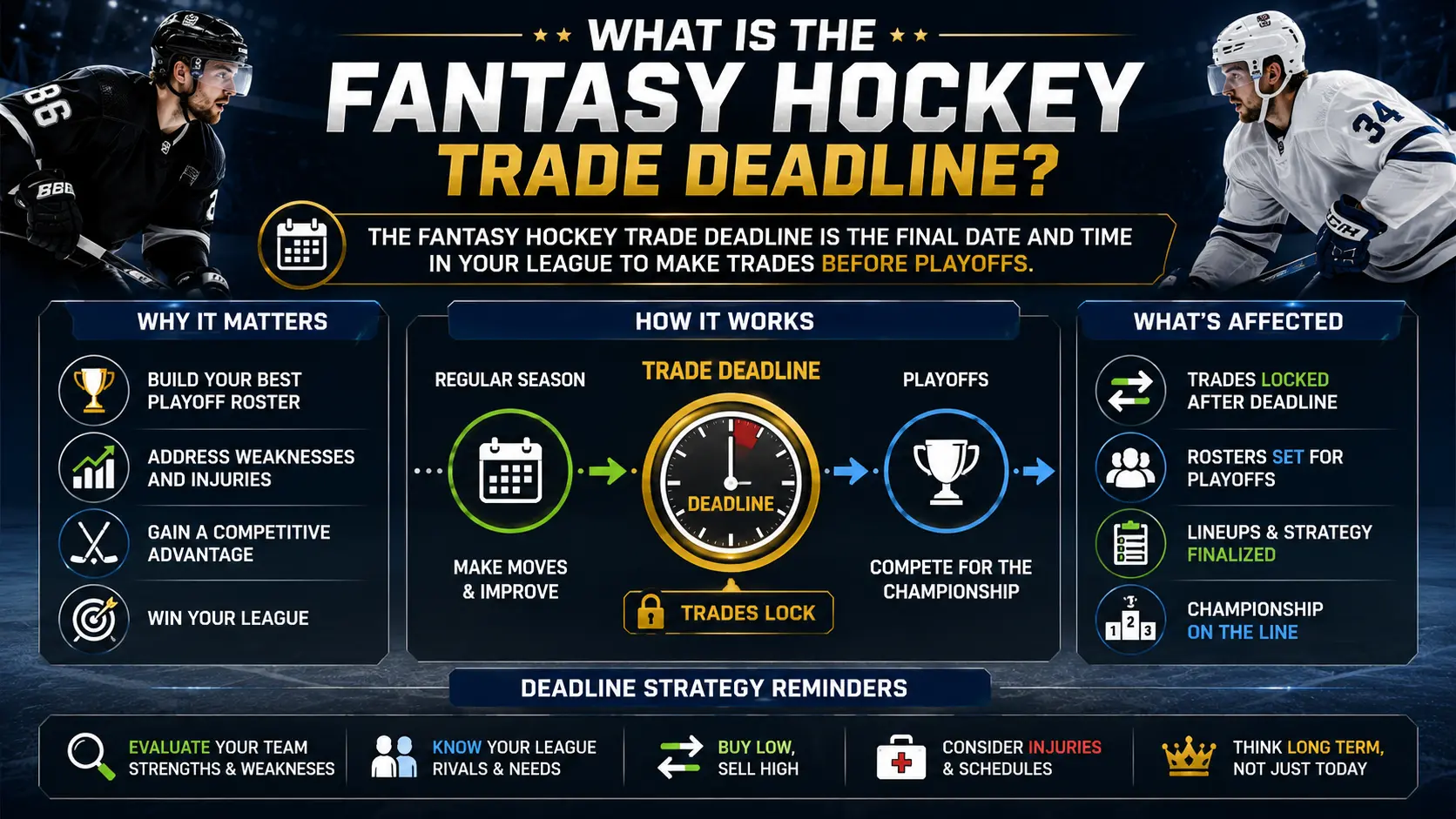
The fantasy hockey trade deadline is the final date set by your fantasy platform or league commissioner after which managers can no longer trade players. It exists to protect competitive balance, prevent collusion, and ensure playoff teams rely on the rosters they built before postseason play begins.
Many new fantasy managers ask:
- Is there a trade deadline in fantasy hockey?
- Does fantasy have a trade deadline?
- When is fantasy hockey trade deadline?
The answer is yes.
Nearly every fantasy platform including Yahoo, ESPN, Fantrax, and CBS uses a trade deadline. Commissioners can also customize these dates depending on league preferences.
Unlike the real NHL trade deadline, your fantasy deadline is determined by your fantasy platform or league commissioner and is usually scheduled before fantasy playoffs begin.
Why Fantasy Hockey Trade Deadlines Exist
Without a deadline, fantasy leagues could become unfair.
Imagine a last-place manager sending Connor McDavid to the first-place team one day before the championship matchup. Even if the trade appears legitimate, it could destroy league integrity.
The fantasy hockey trade deadline helps prevent:
- Collusion
- Tanking
- Last-minute roster dumping
- Unfair playoff advantages
- League disputes
It also encourages managers to plan ahead rather than making panic trades during playoff matchups.
Commissioners benefit because deadline rules reduce veto disputes and league drama later in the season.
Yahoo vs. ESPN Fantasy Hockey Trade Deadline Rules
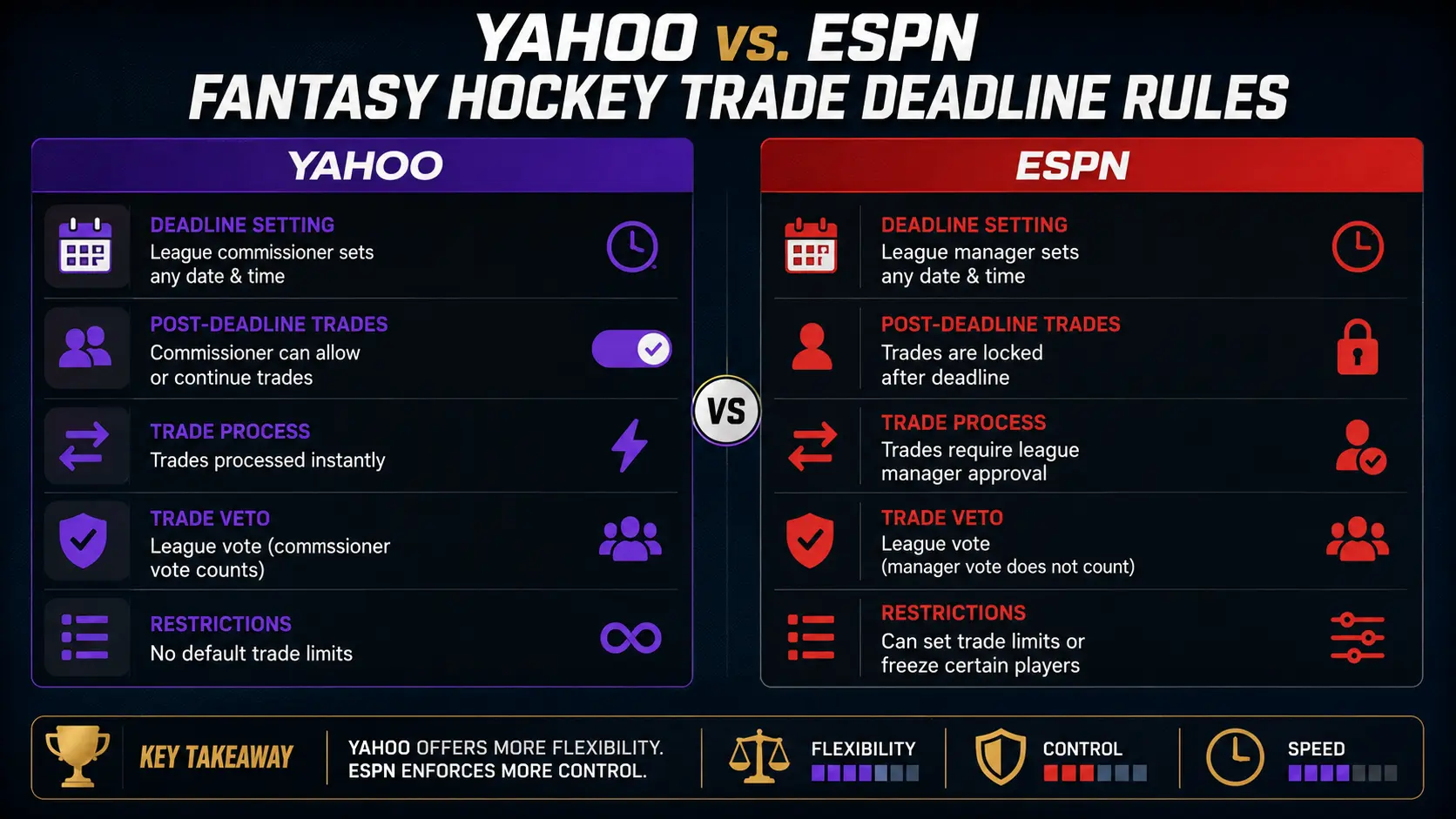
One of the biggest mistakes fantasy managers make is assuming every platform follows identical rules.
| Platform | Default Trade Deadline | Commissioner Can Change? | Trade Review |
| Yahoo Fantasy Hockey | Yes | Yes | League Settings |
| ESPN Fantasy Hockey | Yes | Yes | League Settings |
| Fantrax | Fully Customizable | Yes | Highly Flexible |
| CBS Sports | Customizable | Yes | Commissioner Controls |
Always verify your league settings because the Yahoo fantasy hockey trade deadline may not match your ESPN fantasy hockey trade deadline.
Common searches include:
- yahoo fantasy hockey trade deadline
- yahoo fantasy hockey trade deadline time
- yahoo fantasy trade deadline rules
- yahoo fantasy trade end date
- yahoo fantasy trade deadline time
- espn fantasy hockey trade deadline
- espn fantasy hockey deadline
- espn fantasy hockey trade rules
- espn fantasy hockey draft deadline
Rather than relying on internet dates, check your league’s settings page because commissioners frequently modify deadlines.
How to Prepare Before the Fantasy Hockey Trade Deadline
Winning managers rarely wait until deadline day.
Instead, they begin evaluating trades one to three weeks before the fantasy hockey trade deadline.
Step 1: Evaluate Your Team
Ask yourself:
- Am I realistically competing?
- Do I need immediate production?
- Should I rebuild for next season?
- Which categories am I losing every week?
Knowing your strengths makes trade negotiations much easier.
Step 2: Identify Fantasy Hockey Trade Targets
The best fantasy hockey trade targets are players whose value is likely to increase during fantasy playoffs.
Look for players who have:
- Top-line deployment
- Power Play 1 usage
- Increased ice time
- Favorable playoff schedules
- Consistent shot volume
- Strong peripheral statistics
Avoid chasing players who recently had one huge week if their underlying metrics don’t support continued production.
Step 3: Understand the Fantasy Hockey Trade Market
The fantasy hockey trade market changes dramatically near the deadline.
Contending teams often:
- Pay premium prices
- Overvalue veterans
- Need category specialists
- Need goalie depth
Rebuilding teams usually prefer:
- Draft picks
- Young prospects
- Keeper assets
- Future value
Understanding your opponent’s needs dramatically increases your chances of completing successful trades.
Schedule Density: The Hidden Championship Advantage
Most fantasy managers compare players.
Elite managers compare schedules.
This is one of the biggest content gaps found across competing articles. Managers often ignore off-night games and playoff game density even though these factors can decide fantasy championships.
Suppose Player A averages slightly more fantasy points per game than Player B.
If Player B plays four extra games during your fantasy playoffs, Player B could easily outscore Player A over the course of three playoff weeks.
Focus on Off-Night Games
Off-night games occur on lighter NHL schedule days, including:
- Monday
- Wednesday
- Friday
- Sunday
These nights allow more players to fit into your active lineup because fewer NHL teams are playing.
Managers who maximize off-night games often gain several extra starts without adding better players.
Example
| Player | Fantasy Points/Game | Playoff Games | Off-Night Games |
| Player A | 4.4 | 9 | 2 |
| Player B | 4.0 | 12 | 7 |
Although Player A is better individually, Player B may produce more total fantasy value simply because he can actually be started more often.
This type of schedule optimization is overlooked by many fantasy managers but consistently creates playoff advantages.
Fantasy Hockey Trades to Make Before the Deadline
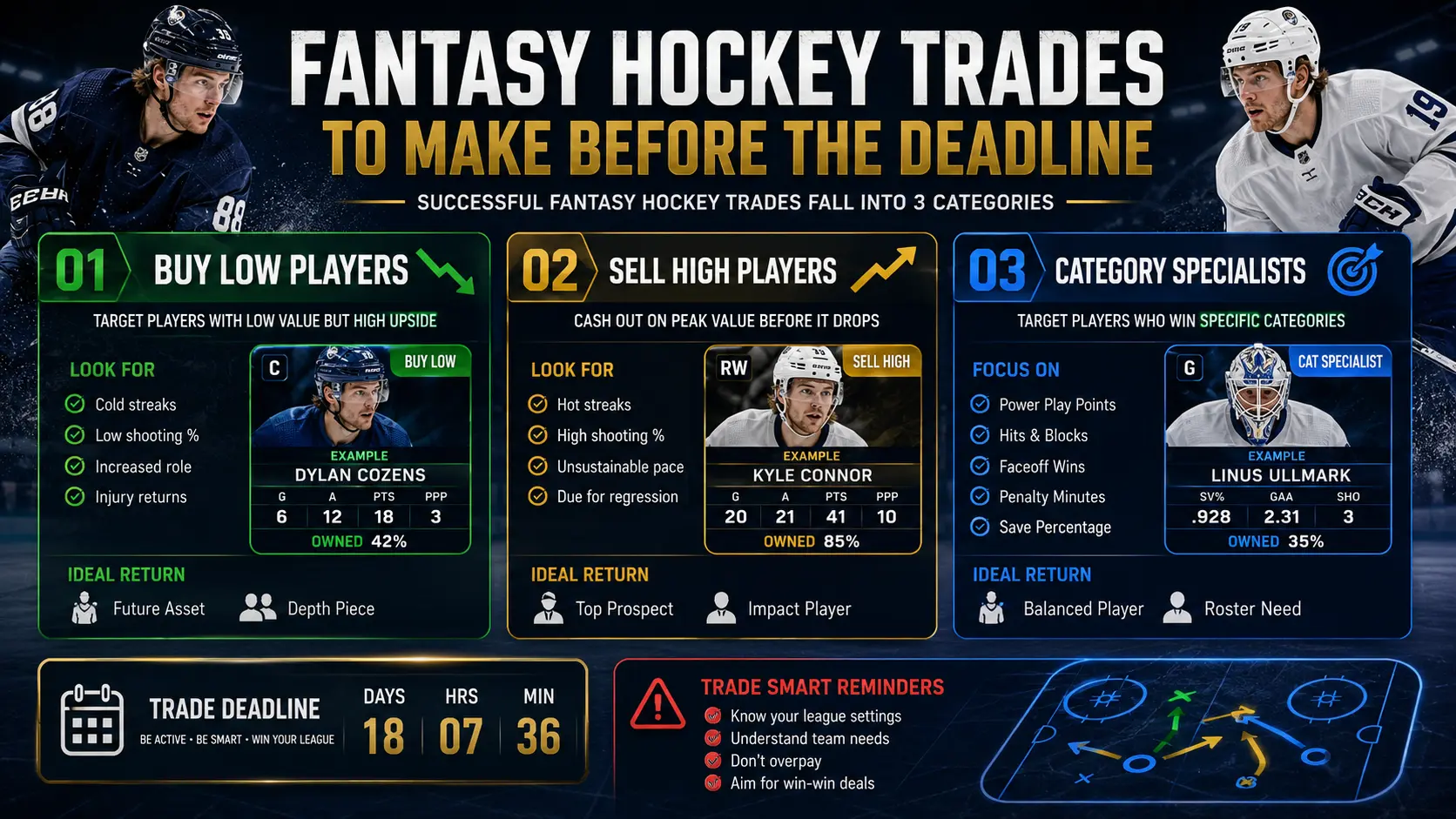
Successful fantasy hockey trades to make usually fall into three categories.
1. Buy Low Players
Target players who:
- Recently returned from injury
- Have strong underlying metrics
- Are receiving PP1 opportunities
- Are shooting below career averages
2. Sell High Players
Move players who are outperforming sustainable expectations.
Warning signs include:
- Unsustainably high shooting percentage
- Limited shot volume
- Reduced power-play usage
- Declining ice time
Advanced metrics like SH%, IPP, PDO, and xGF help identify these players before production drops.
3. Category Specialists
Many playoff matchups are decided by:
- Hits
- Blocks
- Penalty Minutes
- Faceoff Wins
Don’t ignore “banger league” contributors simply because they score fewer goals.
Specialists can swing weekly category matchups by themselves.
Trade Deadline Strategies by League Format
Not every fantasy hockey league rewards the same strategy. A move that wins a redraft league could hurt your long-term outlook in a dynasty format. Before making any deal near the fantasy hockey trade deadline, consider your league’s scoring system, keeper rules, and championship window. Competitors often treat all league types the same, but your approach should change dramatically based on format.
Redraft Leagues
In redraft leagues, your only goal is to maximize production for the remainder of the season.
Best strategy:
- Prioritize playoff schedule over season-long rankings.
- Trade prospects for proven veterans.
- Add category specialists to strengthen weak areas.
- Don’t worry about next year’s value.
Dynasty & Keeper Leagues
Dynasty leagues require balancing immediate success with future assets.
If you’re contending:
- Trade future draft picks only for true difference-makers.
- Target elite players with secure top-line and PP1 roles.
- Avoid overpaying for short-term rentals unless they significantly improve your title odds.
If you’re rebuilding:
- Sell aging veterans before the fantasy hockey trade deadline.
- Acquire young NHL talent and premium draft picks.
- Focus on long-term value instead of short-term production.
The “Draft Pick Liquidation Formula” is a major content gap among competitors. Rather than accepting any offer for veteran players, compare the expected value of future picks against the projected production of rental stars.
Head-to-Head vs. Rotisserie
| League Type | Primary Focus | Trade Strategy |
| H2H Points | Total fantasy points | Target high-volume producers |
| H2H Categories | Category balance | Acquire specialists for weak categories |
| Rotisserie | Season-long accumulation | Avoid risky short-term rentals |
| Banger Leagues | Hits, Blocks, PIM | Prioritize peripherals alongside scoring |
How the NHL Trade Deadline Impacts Fantasy Hockey
One of the most overlooked aspects of the fantasy hockey trade deadline is the relationship between real NHL trades and fantasy value.
A player traded at the NHL deadline may experience:
- More or less ice time
- Better or worse linemates
- Changes in Power Play usage (PP1 vs. PP2)
- Different offensive systems
- Easier or tougher schedules
For example, a top-line winger traded to a Stanley Cup contender might suddenly play on the third line, reducing fantasy production despite joining a stronger team. Conversely, a depth player traded to a rebuilding club may earn first-line minutes and become a valuable waiver-wire pickup.
When evaluating fantasy hockey trade targets, don’t just look at team quality consider deployment, opportunity, and role.
Goalie Management at the Fantasy Hockey Trade Deadline
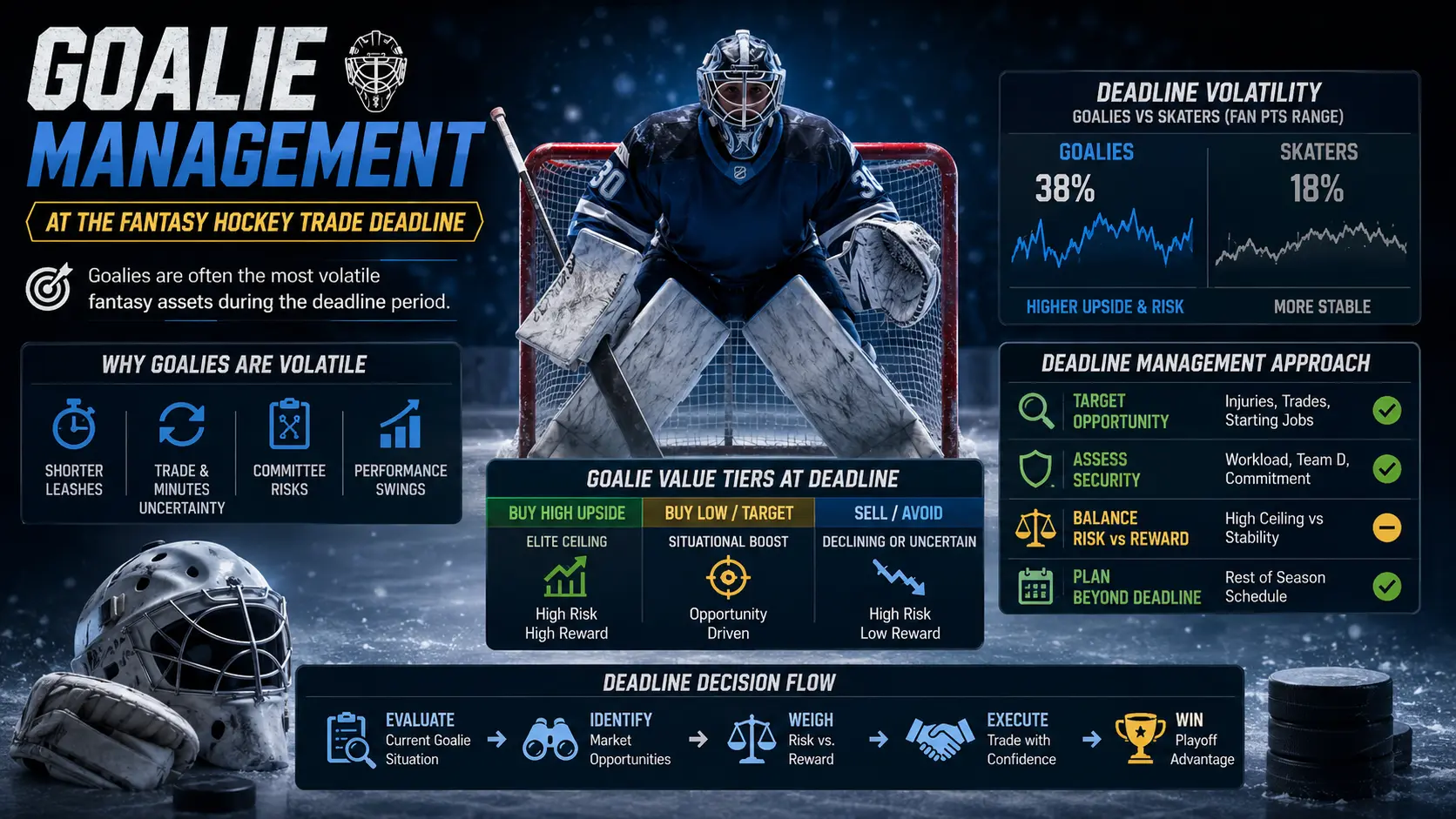
Goalies are often the most volatile fantasy assets during the deadline period.
A trade involving one NHL goalie can dramatically affect:
- Wins
- Save percentage
- Goals-against average
- Shutout opportunities
Smart Goalie Strategies
- Target clear No. 1 starters.
- Handcuff important goalie tandems where possible.
- Monitor NHL trade rumors for potential role changes.
- Avoid paying premium prices for goalies in uncertain situations.
Managers frequently overlook goalie volatility, making it a significant competitive advantage for those who plan ahead.
Trading Psychology and League Politics
Winning trades aren’t only about player values they’re also about understanding your league mates.
Target the Right Trade Partners
Ask yourself:
- Which managers are desperate for wins?
- Who needs goalie help?
- Who has surplus defensemen?
- Which teams are rebuilding?
Managers fighting for the final playoff spot are often more willing to overpay for immediate production than teams comfortably leading the standings.
Avoid Veto Drama
Near the fantasy hockey trade deadline, emotions run high.
To reduce trade disputes:
- Offer balanced deals.
- Communicate clearly with league mates.
- Understand commissioner settings.
- Respect league rules regarding vetoes and review periods.
Strong leagues focus on preventing collusion not rejecting every uneven trade.
Your Pre-Deadline Checklist
Complete these steps before your fantasy hockey trade deadline arrives:
- Confirm your league’s deadline date and processing rules.
- Evaluate your playoff chances honestly.
- Compare fantasy playoff schedules.
- Identify players with strong off-night schedules.
- Review advanced metrics such as SH%, IPP, PDO, and xGF.
- Target managers whose roster needs match your strengths.
- Submit offers several days before the deadline.
- Prepare waiver-wire contingency plans if trades fall through.
Advanced Tips
Experienced fantasy managers separate themselves with preparation and analytics.
- Track PP1 deployment instead of relying only on season-long points.
- Use schedule density to maximize active roster spots during fantasy playoffs.
- Buy players with favorable underlying metrics before their production rebounds.
- Sell players whose recent scoring is driven by unsustainable shooting percentages.
- Monitor NHL line combinations daily after the real trade deadline.
- Build trade offers around your partner’s weaknesses instead of only improving your own roster.
- Don’t ignore IR and IR+ strategies for injured stars if your league allows them.
Common Mistakes
Avoid these costly errors before the fantasy hockey trade deadline:
- Waiting until the final hour to negotiate trades.
- Ignoring fantasy playoff schedules.
- Trading solely based on player name recognition.
- Overlooking category balance.
- Forgetting platform-specific trade review periods.
- Assuming Yahoo and ESPN use identical default deadlines.
- Ignoring real NHL trades that change player deployment.
- Failing to have a waiver-wire backup plan if a trade isn’t completed.
Recommended Tools & Resources
To make smarter decisions before the fantasy hockey trade deadline, consider using:
- Your league’s trade analyzer
- NHL schedule planners
- Line combination trackers
- Advanced analytics sites (Natural Stat Trick, MoneyPuck, Frozen Tools)
- Daily injury reports
- Beat writer updates for line changes and goalie starts
These resources help evaluate players beyond traditional goals and assists.
Future Trends
Fantasy hockey continues to become more data-driven.
Expect managers to increasingly rely on:
- Expected Goals (xGF)
- Individual Point Percentage (IPP)
- PDO regression analysis
- Automated trade analyzers
- Schedule optimization tools
- AI-powered player projections
Managers who combine advanced analytics with schedule planning will continue to gain an edge over those relying solely on rankings.
Conclusion
The fantasy hockey trade deadline isn’t just the last opportunity to make trades it’s your final chance to shape a championship roster.
Success comes from more than acquiring star players. The best managers understand playoff schedules, off-night game advantages, advanced analytics, league settings, and the psychology of trade negotiations. By planning ahead, targeting the right trade partners, and evaluating both player talent and opportunity, you’ll put yourself in the strongest position for fantasy playoff success.
Whether you play on Yahoo, ESPN, Fantrax, or another platform, always verify your league’s rules, act before the deadline rush, and make every trade with your playoff strategy in mind.
Frequently Asked Questions
1. When is the fantasy hockey trade deadline?
The deadline varies by platform and league. Yahoo, ESPN, Fantrax, and custom leagues can all have different trade deadlines, so always check your league settings.
2. Is there a trade deadline in fantasy hockey?
Yes. Nearly every fantasy hockey league has a trade deadline to maintain competitive balance before the playoffs.
3. Can commissioners change the Yahoo fantasy hockey trade deadline?
Yes. Commissioners in private leagues can usually customize the trade deadline and related rules.
4. What happens after the fantasy hockey trade deadline?
Once the deadline passes, managers generally cannot complete player trades, although waiver claims and free-agent pickups may still be allowed depending on league settings.
5. Should I trade future draft picks in dynasty leagues?
Only if you’re a legitimate championship contender and the incoming player significantly improves your roster.
6. What are the best fantasy hockey trade targets?
Look for players with top-line deployment, PP1 usage, favorable playoff schedules, and strong underlying metrics rather than chasing recent hot streaks.
7. How important are off-night games?
Very important. Players with more games on lighter schedule days can provide more usable starts during fantasy playoffs, increasing your team’s total production.
8. Should I make trades on deadline day?
It’s usually better to complete trades several days before the deadline to avoid processing delays, league review periods, and missed opportunities.