Introduction
If you’ve ever sent a dynasty trade offer that looked fair on a calculator but was instantly rejected, you’re not alone. Most fantasy managers struggle with one core problem: dynasty fantasy basketball trade value is not the same as redraft value.
A 31-year-old star might be worth a championship to a contender and almost nothing to a rebuilding team. A future first-round pick can gain or lose value depending on the month, the draft class, and even the league standings. Add 9-category scoring, punt builds, salary cap rules, and rookie hype, and trading becomes far more complex than comparing two player rankings.
This dynasty fantasy basketball trade guide will show you how experienced managers actually evaluate trades, negotiate deals, and build long-term championship rosters. You’ll learn the math behind asset valuation, how to use a dynasty fantasy basketball trade analyzer correctly, when to buy or sell draft picks, and how to avoid the trade calculator traps that sink many leagues.
Table of Contents
- What Is a Dynasty Fantasy Basketball Trade?
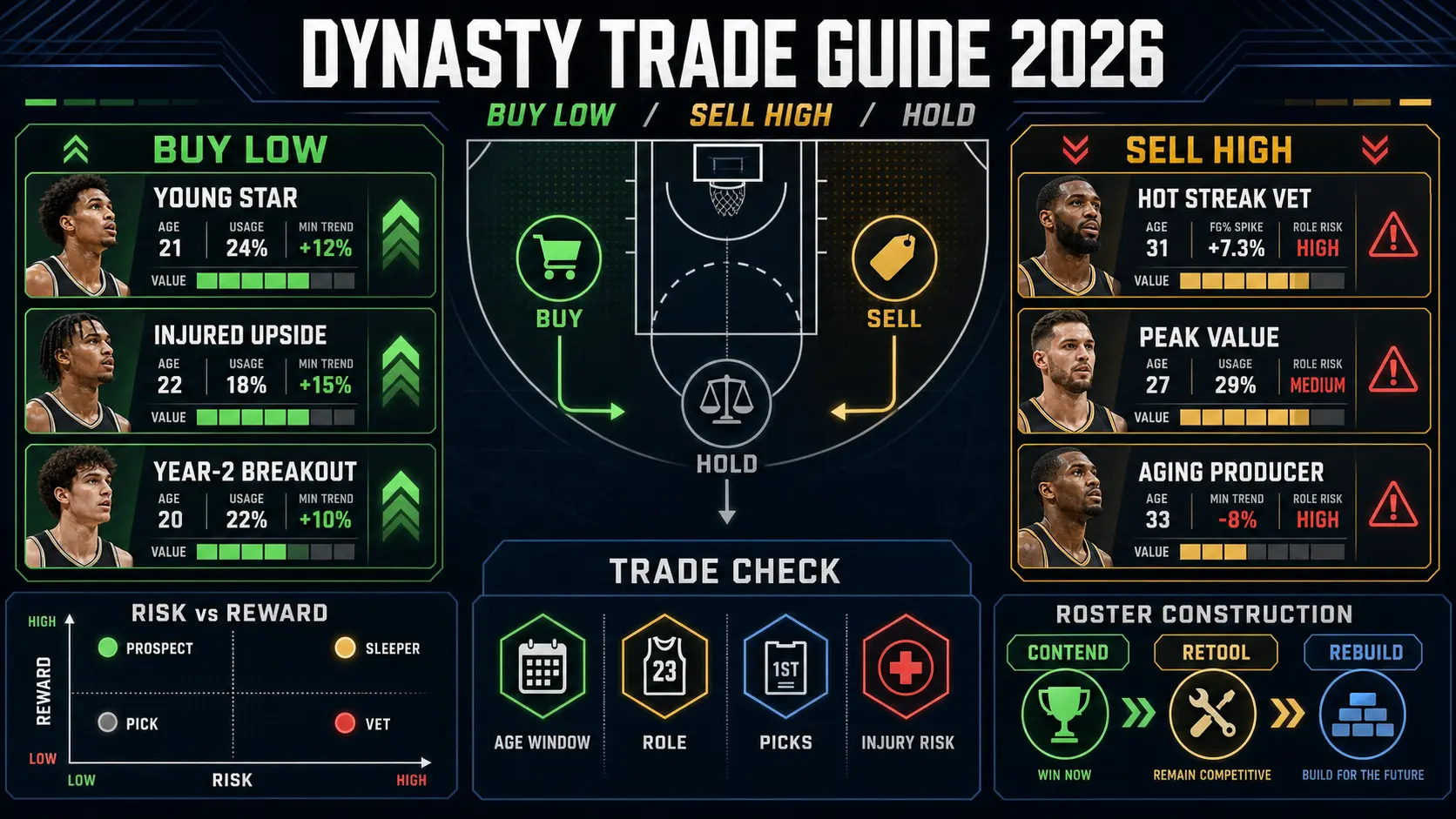
- The Core Philosophy of Dynasty Trading
- Contender vs. Rebuilder Trade Strategy
- The Star Consolidation Principle
- Asset Valuation and the Age-Curve Matrix
- Position-Based Aging Curves
- How to Calculate Dynasty Fantasy Basketball Trade Value
- Trade Calculator Limitations
TL;DR
- Dynasty fantasy basketball trade value changes based on team direction (contending vs. rebuilding).
- Elite players usually win 2-for-1 trades because roster spots have value.
- Guards hold value longer than athletic bigs, while centers with elite defensive stats can age gracefully.
- Draft picks are most valuable right before the rookie draft and least valuable immediately after selections are made.
- Trade calculators are tools, not decision-makers; they cannot fully account for punt builds, league depth, or contract rules.
What Is a Dynasty Fantasy Basketball Trade?
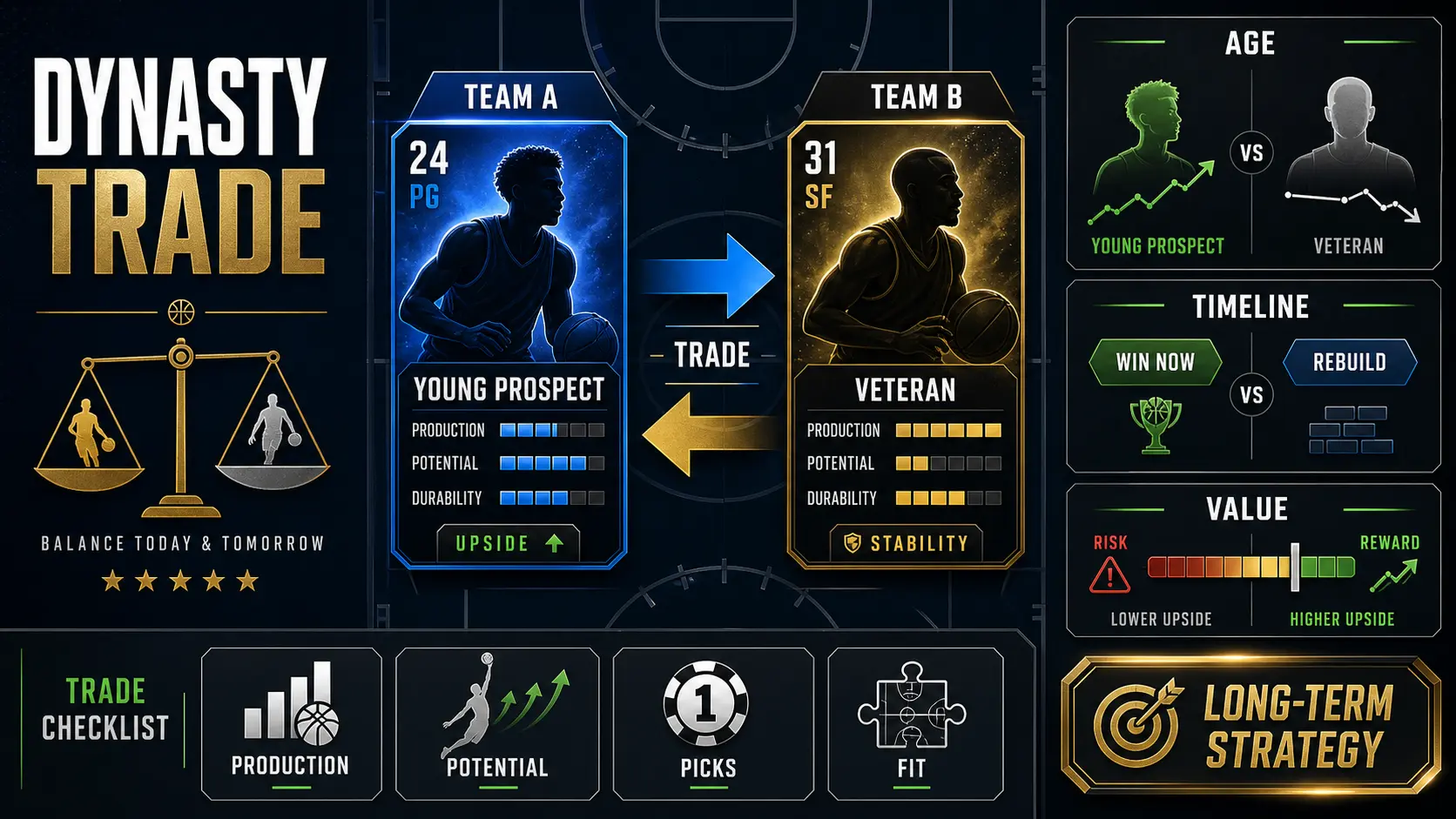
A dynasty fantasy basketball trade is a transaction in which managers exchange players, future rookie draft picks, contract rights, or other long-term assets to improve either their immediate championship odds or their multi-year roster outlook.
Unlike redraft leagues, dynasty trades must account for:
- Player age
- Career trajectory
- Contract situation (in salary-cap leagues)
- Rookie pick value
- Category fit
- Team competitive window
This is why a dynasty fantasy basketball trade guide is essential; simple rankings are not enough.
The Core Philosophy of Dynasty Trading
The biggest mistake beginners make is treating every asset as if it has a single universal value.
A better framework is:
Dynasty trade equation
Asset Value=Talent×Age×Team Fit×Competitive WindowAsset\ Value = Talent \times Age \times Team\ Fit \times Competitive\ WindowAsset Value=Talent×Age×Team Fit×Competitive Window
A player’s value can change dramatically depending on who is evaluating him.
Contender vs. Rebuilder mindset
| Contending Team | Rebuilding Team |
| Buys aging stars | Sells players over 28–29 |
| Moves rookie picks | Accumulates draft capital |
| Focuses on current category wins | Focuses on upside and usage |
| Accepts short-term value decay | Prioritizes long-term appreciation |
The Phase Multiplier
This is the concept most competitors fail to explain.
A 30-year-old top-20 player might have:
- 1.5x value to a contender
- 1.0x value to a neutral team
- 0.5x value to a rebuilder
So if your offer keeps getting rejected, the problem may not be the calculator; it may be that you’re offering the wrong type of asset for that manager’s timeline.
The Star Consolidation Principle
One of the most important lessons in this dynasty fantasy basketball trade guide is that the side receiving the best player usually wins.
Why 2-for-1 trades are overrated
Many managers think this is fair:
- Player A (rank 18)
- for
- Player B (rank 42) + Player C (rank 55)
On paper, the combined value looks close. In reality, the manager receiving Player A opens an extra roster spot for a waiver add, streamer, or future rookie.
Real 9-category example
| Asset | Approx. Z-Score |
| Scottie Barnes | +4.8 |
| RJ Barrett | +1.2 |
| Tobias Harris | +0.8 |
| Combined Barrett + Harris | +2.0 |
Even though you’re getting two usable players, you’re giving up a player who provides elite multi-category production. A dynasty fantasy basketball trade analyzer may call it close, but elite production is harder to replace than mid-tier depth.
Rule of thumb
- Top-10 dynasty players: require an overpay
- Top-25 players: require equal value plus a premium
- Top-60 players: can often be moved in balanced packages
Asset Valuation and the Age-Curve Matrix
Age is the engine of dynasty fantasy basketball trade value.
Ages 24–28 are typically the peak dynasty value window.
Dynasty value by age
| Age Range | Dynasty Value Trend |
| 19–21 | Rapid appreciation |
| 22–23 | Breakout window |
| 24–28 | Peak value |
| 29–30 | Early decline |
| 31–33 | Sharp market discount |
| 34+ | Contender-only assets |
The age drop-off multiplier
Use this when comparing veterans to younger players.
| Age | Value Multiplier |
| 24–28 | 1.00 |
| 29 | 0.92 |
| 30 | 0.82 |
| 31 | 0.70 |
| 32+ | 0.55 |
Example
If a player has a raw value of 100 and is 31 years old:
- Adjusted value = 70
That doesn’t mean he scores 30% fewer fantasy points; it means the dynasty market discounts the remaining career window.
Position-Based Aging Curves
Different positions decline at different rates, which is rarely discussed in a typical dynasty fantasy basketball trade guide.
Point guards
Hold value the longest
- Assists age well
- Skill-based production
- Lower reliance on explosiveness
Example: Stephen Curry remained elite deep into his 30s because shooting and decision-making did not decline as quickly as athletic traits.
Athletic centers
Decline the fastest
- Blocks often fall after age 30
- Rebounding can remain stable
- Mobility and minutes become concerns
Example: Rim-running centers who depend on vertical athleticism are much riskier long-term than skilled passing bigs.
Multi-category forwards
Best long-term bets
Players such as Luka Dončić, Shai Gilgeous-Alexander, and Victor Wembanyama provide:
- Points
- Rebounds
- Assists
- Defensive stats
- Strong usage
- Positional flexibility
These are the players you build around in ESPN dynasty fantasy basketball and Fantrax leagues.
How to Calculate Dynasty Fantasy Basketball Trade Value
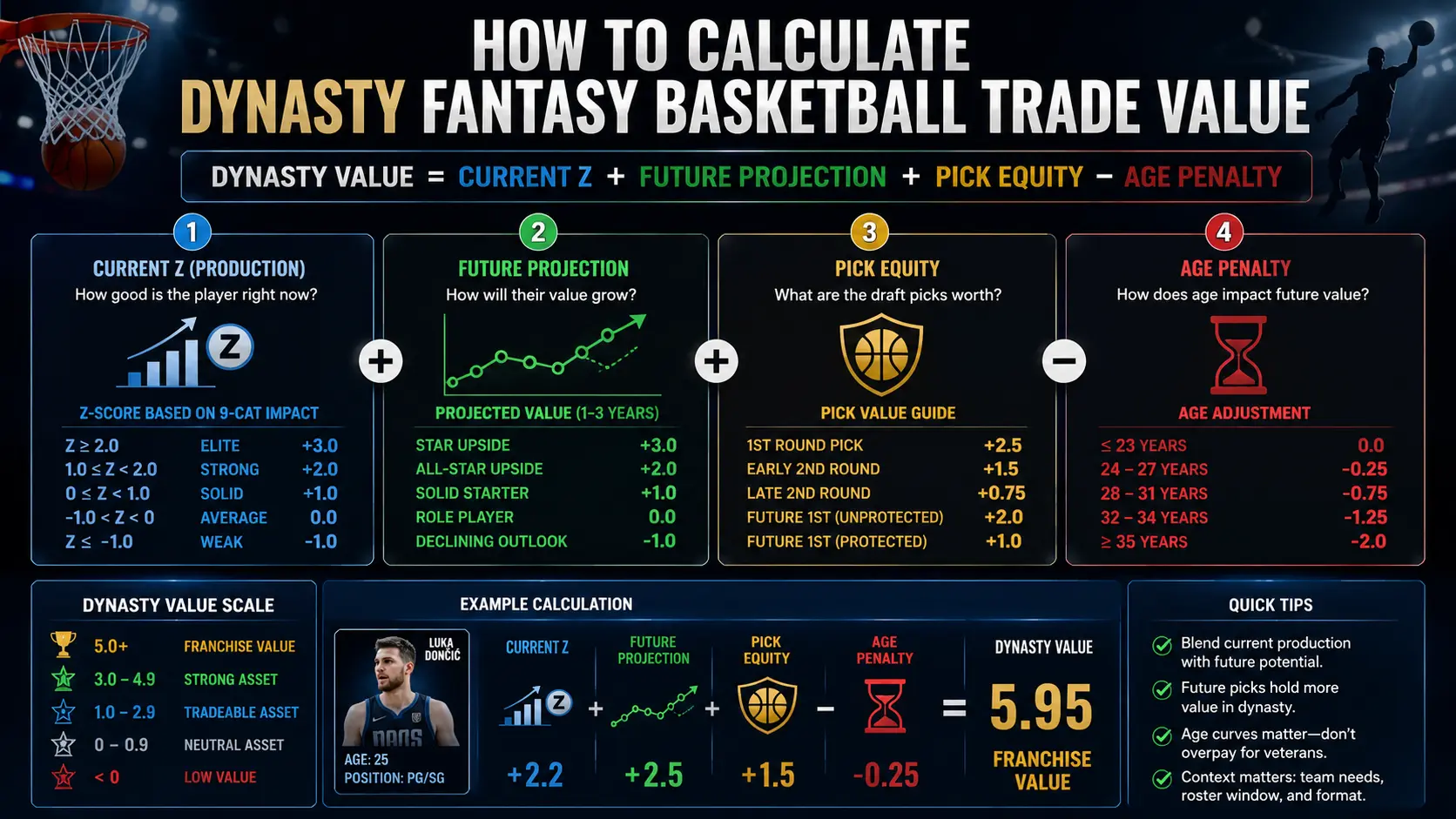
A proper valuation combines current production with future production.
Simple dynasty formula
Quick valuation model
Dynasty Value=Current Z+Future Projection+Pick Equity−Age PenaltyDynasty\ Value = Current\ Z + Future\ Projection + Pick\ Equity – Age\ PenaltyDynasty Value=Current Z+Future Projection+Pick Equity−Age Penalty
Example: 24-year-old breakout forward
- Current Z-score: +3.5
- Future projection: +1.5
- Pick equity: 0
- Age penalty: 0
Final value = 5.0
Example: 31-year-old veteran star
- Current Z-score: +5.0
- Future projection: -0.5
- Pick equity: 0
- Age penalty: -1.5
Final value = 3.0
This is why younger players often rank ahead of veterans in NBA dynasty fantasy basketball rankings even when the veteran is better today.
Trade Calculator Limitations
Every dynasty fantasy basketball trade calculator has blind spots.
What calculators do well
- Compare baseline market value
- Quantify draft pick ranges
- Identify obvious overpays
- Speed up negotiations
Popular tools include:
- Hashtag Basketball
- Basketball Monster
- FantasySP
- KTC dynasty basketball (KeepTradeCut-style community markets)
What calculators do poorly
| Blind Spot | Why It Matters |
| Punt builds | A player can be elite or useless depending on your strategy. |
| Roster spots | Depth is often overvalued. |
| League depth | Top-100 players are far more valuable in 16-team leagues. |
| Salary cap rules | Contracts can completely change value. |
| Manager tendencies | Some leagues overvalue rookies or hometown players. |
The biggest fallacy
A calculator saying “50/50” does not mean the trade is equally beneficial.
Ask yourself:
- Does this improve my starting lineup?
- Does it fit my punt strategy?
- Does it match my competitive window?
- Am I gaining flexibility or creating a roster crunch?
Those questions are more important than the calculator score.
Quick Trade Prep Checklist
Before sending any offer:
- Identify your timeline (Contender or Rebuilder)
- Identify your opponent’s category build
- Match asset types (veterans vs. picks/prospects)
- Check roster-spot impact
- Run the trade through a dynasty fantasy basketball trade analyzer for a baseline
Managers who follow this checklist avoid most of the bad trades that appear on Reddit fantasy basketball dynasty threads every season.
Draft Pick Valuation and Trade Timing
Future rookie picks are among the most misunderstood assets in dynasty leagues. Their value fluctuates throughout the year, making timing just as important as player evaluation.
Rookie Pick Market Cycle
A future first-round pick is not worth the same amount every month.
| Time of Year | Pick Value |
| Offseason (July–August) | Moderate |
| Preseason | Rising |
| Midseason | Stable |
| Trade Deadline | High |
| One Week Before Rookie Draft | Peak Value |
| Immediately After Selection | Often Declines |
This happens because managers become excited about incoming prospects as the draft approaches. If you’re rebuilding, this is often the best time to move veterans for picks.
Early vs. Mid vs. Late First-Round Picks
Not all first-round picks carry equal dynasty fantasy basketball trade value.
| Pick Range | Typical Value |
| Top 3 | Franchise prospect potential |
| 4–6 | High-upside starter |
| 7–10 | Developmental talent |
| Late First | Rotation player with upside |
Whenever possible, negotiate protections or estimate where the pick is likely to land rather than treating every first-rounder equally.
Trading Future Picks
A rebuilding team should generally:
- Accumulate multiple first-round selections.
- Target picks from aging contenders.
- Sell veterans before their market declines.
A contending team can justify trading future picks when acquiring elite producers who significantly improve championship odds.
Category Alignment and Punt Strategy
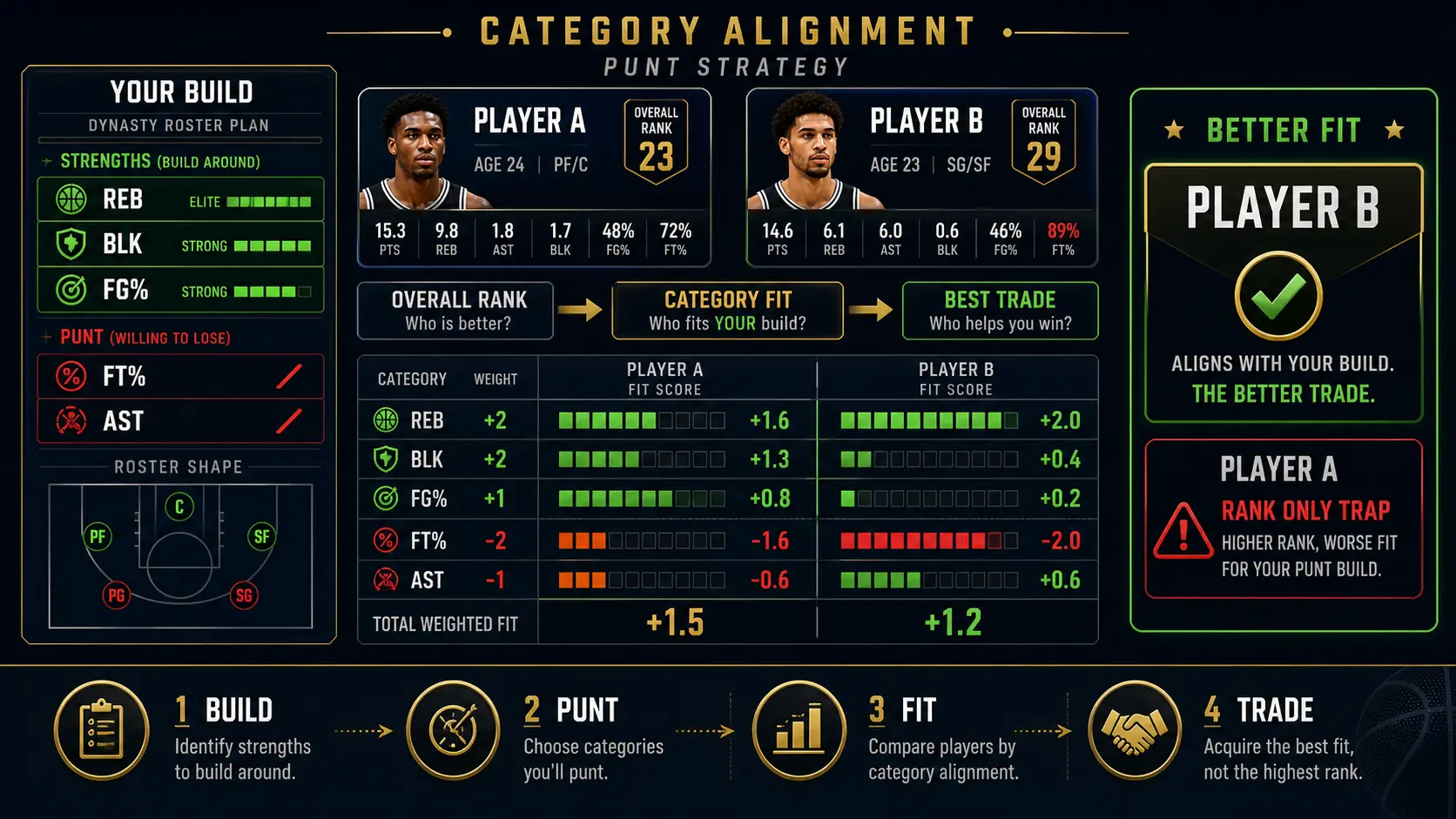
One of the biggest reasons trades fail is because managers only compare overall rankings.
In reality, category fit matters just as much.
Why Punt Strategies Matter
Suppose your team intentionally ignores free-throw percentage.
Receiving an elite free-throw shooter adds very little value if that category doesn’t help your build.
Instead, target players who strengthen categories you’re trying to dominate.
Examples include:
- Punt FT%
- Punt Assists
- Punt Three-Pointers
- Punt Turnovers
Every trade should improve your overall category balance rather than simply increasing total projected value.
Example
Team A dominates:
- Rebounds
- Blocks
- Field Goal Percentage
Adding another high-volume center strengthens an existing advantage.
Trading for an elite guard may actually reduce weekly win probability if it weakens those strengths.
This is why experienced managers don’t blindly trust a fantasy dynasty basketball trade analyzer.
Trade Negotiation Blueprint
Winning trades begin long before an official offer is sent.
Step 1: Study Your Opponent
Ask yourself:
- Are they rebuilding?
- Are they chasing a championship?
- Which categories are they weak in?
- Do they need youth or veterans?
Understanding their goals dramatically increases acceptance rates.
Step 2: Make Fair Opening Offers
Avoid obvious lowball proposals.
Instead:
- Offer comparable value.
- Explain your reasoning.
- Be willing to negotiate.
Managers are far more likely to respond positively when they feel respected.
Sample Message
“I noticed you’re rebuilding and could use future draft capital. Would you consider moving your veteran scorer for a young player plus a 2027 first-round pick?”
A simple explanation often works better than sending offers without context.
Three-Team Trades
Sometimes two managers cannot satisfy each other’s needs.
Adding a third manager can unlock deals by allowing every team to receive assets matching their timeline.
Three-team trades work especially well when:
- One team wants veterans.
- One team wants draft picks.
- One team needs positional upgrades.
Special League Formats
Different league settings completely change player values.
Points Leagues
Points leagues reward raw production.
Prioritize:
- High-minute players
- Reliable usage
- Durable veterans
Efficiency is usually less important.
9-Category Leagues
Here, turnovers, percentages, steals, and blocks become much more valuable.
Elite two-way contributors gain significant dynasty fantasy basketball trade value.
Salary Cap Dynasty Leagues
Contract leagues require another layer of planning.
Consider:
- Remaining contract years
- Cap flexibility
- Dead money penalties
- Extension rules
Sometimes attaching a second-round pick to an expensive veteran is worthwhile if it frees enough cap space to acquire a younger cornerstone.
Trade Deadline Strategy
The fantasy basketball trade deadline creates some of the year’s best buying and selling opportunities.
Buy Before Playoff Pushes
Championship contenders often overpay for veterans.
If you’re rebuilding, capitalize by selling:
- Aging stars
- Expiring contracts
- Short-term producers
Buy Injured Young Stars
Season-ending injuries often create buying opportunities.
If your timeline extends several years, acquiring talented young players at discounted prices can produce enormous long-term value.
Advanced Dynasty Trading Tips
Experienced managers consistently outperform their leagues because they think beyond rankings.
Exploit Market Emotion
Player values fluctuate dramatically after:
- Summer League
- Rookie drafts
- Major injuries
- Hot shooting streaks
- Trade deadline rumors
Buying when public sentiment is low often creates league-winning value.
Sell Peak Hype
Young players sometimes become more valuable than they’ll ever actually produce.
If an emerging player receives superstar-level market value, don’t hesitate to explore offers.
Stack Elite Talent
Depth is replaceable.
Elite producers rarely are.
Whenever possible, consolidate multiple mid-tier assets into genuine difference-makers.
Trade Year-Round
Most dynasty managers only trade during the season.
Savvy owners remain active during:
- Summer
- Training camp
- Rookie draft season
- Immediately after the NBA Draft
Markets are less competitive during these periods.
Common Dynasty Trading Mistakes
Avoid these costly errors.
Trusting calculators blindly
Ignoring age curves
Overvaluing bench depth
Trading based on name recognition
Forgetting category fit
Selling draft picks too cheaply
Waiting too long to move aging veterans
Building without a clear contender or rebuilding strategy
Recommended Tools and Resources
The following resources can improve your decision-making when used alongside your own analysis:
- Dynasty fantasy basketball trade analyzer
- Dynasty fantasy basketball trade calculator
- Basketball Monster
- Hashtag Basketball
- Fantrax
- ESPN Dynasty Fantasy Basketball
- Sleeper dynasty leagues
- Basketball Reference
- Cleaning the Glass
Remember that no calculator fully understands your league settings, roster construction, or league dynamics.
Future Trends in Dynasty Fantasy Basketball
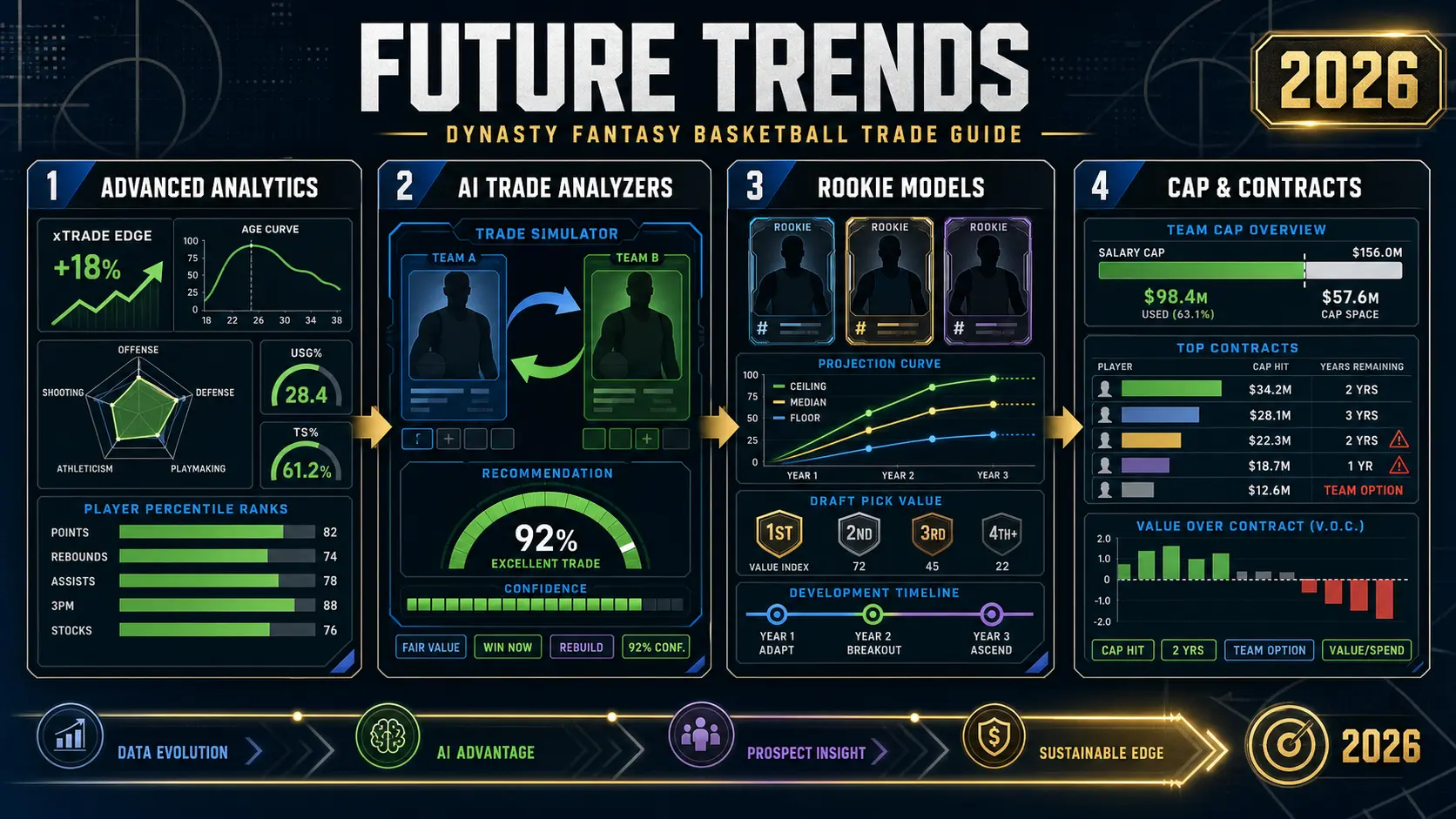
Dynasty leagues continue to evolve.
Managers should expect:
- Greater reliance on advanced analytics.
- Improved AI-powered dynasty fantasy basketball trade analyzers.
- Better rookie projection models.
- More salary-cap and contract dynasty formats.
- Increased emphasis on positional versatility and efficiency metrics.
Managers who adapt early will maintain a competitive edge.
Conclusion
Mastering a dynasty fantasy basketball trade guide requires much more than comparing player rankings. The best dynasty managers understand roster construction, age curves, category synergy, draft pick valuation, and negotiation psychology. Every trade should align with your team’s competitive window while strengthening your long-term championship outlook.
Use dynasty fantasy basketball trade value as a framework, not a fixed number. Combine trusted calculators with league context, market timing, and strategic thinking to make smarter decisions. Whether you’re using a dynasty fantasy basketball trade calculator, researching NBA dynasty fantasy basketball rankings, or targeting your next blockbuster deal, patience and preparation consistently outperform impulse.
If you apply the strategies in this guide, you’ll be better equipped to evaluate offers, identify hidden value, and build a dynasty roster capable of competing for championships year after year.
Frequently Asked Questions
1. What is the best dynasty fantasy basketball trade analyzer?
There isn’t one perfect tool. Most experienced managers compare results from multiple analyzers and adjust for league settings, team direction, and category strategy.
2. How should I calculate dynasty fantasy basketball trade value?
Consider player production, age, upside, injury history, draft pick value, league format, and your team’s competitive timeline rather than relying solely on rankings.
3. Should rebuilding teams trade veterans?
Generally, yes. Rebuilding teams maximize long-term value by exchanging aging veterans for younger players, prospects, and future draft picks before veteran values decline.
4. Are trade calculators accurate?
Trade calculators provide a useful starting point but cannot account for punt builds, league depth, salary-cap rules, or manager preferences. Use them as guidance rather than final authority.
5. When is the best time to trade future rookie picks?
Future rookie picks usually reach their highest market value in the weeks leading up to the rookie draft, when excitement surrounding incoming prospects is greatest.
6. Is a 2-for-1 trade usually worth it?
The side receiving the elite player often gains the advantage because roster spots have value, and elite production is much harder to replace than mid-tier depth.
7. How does strategy differ between Points and 9-Category leagues?
Points leagues emphasize overall fantasy production, while 9-category leagues require managers to evaluate efficiency, turnovers, percentages, and category balance. Trade values can differ significantly between the two formats.
8. How often should I make trades in a dynasty league?
Successful dynasty managers stay active throughout the year. Monitoring injuries, rookie hype, offseason news, and changing team goals creates more opportunities than trading only during the regular season.