Introduction
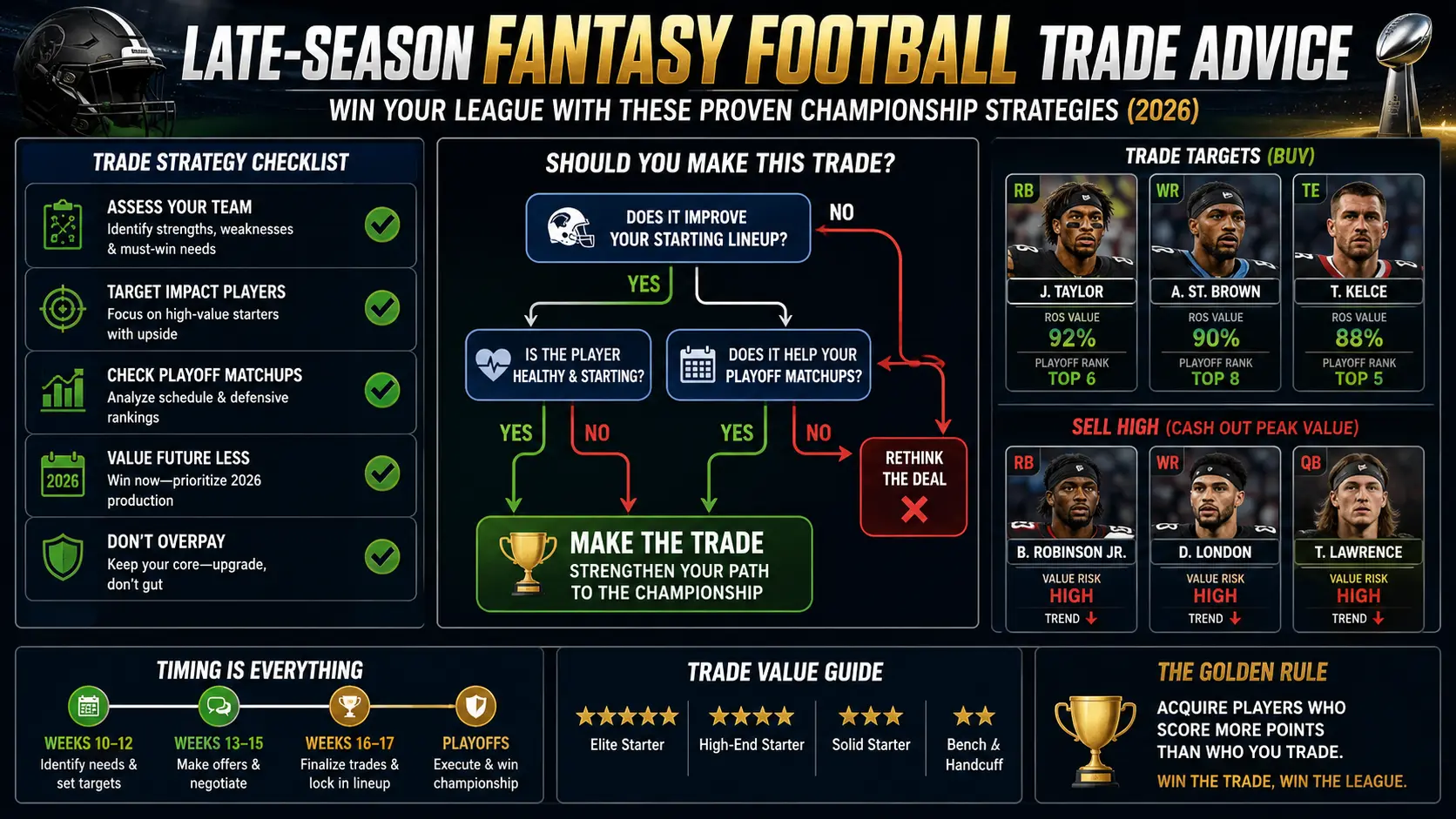
When should you make trades in fantasy football? It’s one of the biggest questions fantasy managers ask every season, and the answer is far more strategic than simply buying low or selling high. Great trades aren’t just about player value; they’re about timing.
Many managers wait until they’re desperate after a losing streak or an injury crisis. By then, the market has already shifted, and competitors know exactly what you need. Successful fantasy managers think differently. They identify market inefficiencies before everyone else, target managers under pressure, and make deals when player values haven’t fully caught up with reality.
Whether you’re playing on Sleeper, ESPN Fantasy, Yahoo Fantasy, or NFL Fantasy, understanding when to make trades in fantasy football can be the difference between an average season and a championship run.
In this guide, you’ll learn the best trading windows throughout the fantasy football calendar, discover advanced strategies that most articles overlook, and avoid costly mistakes that can derail your season.
Table of Contents
- TL;DR
- Why Timing Matters More Than Player Names
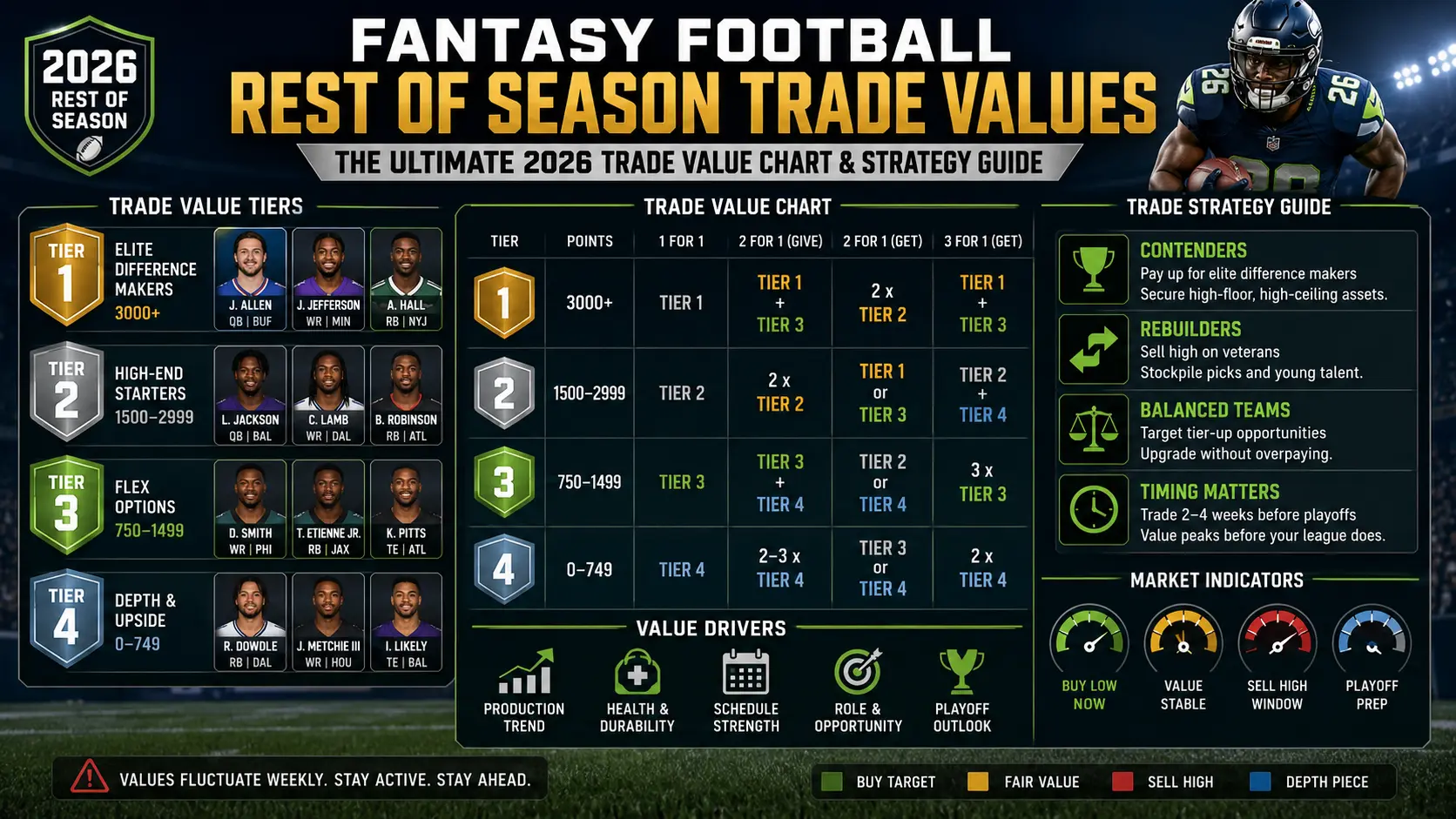
- The Fantasy Football Trade Calendar
- The Post-Draft Regret Window
- Weeks 1–2: Avoid Overreacting
- Week 4 Market Re-Pricing
- Bye Week Leverage
- The Trade Deadline Window
- Key Takeaways
TL;DR
- The best time to make trades in fantasy football is typically between Weeks 3 and 5.
- Don’t panic. After Week 1, small sample sizes often create false narratives.
- Exploit managers facing bye-week problems or losing records.
- The trade deadline creates urgency that smart managers can leverage.
- Always trade based on future opportunity, not recent fantasy points.
Why Timing Matters More Than Player Names
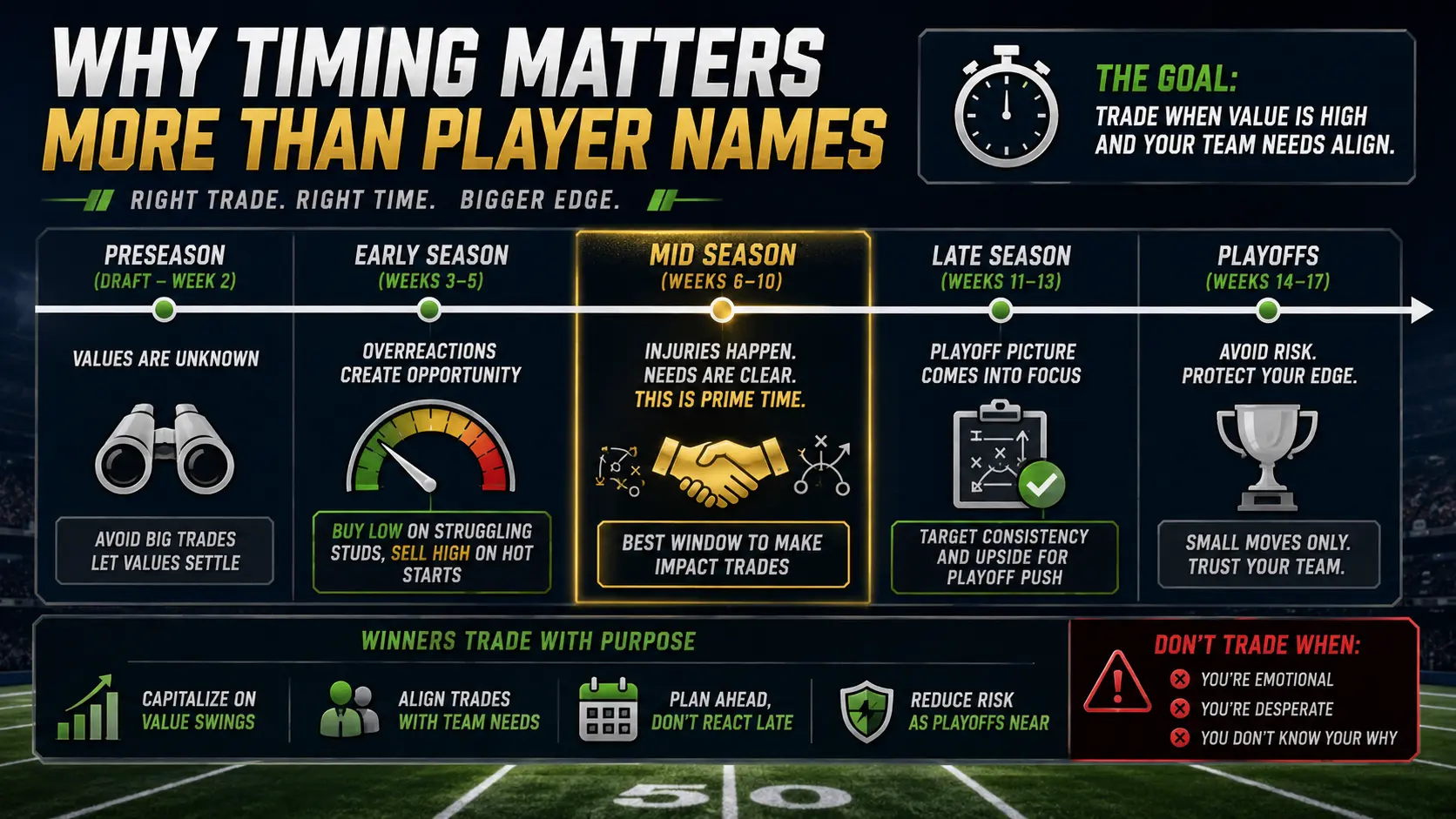
One of the biggest misconceptions in fantasy football is believing that trades are won simply by acquiring the “better” player.
In reality, timing creates value.
Player prices fluctuate throughout the season based on:
- Recent performances
- Injuries
- Bye weeks
- NFL coaching changes
- Strength of schedule
- League standings
- Manager emotions
The best fantasy managers don’t chase yesterday’s points;s they predict tomorrow’s production.
For example:
Manager A sees a receiver score two touchdowns on Sunday Night Football and immediately wants to buy.
Manager B looks deeper and notices the player saw only four targets, while another receiver quietly earned a 31% target share despite a poor fantasy finish.
Manager B gets the better trade because they’re buying volume rather than box-score production.
Draft Capital Isn’t Forever
Many new fantasy players hesitate because they still value players based on where they were drafted.
That’s a mistake.
Once Week 1 begins, draft position quickly loses importance.
Instead, evaluate players using:
- Snap Share
- Target Share
- Route Participation
- Expected Fantasy Points (xFP)
- Red Zone Opportunities
- Offensive Role
Elite fantasy managers understand that the current opportunity beats preseason expectations.
The Fantasy Football Trade Calendar
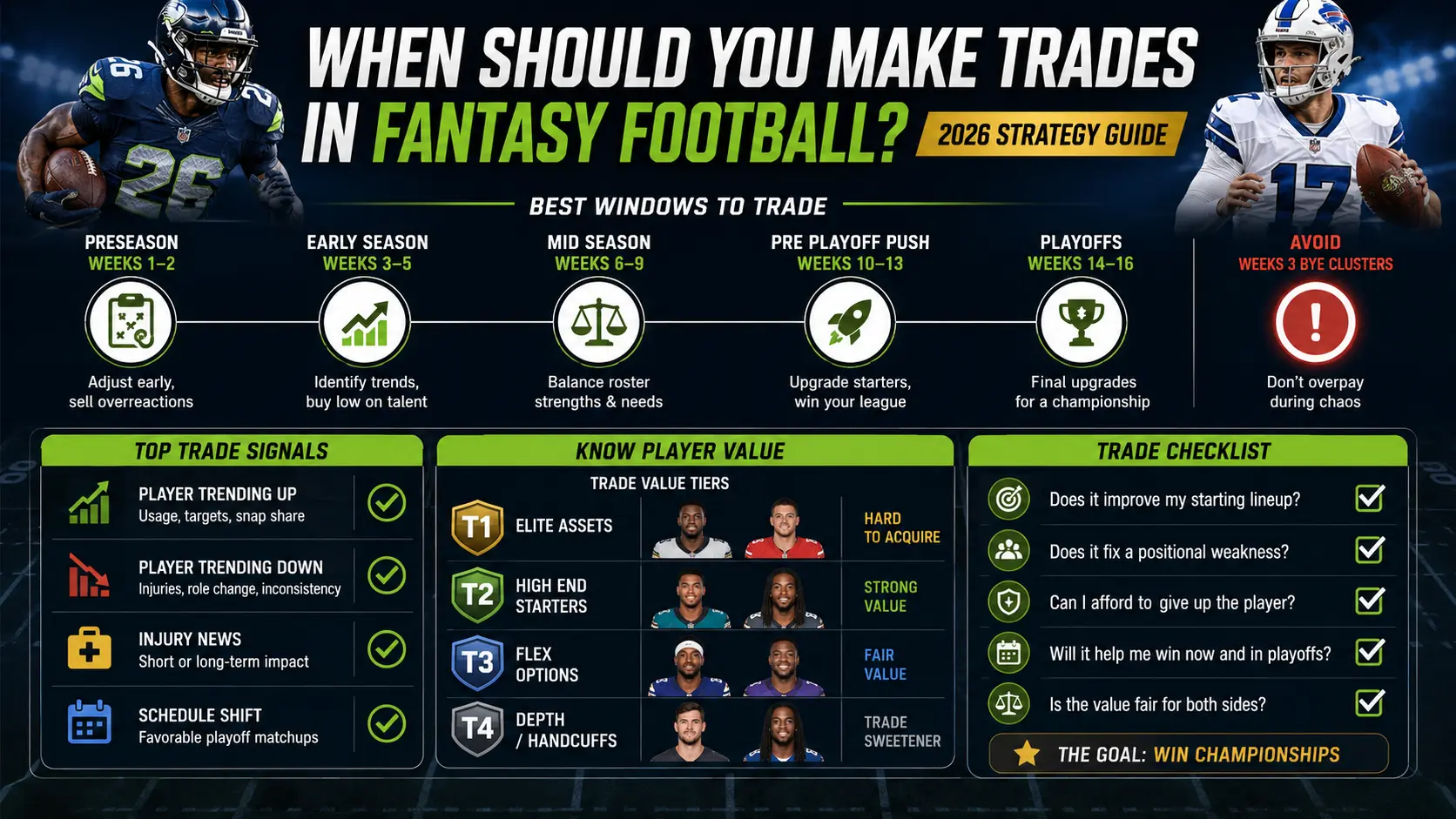
Instead of asking, “When should you make trades in fantasy football?”, think of the season as several unique trading markets. Each window offers different opportunities.
The Post-Draft Regret Window (Immediately After Your Draft)
Best for: Finding impatient league mates.
One of the most overlooked opportunities occurs within 24–48 hours after the fantasy draft.
Many managers instantly regret the selections they made under pressure.
Examples include:
- Drafting too many quarterbacks.
- Forgetting to draft enough running backs.
- Selecting injured players too early.
- Ignoring positional balance.
Before a single NFL game is played, these managers often become surprisingly willing to trade.
How to Take Advantage
- Review every roster.
- Identify obvious positional weaknesses.
- Offer balanced trades, not lowball offers.
- Focus on solving problems instead of “winning” the trade.
For example:
A manager drafted six wide receivers but only two startable running backs.
You have extra RB depth.
Both teams improve with one simple deal.
This “Need Mapping” approach produces far more accepted trades than random offers.
Why This Window Works
Managers still anchor player values to draft rankings.
If you can identify structural roster flaws before they do, you’ll often acquire undervalued talent at a discount.
Weeks 1–2: Avoid the Panic Trade Trap
Many fantasy managers completely overreact after the first game.
A first-round pick has one bad week.
A rookie explodes for 100 yards.
A backup running back scores twice.
Suddenly, trade offers flood the league.
This is usually the worst time to make aggressive trades in fantasy football.
Why Early Data Lies
NFL football is unpredictable.
Small sample sizes create misleading statistics.
Touchdowns, long plays, and defensive matchups can dramatically skew fantasy scoring.
Instead of focusing on fantasy points, examine underlying usage.
Ask questions like:
- Is the player actually playing more snaps?
- Did the target share increase?
- Is the offensive line improving?
- Were touchdowns sustainable?
Buy Opportunity
Players who disappoint in Weeks 1–2 often become league-winning trade targets if their workload remains strong.
Examples include:
- Running backs with heavy goal-line work but no touchdowns.
- Wide receivers are seeing double-digit targets without big fantasy production.
- Tight ends running routes on nearly every dropback.
These players often experience regression toward the mean, making them excellent buy-low candidates before the market adjusts.
The Week 4 Market Re-Pricing Window (The Best Time to Trade)
Featured Snippet
When is the best time to make a trade in fantasy football?
The best time to make a trade in fantasy football is between Weeks 3 and 5. By Week 4, player usage trends become more reliable, preseason hype begins to fade, and managers with losing records become much more willing to negotiate.
Most fantasy experts say:
“Trade early.”
That advice is incomplete.
The true turning point is Week 4.
By this point:
- Snap counts stabilize.
- Offensive roles become predictable.
- Coaching tendencies emerge.
- Target shares become meaningful.
- Depth charts settle.
More importantly…
Managers stop valuing players based on draft position and start valuing them based on production.
This creates massive market inefficiencies.
The Week 4 Re-Pricing Strategy
Target players with:
- High Target Share
- High Snap Share
- Strong Expected Fantasy Points
- Poor touchdown luck
- Difficult early schedules
Avoid chasing players who rely on:
- Unsustainable touchdown rates
- Long broken plays
- Limited weekly volume
Practical Example
Imagine a wide receiver averaging only 11 fantasy points per game.
Many managers consider him disappointing.
However:
- 31% Target Share
- 95% Route Participation
- Top-10 Air Yards
- Top-15 Expected Fantasy Points
Those underlying metrics suggest a breakout is coming.
Buying before the fantasy community notices can provide league-winning value.
The Mid-Season Bye Week Crunch
One of the biggest competitive advantages in fantasy football comes from exploiting bye-week desperation.
When several starters share the same bye week, managers often prioritize surviving the current matchup over long-term roster strength.
That’s your opportunity.
Why Bye Weeks Create Trade Value
Imagine a manager entering Week 9 without:
- RB1
- WR1
- Flex option
They may be willing to overpay for a healthy starter simply to avoid an automatic loss.
Instead of waiting for them to ask, proactively identify teams facing difficult bye weeks and initiate discussions before the waiver claims process.
Smart Bye-Week Targets
Look for managers who:
- Are 3–5 or worse in the standings.
- Have multiple starters on bye.
- Recently lost a player to injury.
- Lack of bench depth.
Offering immediate help can often net you higher-upside assets for the fantasy playoff stretch.
The Data-Driven Diagnostic: Knowing Who and When to Trade
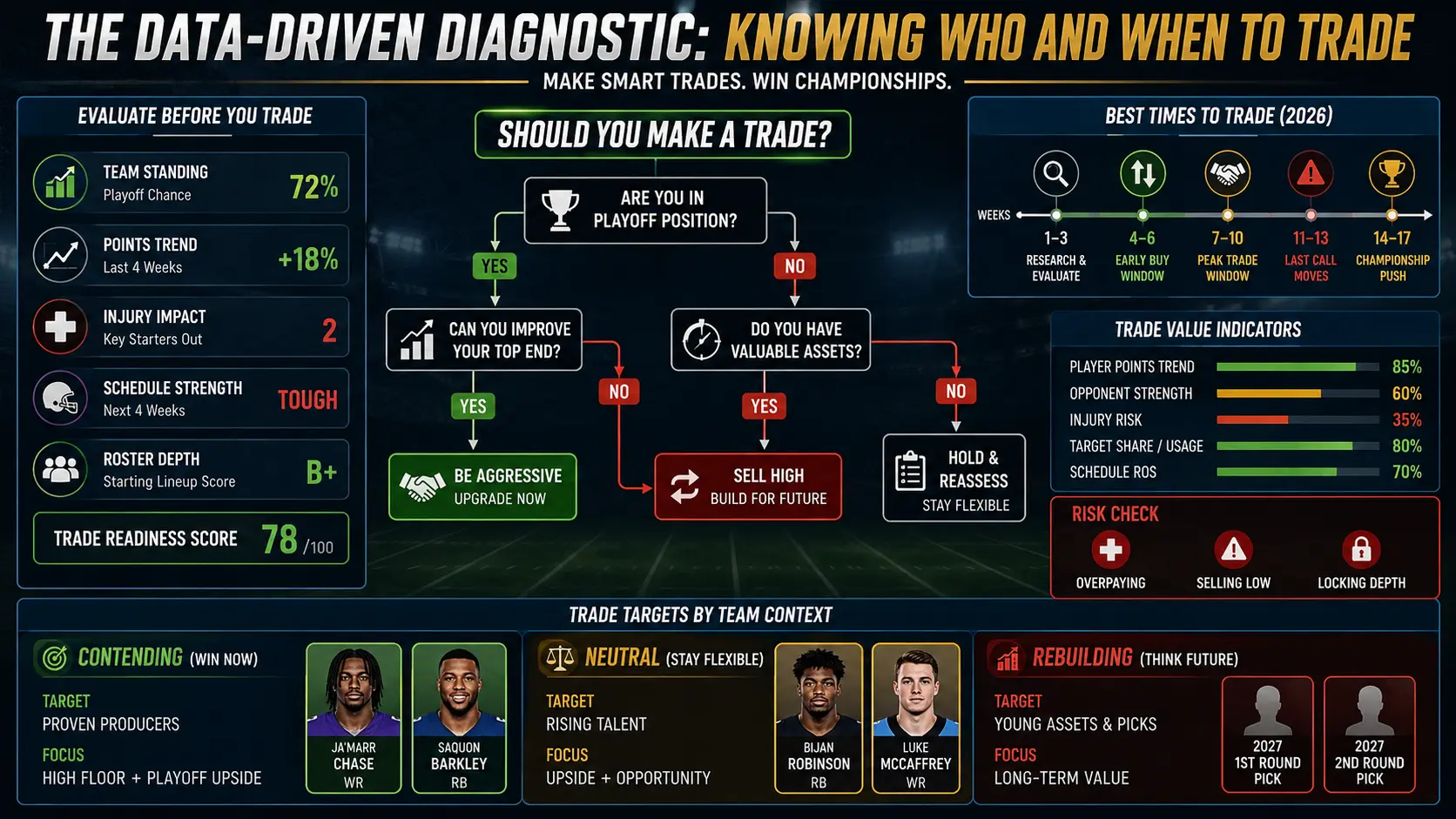
Timing alone won’t win trades; you also need to identify which players are genuinely undervalued or overvalued. Many fantasy managers still make decisions based on last week’s fantasy points, but experienced players rely on advanced usage metrics that predict future production.
If you’re wondering when you should make trades in fantasy football, the answer often comes when the underlying data tells a different story than the box score.
Volume Beats Fantasy Points Every Time
One of the most important concepts in fantasy football is:
Volume is more predictive than efficiency.
A player who scores 10 fantasy points on 12 opportunities is usually a better long-term investment than someone scoring 20 fantasy points on only five opportunities.
Instead of chasing touchdowns, evaluate opportunity.
Metrics That Matter
| Metric | Why It Matters | Buy or Sell Signal |
| Target Share | Percentage of team passing targets | Higher is better |
| Snap Share | How often the player is on the field | Stable playing time |
| Expected Fantasy Points (xFP) | Predicts sustainable production | High xFP + Low Points = Buy Low |
| Air Yards | Future receiving upside | High Air Yards often precede breakouts |
| Red Zone Opportunities | Scoring potential | Indicates touchdown upside |
If a receiver ranks top ten in Target Share but outside the top thirty in fantasy scoring, they’re often an excellent trade target before the rest of your league notices.
Buy Low Checklist
Trade for players who have:
- High Snap Share
- Consistent Route Participation
- Strong Target Share
- Low touchdown totals despite heavy usage
- Difficult early-season schedules that become easier later
These are classic regression-to-the-mean candidates.
Don’t Chase Unsustainable Production
Many fantasy managers buy players immediately after a huge performance.
That’s usually paying peak price.
Instead, ask:
- Were the two long touchdowns inflating fantasy points?
- Did the player receive fewer than six touches?
- Was the performance driven by defensive mistakes?
- Will that workload continue?
One explosive game shouldn’t outweigh four weeks of mediocre usage.
Strength of Schedule: Trade for the Fantasy Playoffs
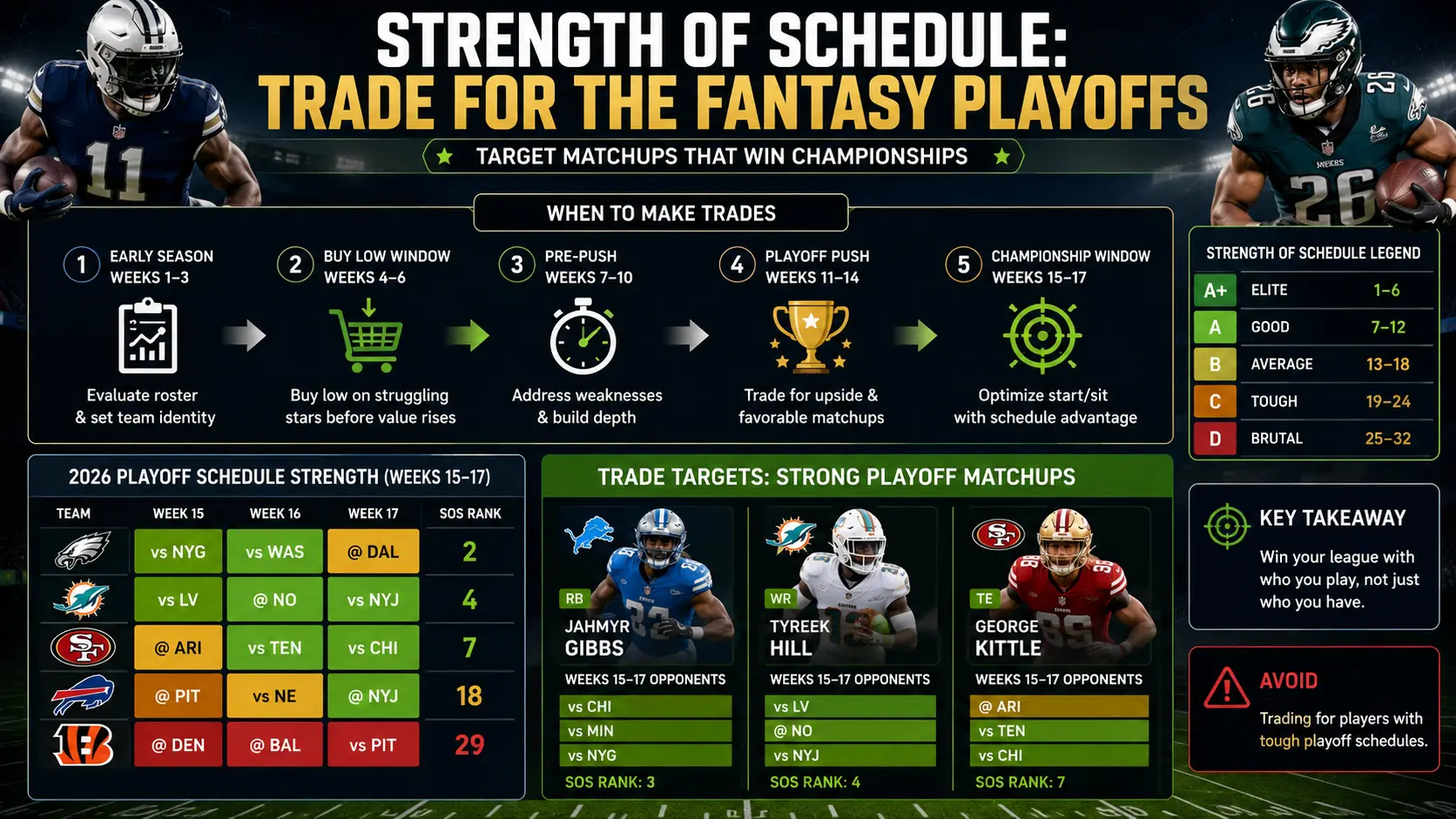
Most fantasy managers only look at this week’s matchup.
Championship managers plan months.
Around Weeks 7–9, begin evaluating fantasy playoff schedules (typically Weeks 15–17).
If two similarly ranked players project equally for the next month, choose the one with easier playoff opponents.
Example Strategy
Imagine:
Player A faces three top-five defenses during fantasy playoffs.
Player B has nearly identical season-long projections but faces three bottom-ten defenses.
Trading Player A for Player B before your league notices could be the difference between winning and losing a championship.
When to Check Strength of Schedule
Review playoff schedules once:
- Bye weeks are nearly complete.
- Team identities become clear.
- Defensive performance stabilizes.
Don’t overreact to preseason defensive rankings; they change dramatically throughout the NFL season.
League Format Changes Everything
The answer to when you should make trades in fantasy football depends heavily on your league settings.
Trading strategies that dominate in one format can fail in another.
Redraft Leagues
Redraft leagues focus entirely on this season.
Priority:
- Weekly production
- Injury replacements
- Playoff schedules
- Immediate roster upgrades
Future value doesn’t matter.
If trading a young breakout player for a veteran helps you win now, it’s usually worth considering.
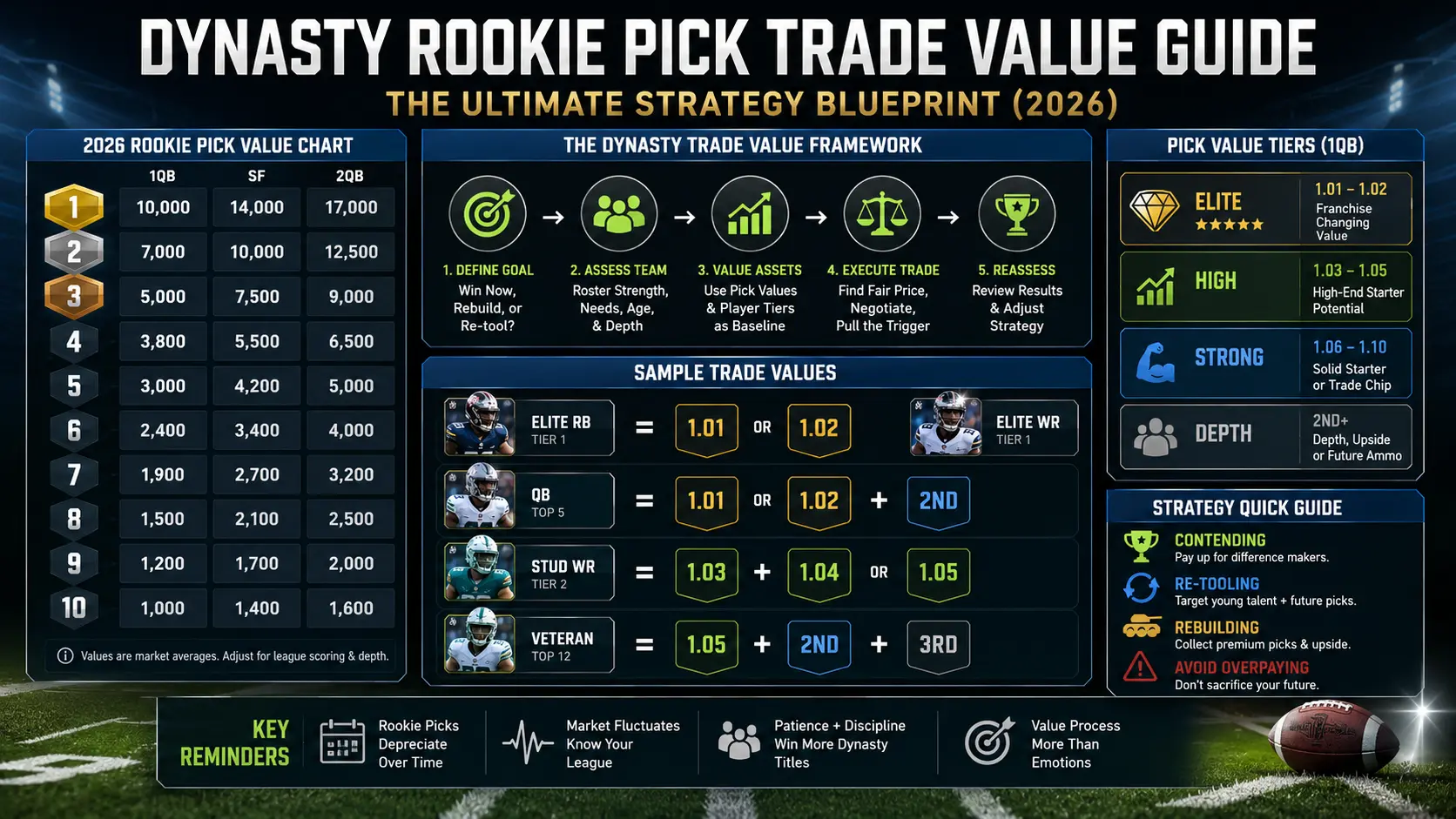
Dynasty Leagues
Dynasty leagues require long-term planning.
Player age becomes extremely important.
Dynasty Calendar
| Time of Year | Best Strategy |
| January–March | Acquire rookie picks |
| April–May | Rookie picks reach peak value |
| September–November | Contenders buy veterans |
| After Season | Rebuilders sell aging stars |
Contender vs. Rebuilder
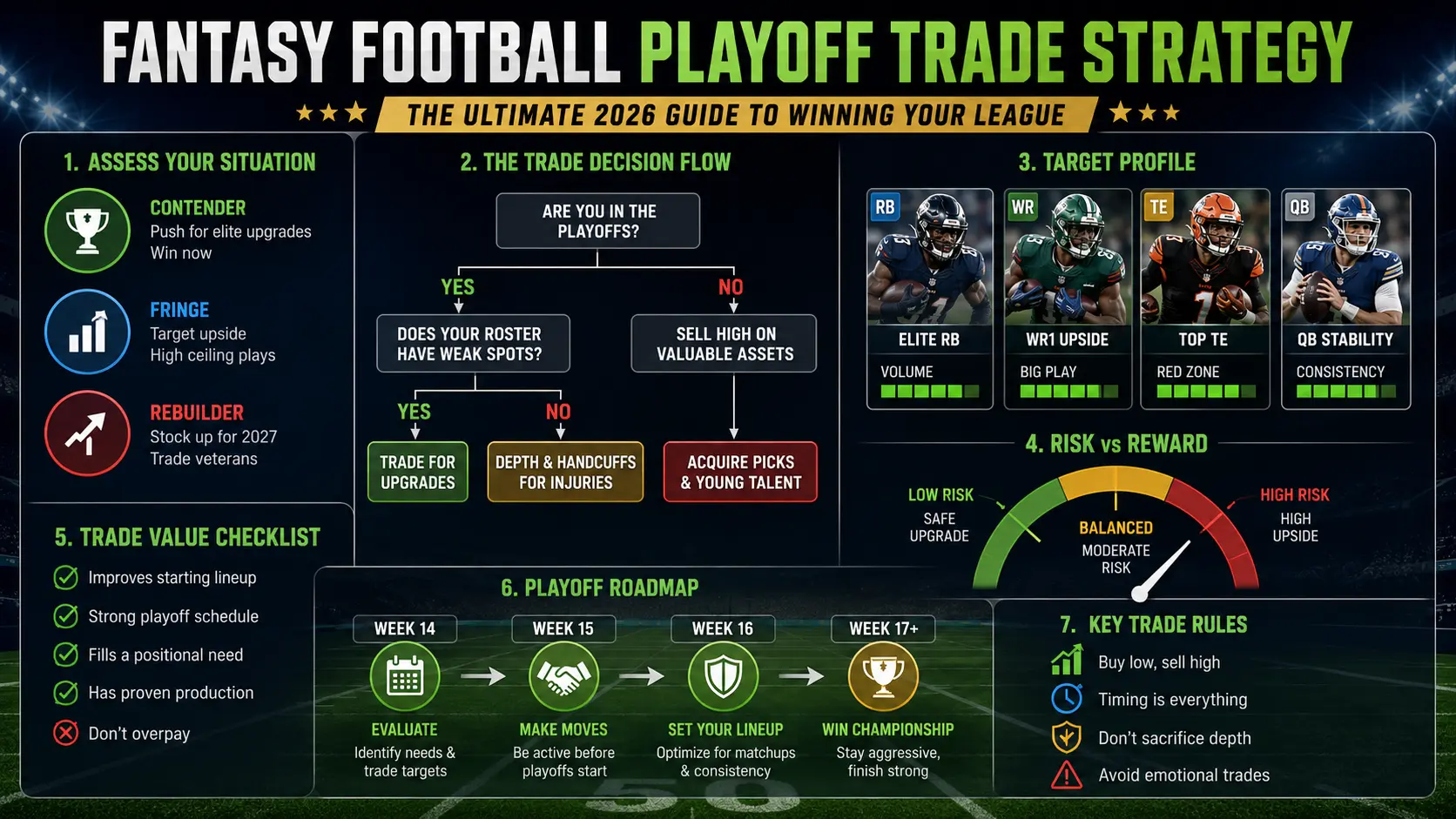
If you’re:
7–1
Target proven veterans who can help win immediately.
If you’re:
2–6
Sell older players for rookie picks and younger talent before their value declines further.
Running backs over age 27 often experience the sharpest dynasty value drop.
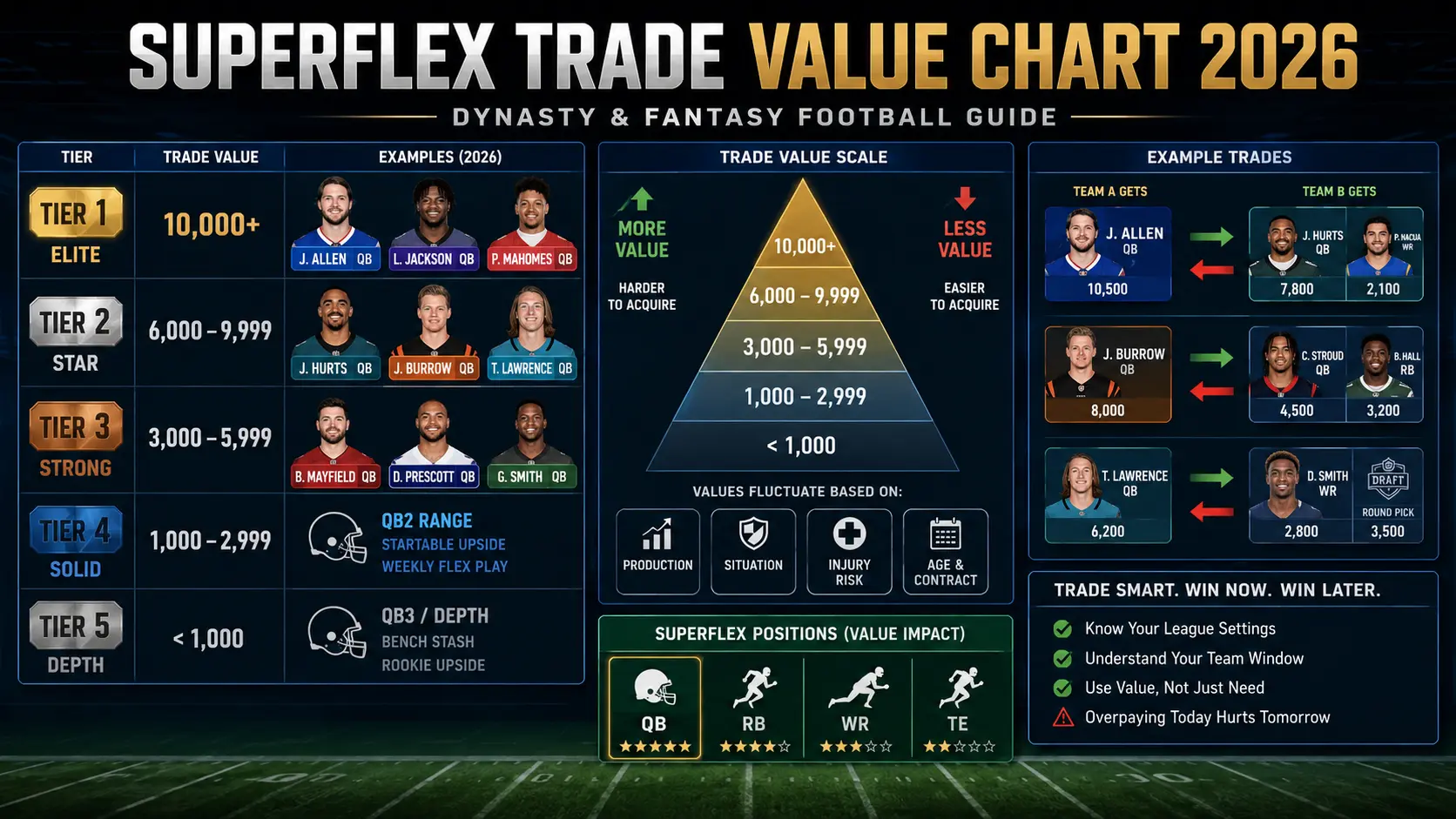
Superflex Leagues
Quarterbacks become dramatically more valuable.
A third starting quarterback isn’t just bench depth; it’s a premium trade asset.
Quarterback prices usually spike after:
- Major NFL injuries
- Benchings
- Rookie promotions
- Trade deadline changes
Holding extra quarterback depth early can create enormous leverage later.
The 2-for-1 Roster Math Most Managers Ignore
One of the biggest mistakes fantasy managers make is evaluating only the players involved in a trade.
They ignore roster space.
Imagine receiving two players for one.
Sounds great.
But you’ll probably need to drop someone.
That dropped player has value.
Replacement Value Formula
Net Trade Value = Incoming Player Value – Outgoing Player Value – Drop Candidate Value
Ignoring the drop player often makes seemingly good trades much worse.
Shallow Bench vs. Deep Bench Strategy
| Bench Size | Best Trade Type | Why |
| 4–5 Bench Spots | 2-for-1 Consolidation | Waiver wire is strong |
| 6–7 Bench Spots | Either Strategy | Depends on roster needs |
| 8+ Bench Spots | Depth Trades | Waivers offer little replacement value |
Consolidate When:
- You have excellent bench depth.
- Waiver wire remains active.
- Elite starters improve your weekly ceiling.
Diversify When:
- Injuries have devastated your roster.
- You need multiple weekly starters.
- You’re simply trying to reach the playoffs.
The Psychology Behind Successful Trades
Fantasy football isn’t only about statistics.
It’s about people.
Understanding psychology helps answer when to trade in fantasy football just as much as analytics do.
Anchoring Bias
Managers often overvalue players based on draft position.
Example:
A second-round pick struggles through four weeks.
Despite poor production, many managers still expect second-round value in return.
Patient traders exploit this by waiting until frustration grows before making an offer.
Emotional Premium
Never buy immediately after:
- Three-touchdown games
- National TV explosions
- Viral highlight plays
Instead, target players after:
- Quiet games with strong usage
- Tough defensive matchups
- Temporary touchdown droughts
The public reacts emotionally.
Successful managers react analytically.
The Rule of Three Targets
Before sending any trade offer, answer three questions:
- What does my opponent actually need?
- Which of my players solves that problem?
- What position am I trying to improve?
Trades built around mutual benefit receive significantly more acceptance than random offers.
How to Counter Lowball Offers Without Burning Bridges
Every league has managers who send terrible offers.
Don’t immediately reject them.
Instead:
- Thank them for reaching out.
- Explain what you’re looking for.
- Suggest one alternative.
- Keep communication positive.
Maintaining strong league relationships keeps future negotiations alive throughout the season.
Managing League Veto Culture
One of the biggest frustrations in fantasy football is leagues vetoing perfectly fair trades simply because a strong team improves.
Healthy leagues should only overturn trades involving:
- Clear collusion
- Intentional league sabotage
- Obvious cheating
They should not veto trades because one side appears to get the better player.
If your league frequently blocks legitimate deals, recommend switching to Commissioner Approval Only, where trades are reviewed solely for integrity rather than perceived fairness.
Advanced Trade Tips That Separate Good Managers from Champions
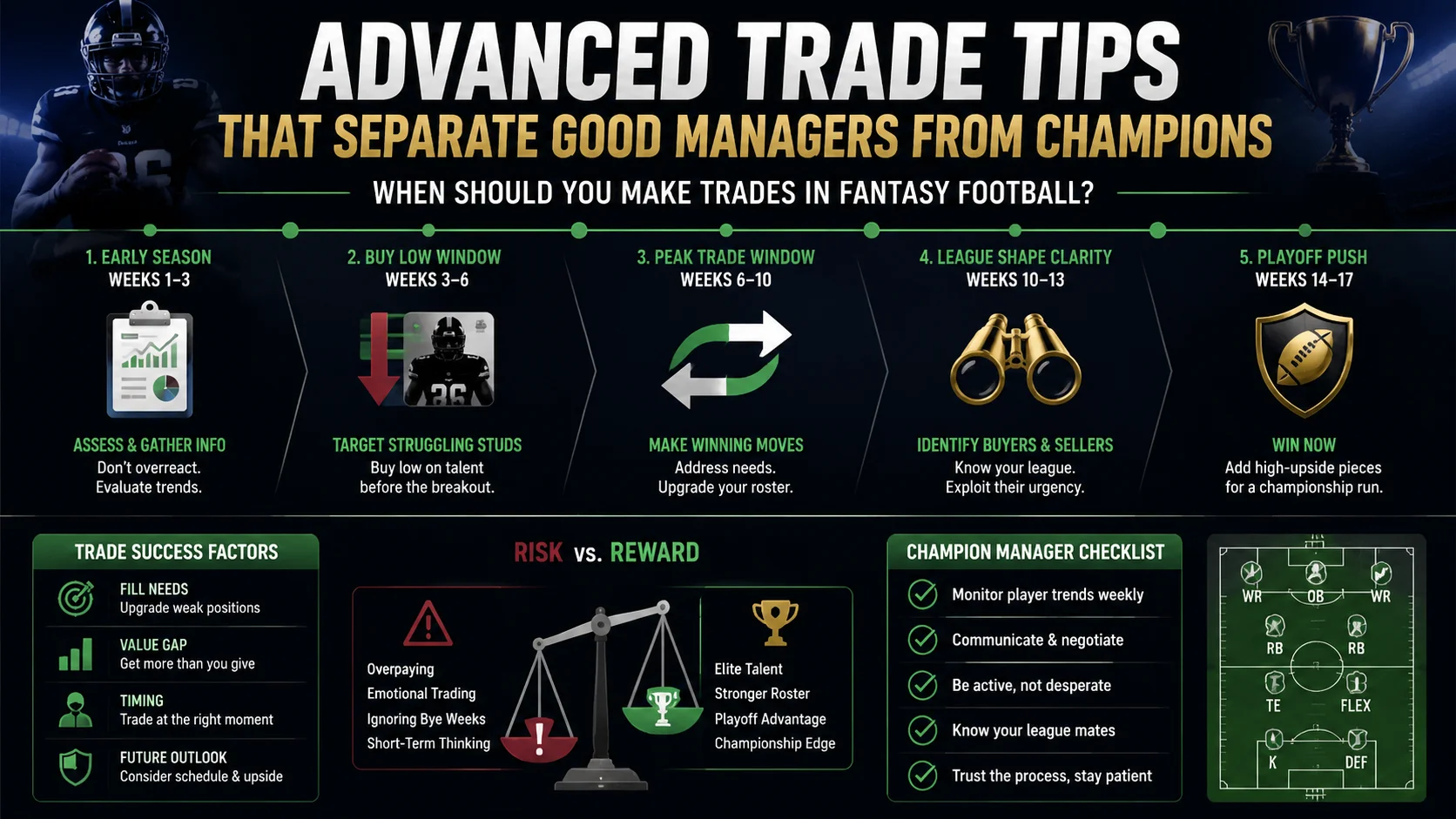
If you’ve mastered the basics, the next step is identifying micro-trade windows that most fantasy managers completely overlook. These opportunities can provide a significant edge, especially in competitive leagues.
Exploit the Mid-Game Injury Window
One of the fastest ways to gain an advantage is reacting before the rest of your league.
When a star player suffers an injury during Sunday games, many managers panic immediately. Instead of waiting until the waiver process, assess the situation and determine whether the injury appears minor or severe.
Smart Approach
- Monitor injury reports during Sunday games.
- If the injury looks short-term, consider buying low before official news is released.
- If the injury is season-ending, pivot quickly toward teammates who may see increased opportunity.
Acting before the waiver claims process often gives you access to value that disappears by Tuesday morning.
Trade Around FAAB and Waiver Priorities
Many managers focus only on waivers.
Experienced managers understand that sometimes trading is more valuable than spending FAAB.
For example:
A breakout backup running back is expected to become the week’s top waiver pickup.
Instead of entering a bidding war, package a bench player in a trade for that manager before waivers run.
This strategy saves valuable FAAB while improving your roster.
Use Vegas Lines and Expected Points
Fantasy points don’t always tell the full story.
Advanced managers also evaluate:
- Team implied totals
- Offensive efficiency
- Red-zone opportunities
- Expected Fantasy Points (xFP)
If a player consistently outperforms their expected production, regression may be coming.
Likewise, players underperforming despite strong opportunities often become excellent buy-low candidates.
Build Every Trade Around Mutual Value
One mistake many fantasy managers make is trying to “win” every trade.
Instead, focus on improving both teams.
Ask yourself:
- Does this solve my opponent’s biggest roster weakness?
- Does it strengthen my starting lineup?
- Would I accept this offer if our teams were reversed?
Trades built around mutual improvement are accepted far more often than one-sided offers.
Common Mistakes to Avoid
Even experienced managers occasionally mistime trades. Avoid these common pitfalls to maximize long-term success.
Trading Based Only on Last Week’s Score
One explosive game doesn’t automatically increase a player’s long-term value.
Always evaluate underlying usage before making a move.
Waiting Until You’re Desperate
Managers who wait until injuries or a losing streak force them to trade usually receive worse offers.
Be proactive instead of reactive.
Ignoring League Standings
A 7–1 manager and a 2–6 manager have completely different priorities.
Tailor every trade proposal to your opponent’s situation.
Overvaluing Draft Position
Draft capital matters in August.
By October, the current opportunity matters much more.
Never refuse a strong trade simply because you drafted someone early.
Trading Without Checking the Playoff Schedule
A player facing elite defenses during Weeks 15–17 may not be as valuable as someone with a much easier championship schedule.
Always plan several weeks.
Recommended Fantasy Football Trade Tools
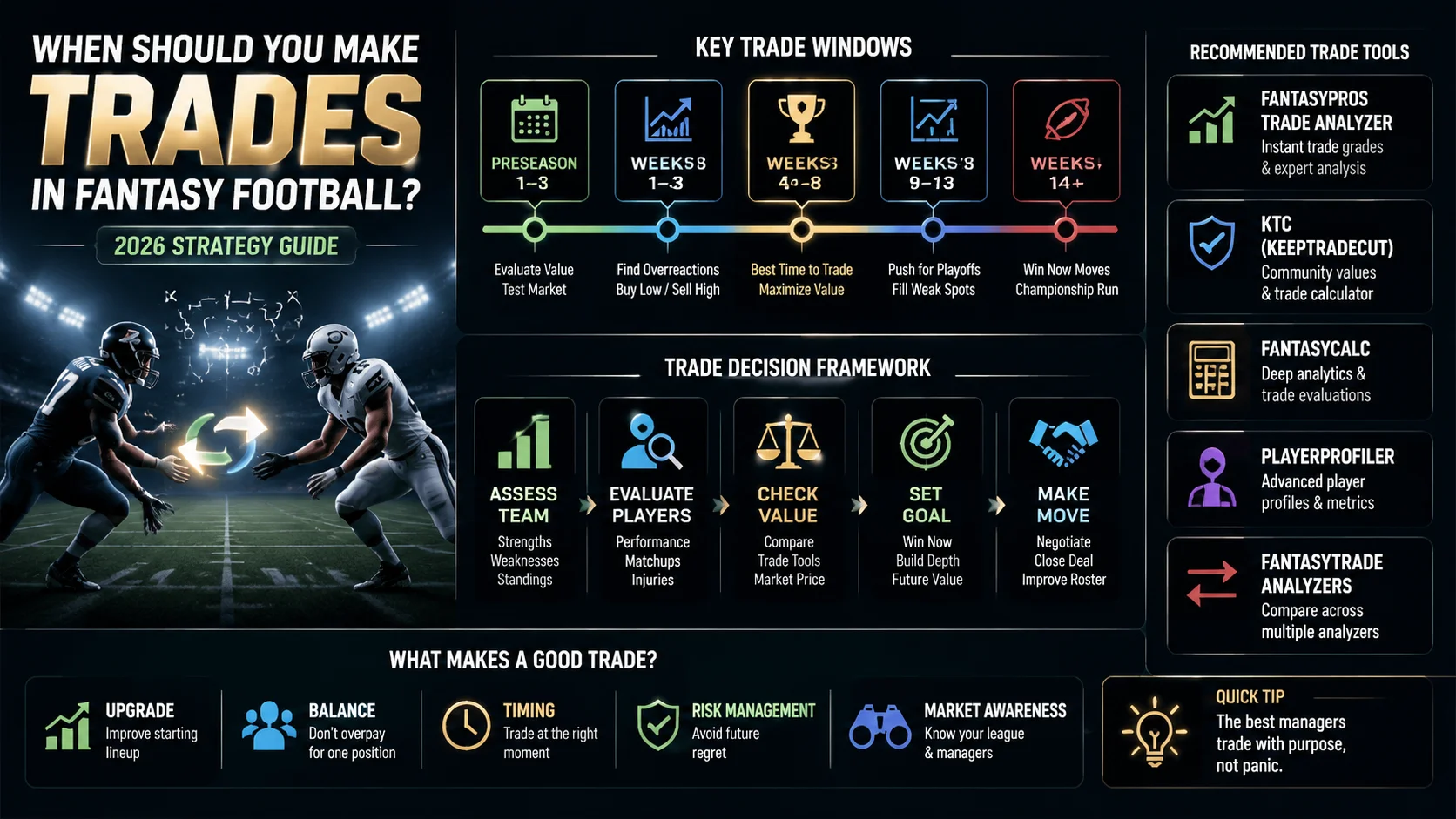
While no calculator should replace your own judgment, these resources can help validate trades and identify market trends.
| Tool | Best For |
| FantasyPros Trade Analyzer | Instant trade evaluations and projections |
| KeepTradeCut (KTC) | Dynasty market values based on community rankings |
| FantasyCalc | Crowd-sourced dynasty trade database |
| PlayerProfiler | Advanced player metrics, including Snap Share, Air Yards, and Target Share |
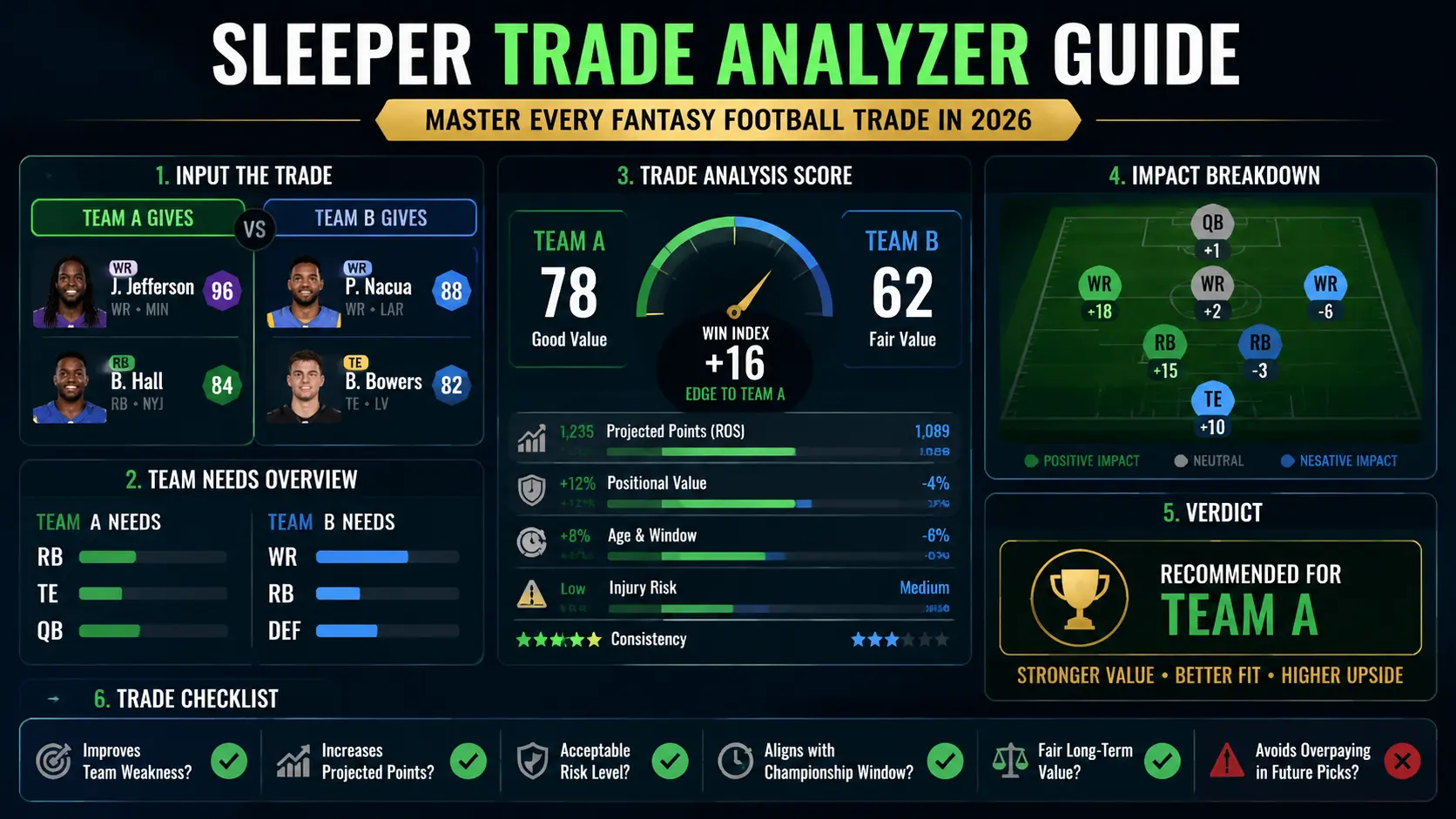
| FantasyTradeAnalyzers | Trade advice, strategy guides, and roster optimization content |
Remember that calculators provide a baseline,e not a final answer. League settings, roster construction, and playoff outlook should always influence your decision.
Future Trends in Fantasy Football Trading
Fantasy football strategy continues to evolve each season.
Expect future trades to rely even more on:
- AI-powered player projections
- Advanced usage metrics
- Machine-learning trade calculators
- Real-time injury probability models
- Customized league-specific valuations
Managers who embrace analytics while understanding league psychology will continue gaining an edge over opponents relying solely on traditional rankings.
Conclusion
So, when should you make trades in fantasy football?
While opportunities exist throughout the season, the most valuable trade windows typically occur:
- Immediately after your draft
- Between Weeks 3 and 5, when usage trends stabilize
- During bye-week crunches
- Before your league’s trade deadline
The most successful fantasy managers don’t wait until they have a problem; they constantly evaluate their roster, monitor league dynamics, and anticipate market shifts before everyone else.
Remember that fantasy football trades are about more than acquiring talented players. They’re about improving your roster relative to your league at exactly the right moment.
Use advanced metrics like Target Share, Snap Share, Expected Fantasy Points (xFP), and Air Yards, understand your league format, and always consider your opponent’s needs before sending an offer.
If you consistently combine smart timing with data-driven analysis, you’ll put yourself in a much stronger position to compete for a fantasy championship every season.
Frequently Asked Questions
When should you make trades in fantasy football?
The best time to make trades in fantasy football is usually between Weeks 3 and 5, when player roles become more predictable, and managers begin adjusting expectations based on real performance rather than draft rankings.
Can you make trades in fantasy football playoffs?
Most leagues lock trades before the fantasy playoffs begin. However, league settings vary across platforms like ESPN, Sleeper, and Yahoo, so always review your league’s trade deadline before the season starts.
When can you start making trades in fantasy football?
Most fantasy platforms allow trades immediately after your draft, once league settings enable trading. The post-draft period is often one of the best opportunities to capitalize on roster imbalances.
How do you make trades in fantasy football?
Review your roster, identify areas of strength and weakness, find a league manager with complementary needs, and submit a fair trade proposal through your fantasy platform. Communicating before sending the offer often improves acceptance rates.
Should I make a fantasy football trade after one bad game?
Usually not. One poor performance rarely changes a player’s long-term value. Focus on usage metrics like Snap Share, Target Share, and Expected Fantasy Points rather than a single week’s fantasy score.
How many trades can you make in fantasy football?
There is no universal limit. Most leagues allow unlimited trades unless the commissioner sets a maximum number. Always review your league’s rules before making multiple deals.
Can you still make trades after Thursday Night Football?
In many leagues, players who have already played are locked for the current scoring period. Trades may still be accepted, but the players generally won’t become available until the following week, depending on your platform’s processing rules.
What are the best fantasy football trades to make before the deadline?
Target players with favorable fantasy playoff schedules, increasing usage, and strong underlying metrics but disappointing recent fantasy production. Avoid paying premium prices for players coming off unsustainably big performances.
Key Takeaways
- Week 3–5 is generally the best time to make trades in fantasy football, as player roles stabilize and market values adjust.
- Prioritize volume metrics like Target Share, Snap Share, Air Yards, and Expected Fantasy Points over recent fantasy scores.
- Adapt your strategy to your league format. Redraft, Dynasty, Superflex, and Keeper leagues each require different approaches.
- Use bye weeks, injuries, and league standings to identify managers motivated to trade.
- Plan for the fantasy playoffs by evaluating upcoming schedules well before your league’s trade deadline.
- Build offers that benefit both teams, increasing your chances of closing deals throughout the season.