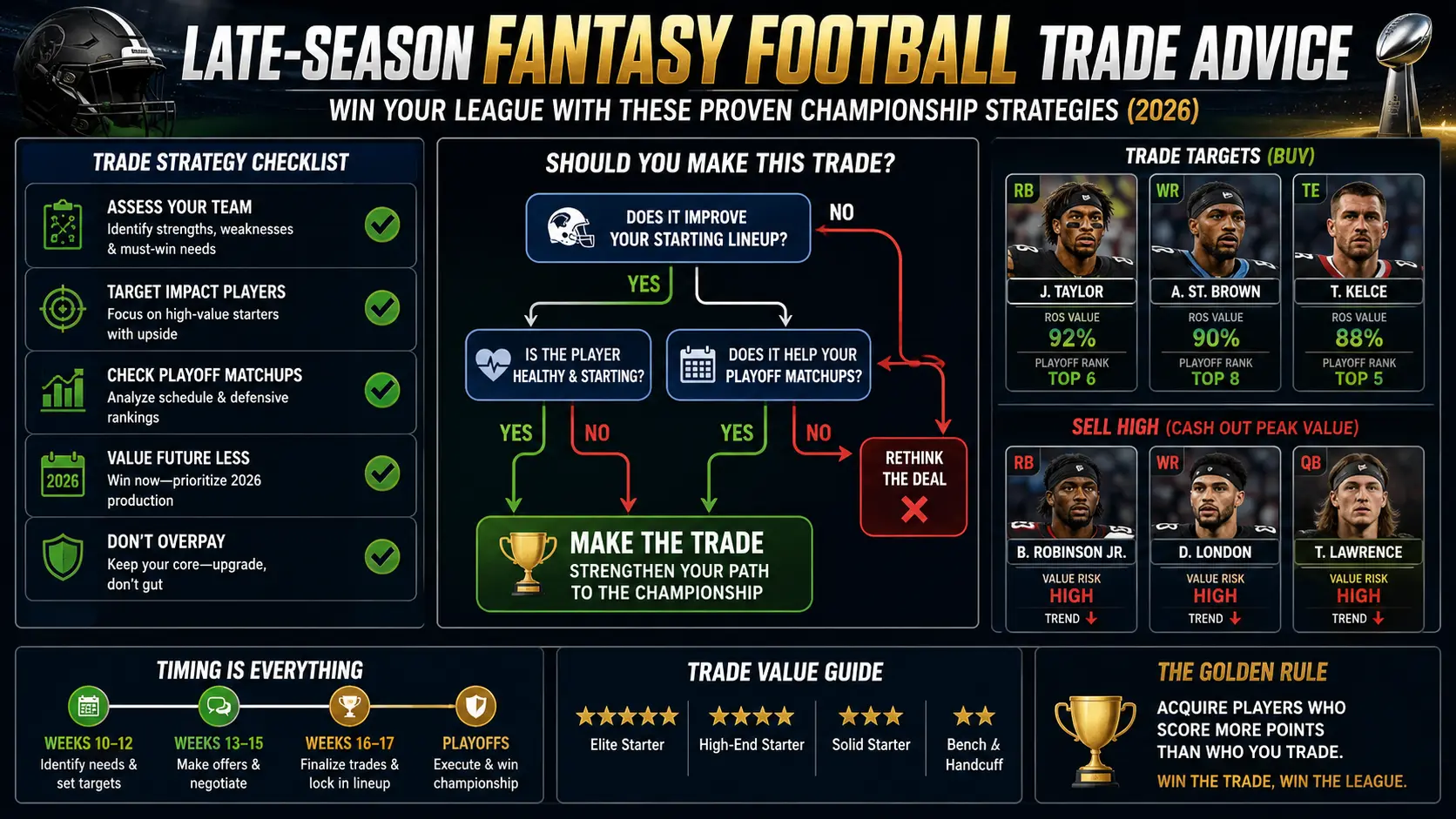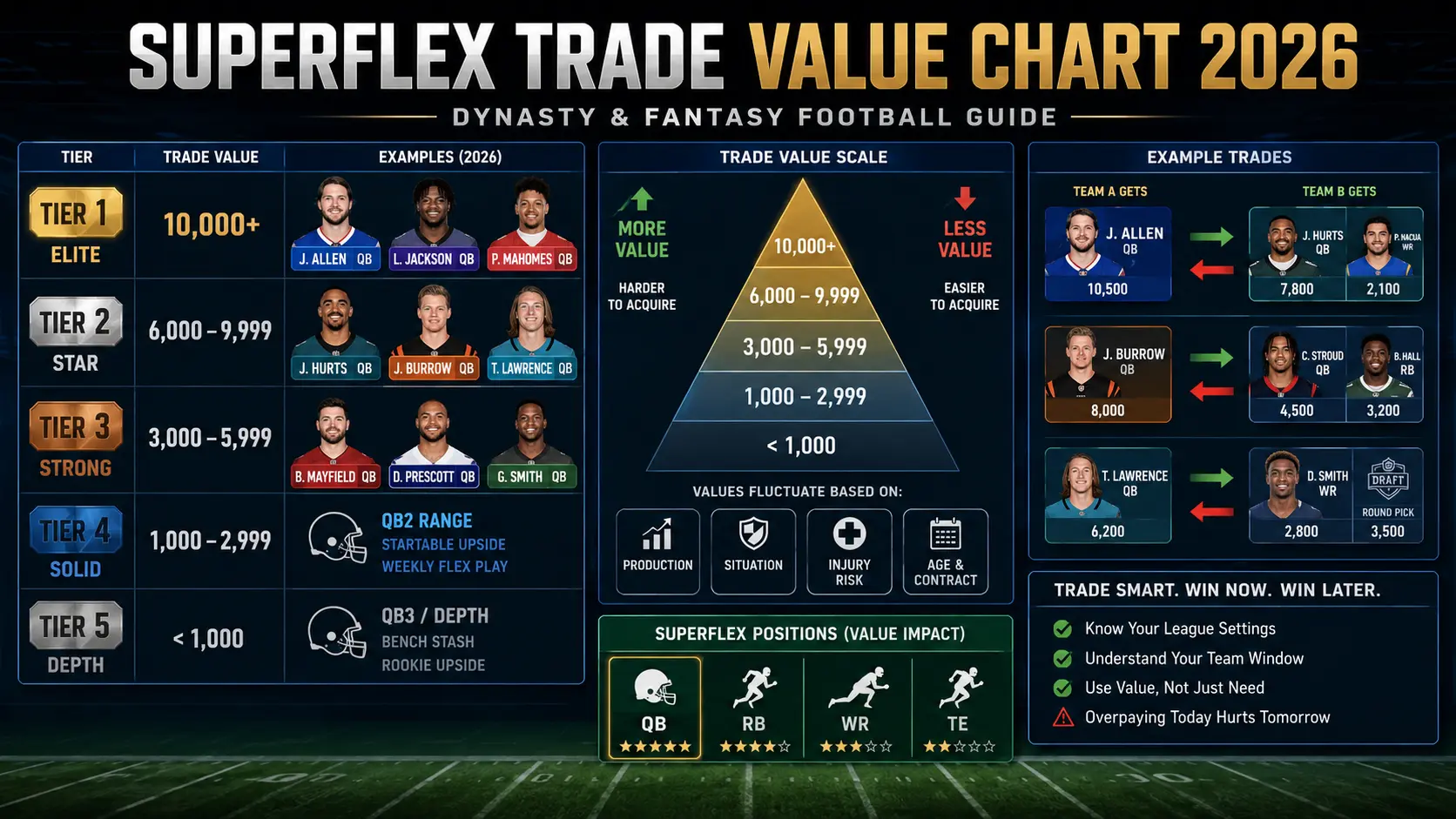
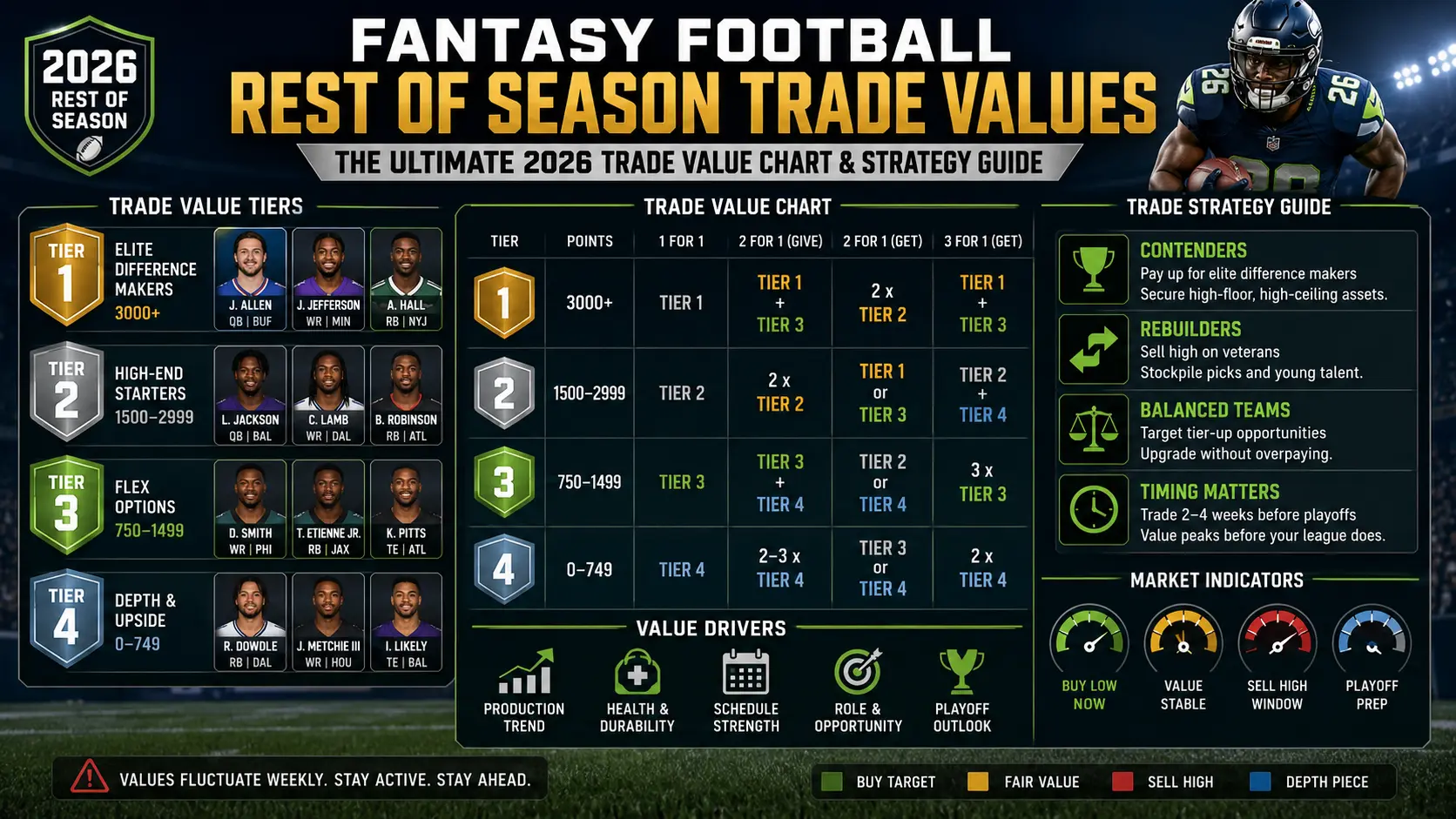
Introduction
Winning a fantasy football championship isn’t just about drafting well; it’s about making smart trades throughout the season. Understanding Fantasy Football Rest of Season Trade Values helps you identify undervalued stars, avoid overpaying for recent hot streaks, and build a roster capable of dominating the fantasy playoffs.
Unlike static rankings that only compare player names, a quality fantasy football rest of season trade value chart considers workload trends, expected fantasy points (xFP), target share, remaining strength of schedule (ROS SoS), injury risk, and playoff matchups. These factors create a more accurate picture of each player’s true market value.
Whether you play on ESPN, Yahoo, Sleeper, or another platform, this guide explains how to apply trade values in real leagues instead of blindly following charts. You’ll also learn advanced negotiation strategies, package trade math, roster optimization, and playoff-focused decision-making.
Table of Contents
- TL;DR
- Why Rest of Season Trade Values Matter
- Fantasy Football Trading 101
- Master Rest of Season Trade Value Chart
- Buy-Low & Sell-High Targets
- Advanced Trade Math
- Position-Specific Value Factors
- Playoff Schedule Strategy
- (Continued in Part 2)
TL;DR
- Rest-of-season trade values project future production, not past fantasy points.
- Expected Fantasy Points (xFP), target share, and strength of schedule often predict future breakouts better than box scores.
- Two average players rarely equal one elite player because roster spots have value.
- Weeks 15–17 playoff schedules should heavily influence trade decisions after midseason.
- Winning trades improve starting lineups,s not simply total roster value.
Why Fantasy Football Rest of Season Trade Values Matter
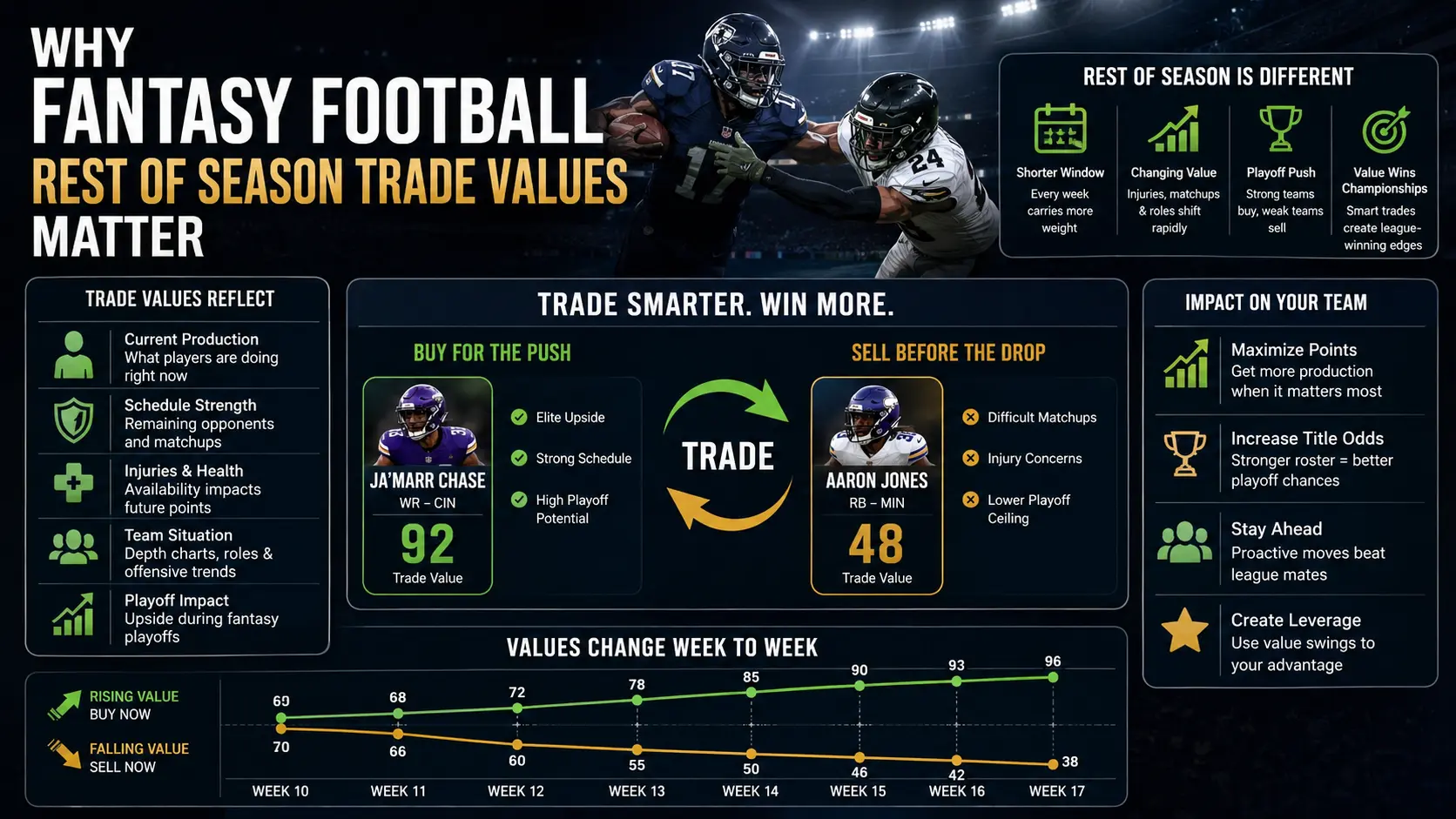
Fantasy Football Rest of Season Trade Values estimate what every player is worth for the remainder of the fantasy season.
Instead of asking:
“Who scored the most last week?”
You should ask:
“Who will produce the most from today through the fantasy playoffs?”
This shift separates championship managers from average players.
Trade values typically consider
- Expected Fantasy Points (xFP)
- Weighted Opportunity Rating (WOPR)
- Target Per Route Run (TPRR)
- Route Participation Rate
- High-value touches
- Red-zone usage
- Remaining strength of schedule
- Injury probability
- Offensive efficiency
- Quarterback stability
These advanced metrics often reveal hidden value before fantasy points catch up.
Fantasy Football Trading 101
Many fantasy managers misunderstand how trade charts should be used.
A player ranked inside the Top 10 can still be a sell-high candidate if:
- Their touchdown rate is unsustainably high.
- They are outperforming expected fantasy points.
- Difficult playoff matchups are approaching.
- Usage trends are declining.
Likewise, struggling stars often become ideal fantasy football players to trade for because underlying opportunity remains elite.
How Trade Values Are Calculated
Featured Snippet Answer
Fantasy football trade values are calculated by projecting a player’s expected rest-of-season production using workload metrics such as target share, expected fantasy points (xFP), high-value touches, remaining strength of schedule, and injury outlook. These projections are converted into numerical trade values relative to replacement-level players.
Sample Trade Value Table
| Player | Position | Rest of Season Trade Value |
| Ja’Marr Chase | WR | Elite |
| Bijan Robinson | RB | Elite |
| CeeDee Lamb | WR | Elite |
| Christian McCaffrey | RB | High |
| Justin Jefferson | WR | High |
| Jahmyr Gibbs | RB | High |
| Puka Nacua | WR | High |
| Malik Nabers | WR | Rising |
| Jaxon Smith-Njigba | WR | Rising |
| Trey McBride | TE | Premium |
Trade values should be updated weekly as injuries, usage, and NFL news change player outlooks.
The Biggest Mistake Most Managers Make
Most fantasy players simply compare fantasy points.
Winning managers compare:
- Opportunity
- Volume
- Schedule
- Team context
- Future matchups
For example:
Player A scores 24 fantasy points from two touchdowns.
Player B scores 15 fantasy points despite seeing:
- 12 targets
- 38% target share
- 42% air-yard share
- 9 expected receptions
Player B is usually the better long-term investment despite scoring fewer points.
Master Fantasy Football Rest of Season Trade Value Framework
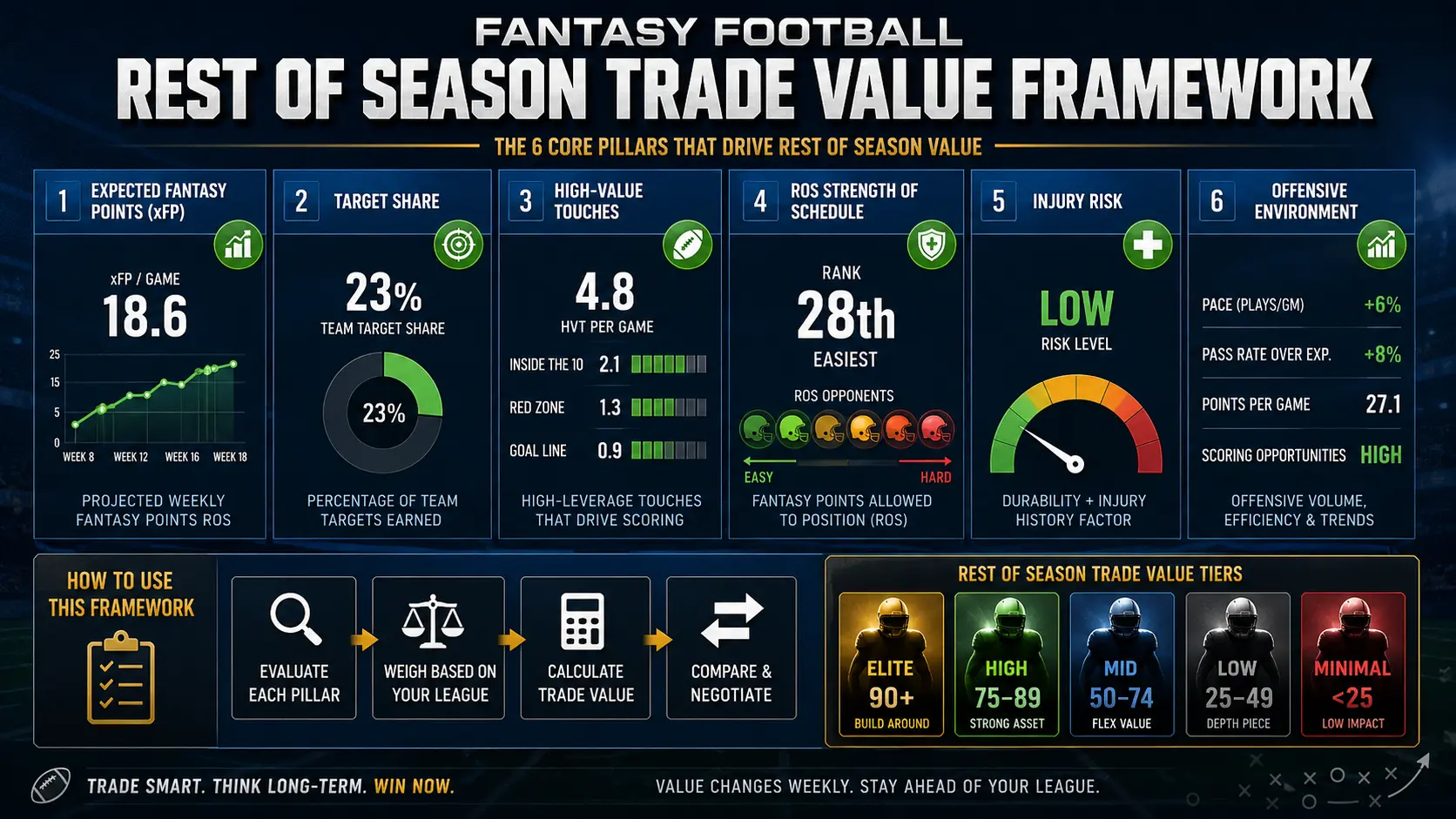
Rather than relying only on rankings, evaluate every player across six categories.
| Factor | Why It Matters |
| Expected Fantasy Points (xFP) | Shows sustainable production |
| Target Share | Predicts receiving volume |
| High-Value Touches | Measures premium opportunities |
| ROS Strength of Schedule | Identifies favorable matchups |
| Injury Risk | Lowers long-term value |
| Offensive Environment | Better offenses create more scoring chances |
This framework consistently identifies undervalued fantasy football players before the market adjusts.
Buy-Low Trade Targets
The best players to trade for fantasy football usually have disappointing fantasy totals despite encouraging underlying metrics.
Jaxon Smith-Njigba Fantasy Football Outlook
Jaxon Smith-Njigba fantasy football managers should pay close attention to:
- Increasing Route Participation Rate
- Rising Target Per Route Run
- Growing market share of air yards
- Improved red-zone involvement
These indicators often appear before fantasy breakouts, making him one of the more attractive fantasy football trade targets.
Running Backs With Positive Regression
Look for backs who:
- Rank highly in expected fantasy points
- Receive goal-line opportunities
- Dominate backfield snaps
- Lead their team in high-value touches
Even if touchdowns haven’t arrived yet, these players frequently outperform expectations over the remainder of the season.
Wide Receivers Ready to Break Out
Advanced metrics worth monitoring include:
- Target Share
- WOPR
- TPRR
- Air-yard market share
- End-zone targets
Receivers with elite opportunity but average fantasy production often become league-winning acquisitions.
Sell-High Candidates
Not every high scorer should remain on your roster.
Consider moving players who:
- Depend on long touchdowns
- Score far above expected fantasy points
- Face brutal playoff schedules
- Experience declining snap rates
- Lose red-zone usage
Selling before regression hits is one of the biggest competitive advantages in fantasy football.
Advanced Trading Math
Most trade calculators ignore the most important concept:
The 2-for-1 Formula
Many managers believe:
Player A (30)
equals
Player B (15)
Player C (15)
Unfortunately, fantasy football doesn’t work that way.
Correct Formula
Net Trade Value = Total Incoming Value − Bench Replacement Cost − Roster Spot Tax
Example:
Receive:
- Player B (15)
- Player C (15)
Total = 30
But adding two players usually forces you to cut a bench player worth approximately 5–7 trade points.
Actual value:
30 − 6 = 24
Your “fair” trade suddenly becomes a losing deal.
This explains why elite players command a premium beyond their listed trade value.
Quantifying Bench Space Tax
Every additional roster spot has value.
Bench players provide:
- Injury insurance
- Bye-week flexibility
- Future trade assets
- Handcuff upside
Ignoring this hidden cost is why many package trades weaken otherwise strong fantasy rosters.
Roster Consolidation Strategy
Championship teams often benefit from turning:
- Three good players
into
- Two elite starters
Elite players consistently outperform depth during fantasy playoffs because only starting lineups score points.
Position-Specific Trade Value Factors
Running Backs
Running backs fluctuate more than any other position because they rely heavily on:
- High-value touches
- Goal-line carries
- Injury health
- Offensive line play
Late in the season, prioritize backs with stable workloads over players living off explosive touchdown production.
Wide Receivers
Receivers generally offer more predictable weekly production.
Key evaluation metrics include:
- Target Share
- Route Participation
- Air-yard market share
- TPRR
- Quarterback efficiency
Elite volume usually wins over unsustainable efficiency.
Playoff Schedule Optimization Guide (Weeks 15–17)
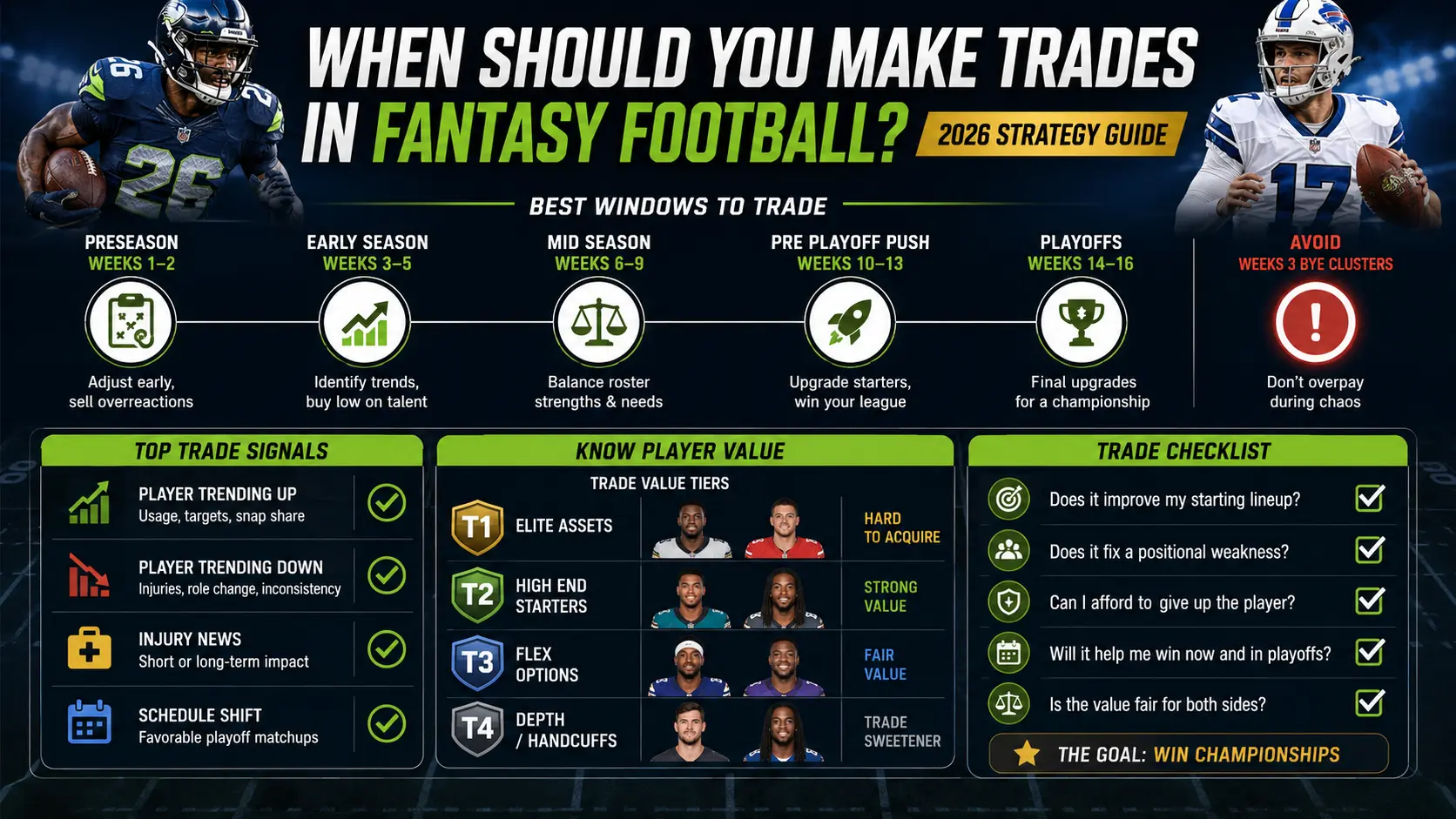
As the fantasy playoffs approach, Fantasy Football Rest of Season Trade Values should shift from season-long projections to playoff-winning potential. By Week 8 or later, managers should weigh Weeks 15–17 matchups more heavily than early-season performance.
Prioritize Players With
- Favorable fantasy playoff schedules
- High snap percentages
- Consistent target or carry volume
- Stable quarterback play
- Strong offensive environments
Playoff Heatmap Example
| Schedule Rating | Meaning | Trade Action |
| 🟢 Easy | Multiple favorable defenses | Buy Aggressively |
| 🟡 Neutral | Average matchups | Hold |
| 🔴 Difficult | Elite defensive opponents | Sell or downgrade |
A soft playoff schedule can elevate a player by an entire tier, while a brutal stretch may justify trading away a recognizable star.
Position-Specific Strategy for Rest-of-Season Values
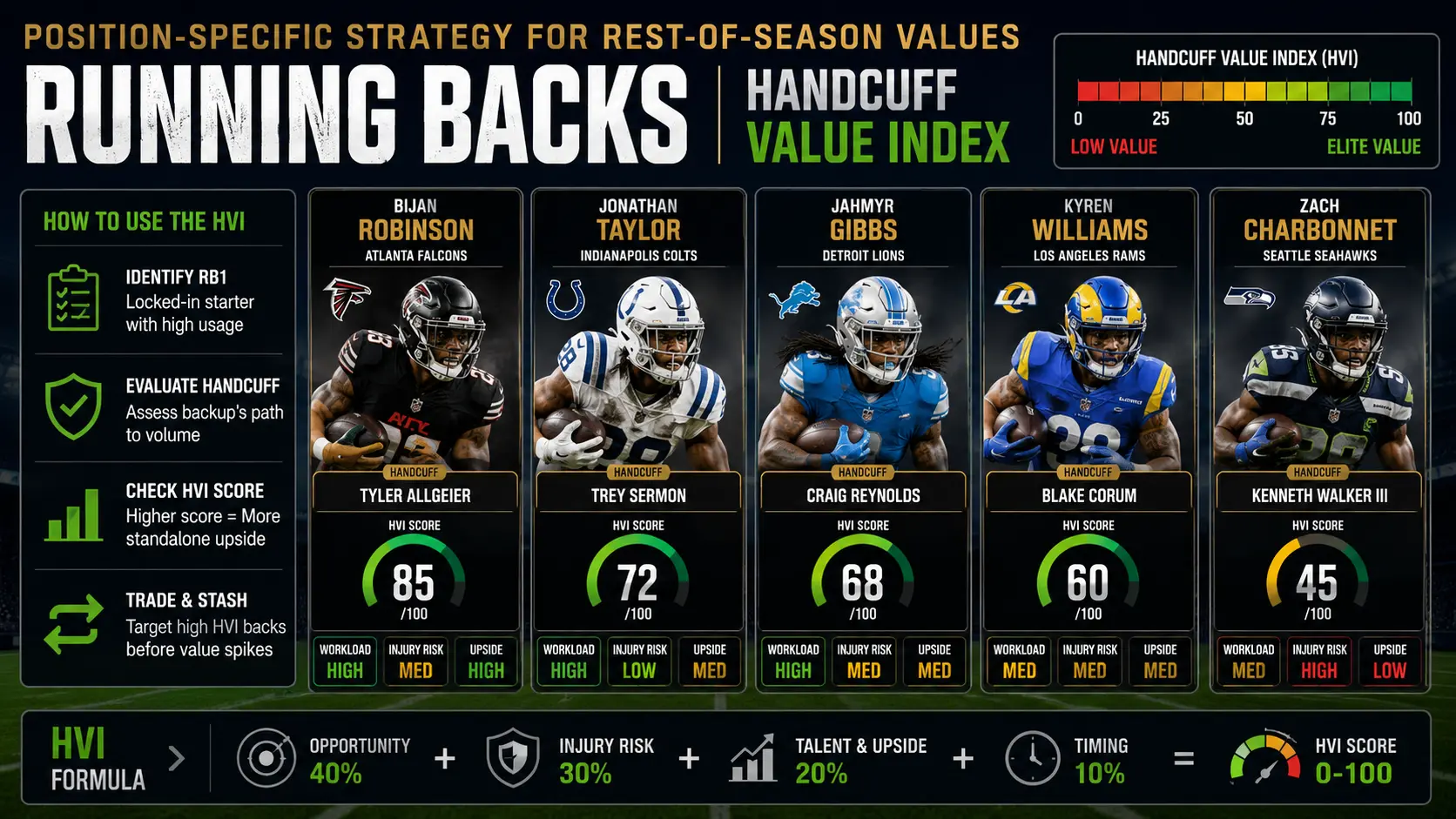
Running Backs: Volume Wins Championships
Running back values change rapidly because injuries, workload, and coaching decisions can shift overnight.
Prioritize backs with:
- High-value touches (HVT)
- Goal-line carries
- Receiving involvement
- Script-independent volume
- Strong offensive lines
Handcuff Value Index
Not all backup running backs are equal. Premium handcuffs deserve additional trade value because they can become RB1s with one injury.
Examples include backups who already receive meaningful touches or dominate third-down work.
Wide Receivers: Follow Opportunity, Not Highlights
Elite receivers maintain value through volume rather than long touchdowns.
Key metrics include:
- Target Share
- Target Per Route Run (TPRR)
- Weighted Opportunity Rating (WOPR)
- Route Participation Rate
- Market Share of Air Yards
A receiver with 10 targets and no touchdown is often a stronger long-term asset than one who scores twice on four targets.
Quarterbacks
In one-QB leagues, quarterback values remain relatively flat unless they provide elite rushing upside.
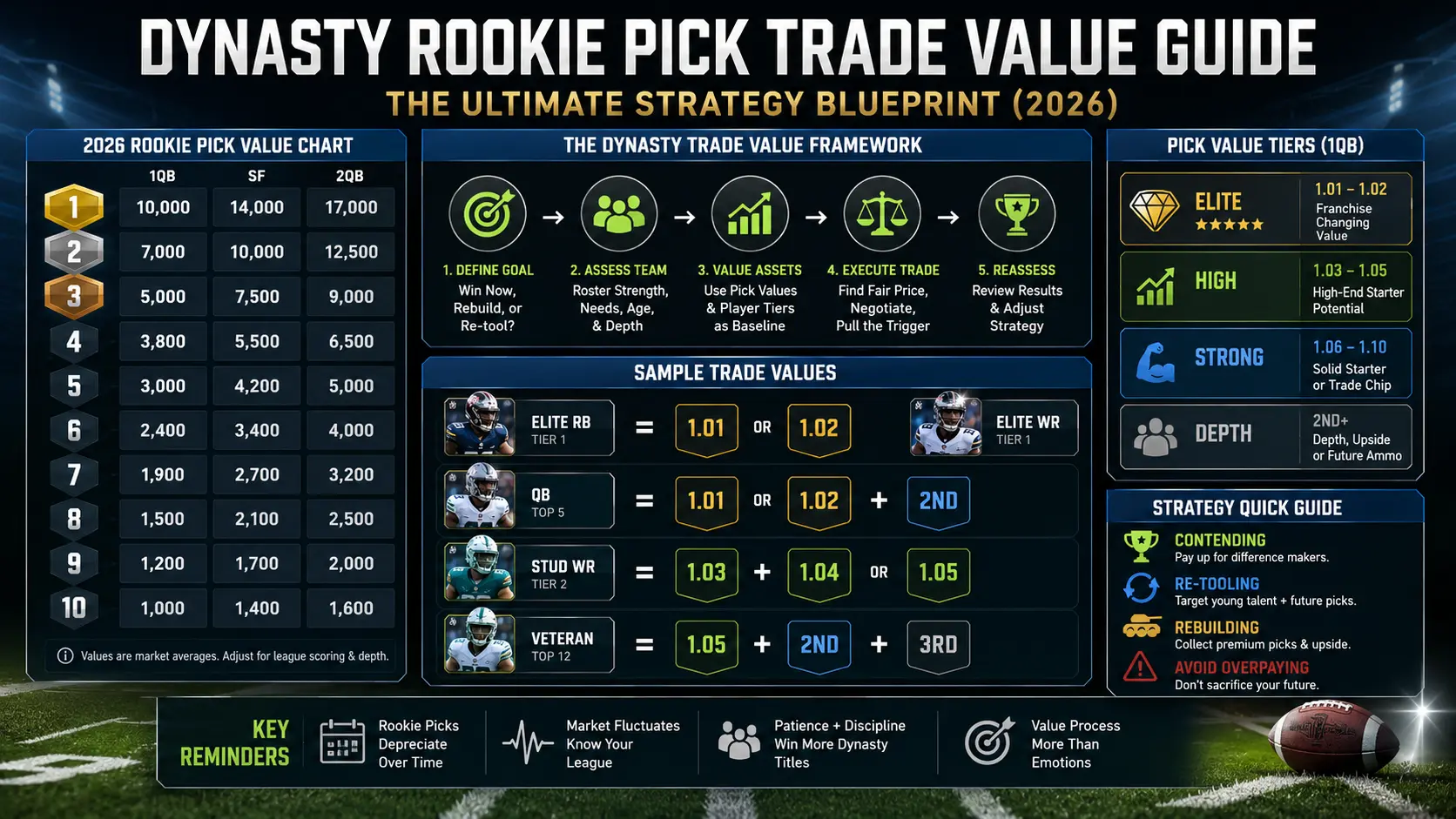
In Superflex leagues, however, starting quarterbacks receive a significant premium because every starting QB carries scarcity value.
Superflex Value Adjustment
A practical rule:
- Elite QB = Top-tier WR or RB
- Mid-range QB = High-end WR2 value
- Streaming QB = Flex value
This adjustment helps avoid undervaluing quarterbacks in Superflex formats.
Tight Ends
Elite tight ends create a weekly positional advantage.
Managers should be willing to pay a premium for consistent options because replacement-level production at the position is usually much lower than at WR or RB.
Advanced Trading Strategies
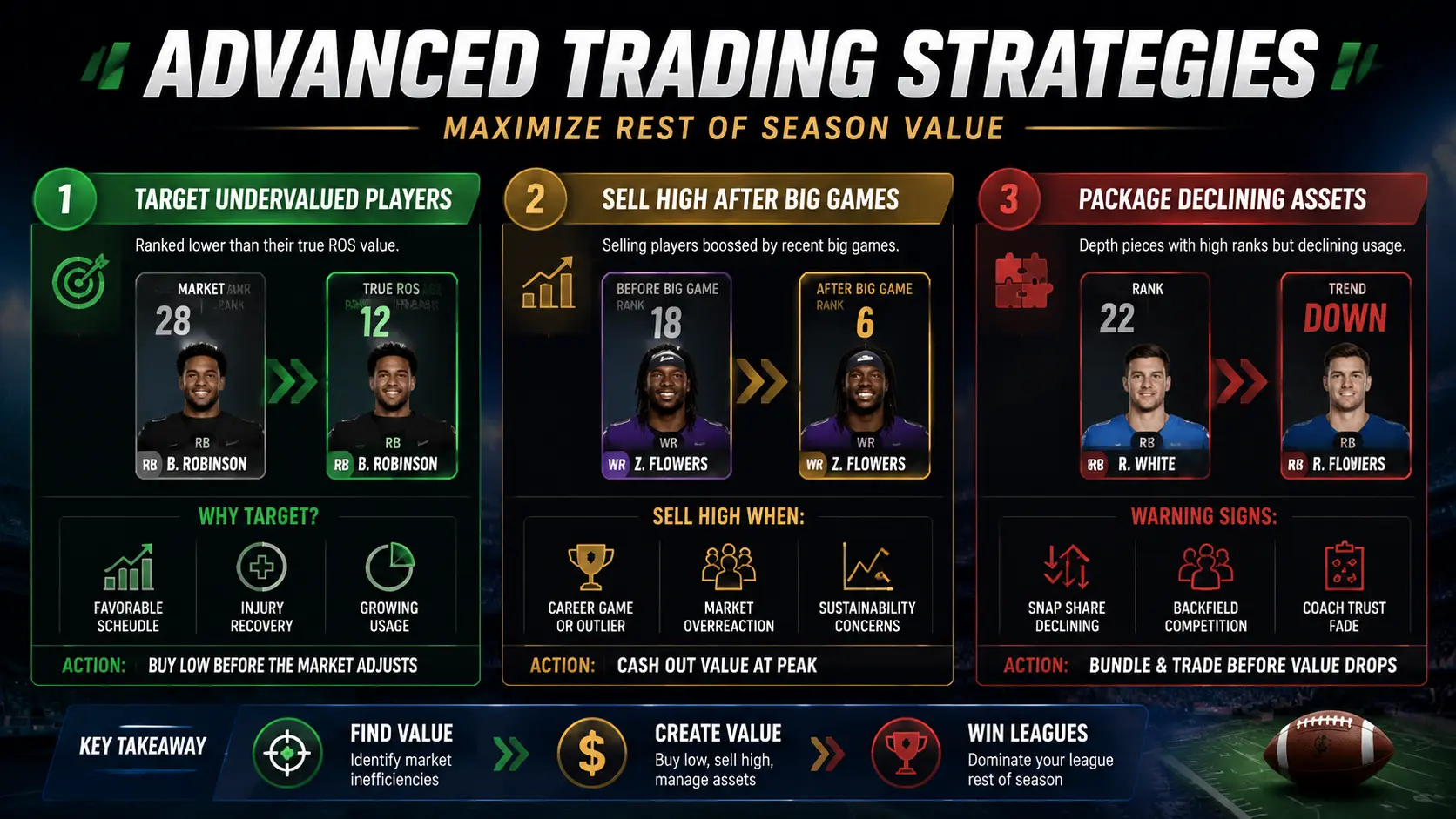
Exploit Platform Ranking Bias
Managers on ESPN, Yahoo, and Sleeper often rely heavily on default rankings.
You can use this to your advantage by:
- Targeting players ranked lower than their true ROS value.
- Selling players boosted by recent big games.
- Packaging depth pieces that appear highly ranked but have declining usage.
Trade Based on Team Record
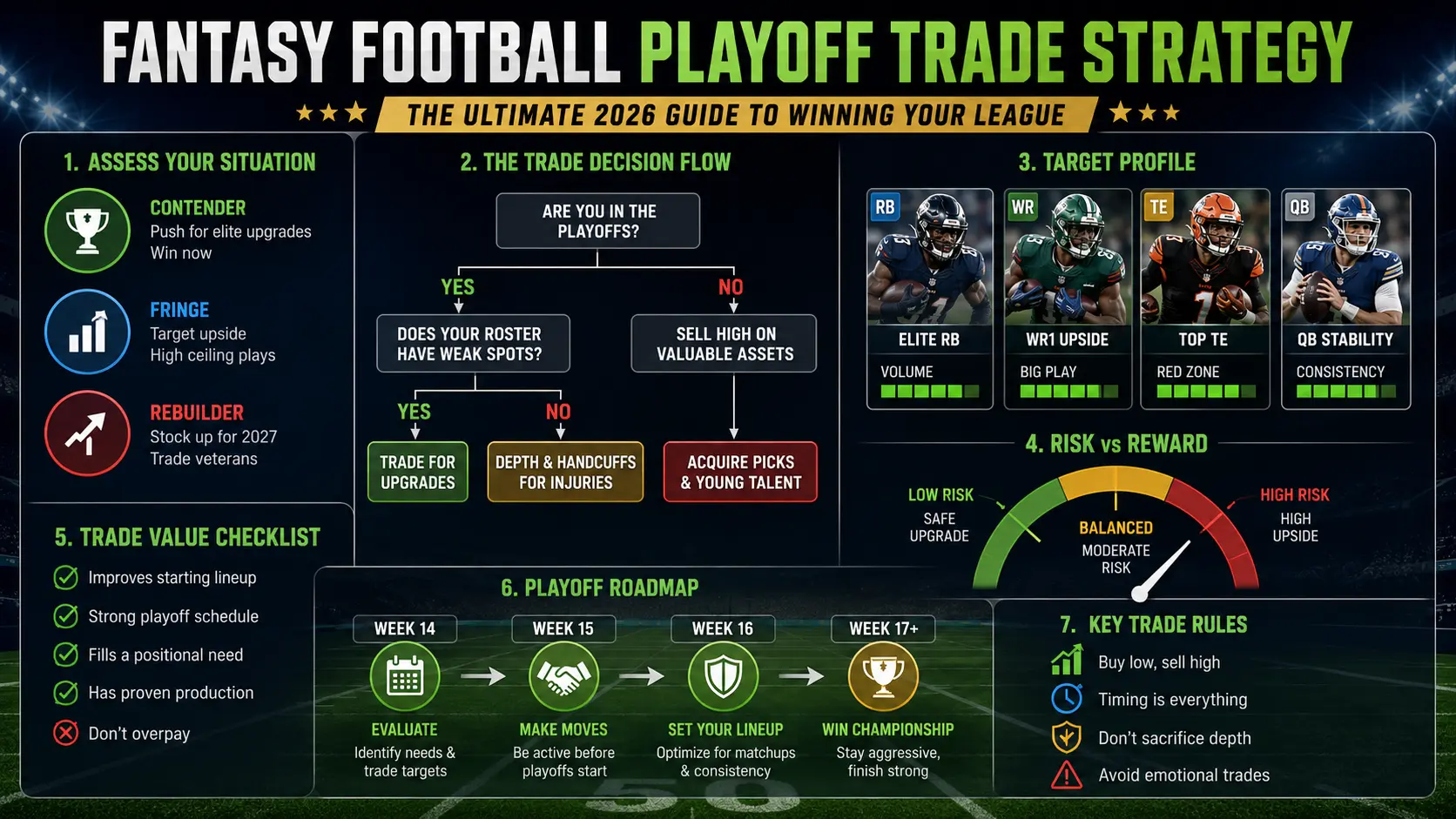
Your record should influence how you value players.
| Record | Strategy |
| 1–5 or 2–6 | Chase immediate production, even if you slightly overpay. |
| Around .500 | Balance current production with playoff upside. |
| Leading the league | Prioritize Weeks 15–17 matchups and consolidate elite talent. |
The Psychology of Negotiation
Successful trades aren’t only about numbers.
Avoid sending obviously one-sided offers. Instead:
- Identify your trade partner’s biggest roster weakness.
- Explain how your offer helps solve that problem.
- Let them feel involved by asking for feedback instead of demanding acceptance.
Managers are far more likely to accept trades that appear mutually beneficial.
Practical Trade Scenario
Imagine this offer:
Receive
- Elite WR
Trade Away
- Mid-tier RB
- WR2
At first glance, the values may appear equal.
However:
- You upgrade your weekly starter.
- You free a bench spot.
- You improve playoff lineup strength.
- Your waiver wire replacement fills the vacated depth role.
This is an example of roster consolidation, one of the most effective championship-building strategies.
Comparison: Volume vs. Efficiency
| Volume-Based Players | Efficiency-Based Players |
| Reliable weekly floor | Boom-or-bust production |
| Stable target share | Dependent on long plays |
| Easier to project | Higher regression risk |
| Better playoff investment | Better DFS tournament options |
When evaluating Fantasy Football Rest of Season Trade Values, prioritize sustainable volume over unsustainable efficiency.
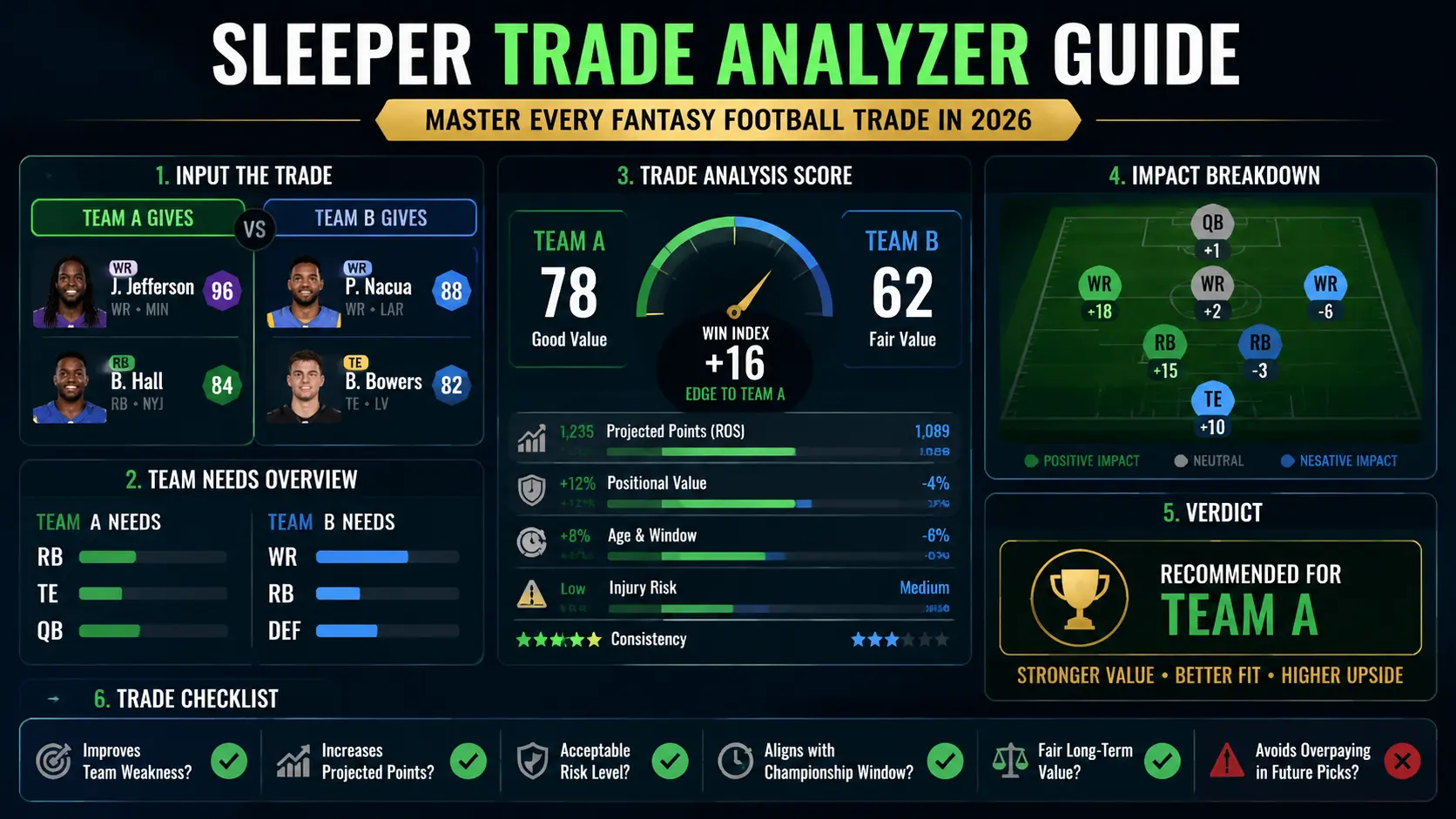
Fantasy Football Trade Approval Checklist
Before clicking Accept, ask yourself:
✅ Does this improve my starting lineup?
✅ Am I sacrificing too much bench depth?
✅ Do the incoming players have favorable playoff schedules?
✅ Am I creating bye-week conflicts?
✅ Does league scoring (PPR, Half-PPR, Standard, or Point-Per-First-Down) change player values?
✅ Am I buying future opportunity rather than chasing last week’s points?
If you answer “No” to several of these questions, reconsider the trade.
Advanced Tips
Experienced fantasy managers gain an edge by looking beyond rankings.
- Monitor Expected Fantasy Points (xFP) instead of fantasy points alone.
- Track Weighted Opportunity Rating (WOPR) for wide receivers.
- Use Target Per Route Run (TPRR) to identify breakout candidates.
- Watch red-zone rushing share rather than total carries.
- Prioritize players with stable usage regardless of game script.
- Begin emphasizing playoff schedules once the fantasy trade deadline approaches.
- Regularly compare your league’s market values with updated fantasy football rest-of-season trade value chart projections.
Common Mistakes
Avoid these costly errors:
- Trading based solely on one huge game.
- Ignoring expected volume metrics.
- Overvaluing bench depth in shallow leagues.
- Forgetting the roster-space tax in 2-for-1 deals.
- Ignoring playoff schedules.
- Failing to account for league scoring settings.
- Selling struggling stars before positive regression occurs.
- Overreacting to temporary injuries without considering long-term outlook.
Recommended Tools & Resources
To make smarter trades throughout the season, consider using:
- A fantasy football trade calculator.
- Weekly rest-of-season rankings.
- Strength of schedule (ROS SoS) tools.
- Snap share and route participation reports.
- Target share and air-yard tracking dashboards.
- Injury news trackers.
- NFL depth charts.
These related resources can help you refine trade decisions and build stronger rosters.
Future Trends
Fantasy football trade analysis continues to evolve.
Expect future Fantasy Football Rest of Season Trade Values models to rely even more on:
- Machine-learning projections
- Real-time injury probability
- Expected fantasy points (xFP)
- Player tracking data
- Route participation trends
- AI-powered matchup simulations
- Dynamic playoff schedule adjustments
Managers who embrace these advanced metrics will likely gain an edge over those relying only on traditional rankings.
Conclusion
Understanding Fantasy Football Rest of Season Trade Values is about much more than assigning numbers to players. Winning managers evaluate opportunity, expected production, remaining schedule, roster construction, and league context before making every deal.
Whether you’re searching for fantasy football trade targets, identifying players to trade for fantasy football, or using a fantasy football rest of season trade value chart to evaluate offers, remember that context is everything. Package trades should account for roster-space tax, elite players deserve a consolidation premium, and playoff schedules become increasingly important as the season progresses.
By combining advanced metrics like xFP, WOPR, TPRR, high-value touches, and rest-of-season strength of schedule with smart negotiation tactics, you’ll consistently make stronger trades and maximize your championship odds.
Frequently Asked Questions
1. What are Fantasy Football Rest of Season Trade Values?
They are player valuations that estimate each player’s projected fantasy value from today through the end of the season based on workload, efficiency, schedule, and opportunity.
2. How often should a fantasy football rest-of-season trade value chart be updated?
Ideally every week or immediately after major injuries, depth-chart changes, or significant NFL news.
3. Why doesn’t a 2-for-1 trade always work?
Because roster spots have value. Acquiring two players often forces you to drop another player, reducing the net value of the trade.
4. Should I value playoff schedules more than season-long rankings?
Yes. Once the fantasy playoffs approach, favorable Weeks 15–17 matchups can significantly increase a player’s trade value.
5. Which metrics are most important for identifying buy-low candidates?
Expected Fantasy Points (xFP), target share, Target Per Route Run (TPRR), Weighted Opportunity Rating (WOPR), route participation, and high-value touches.
6. How do league scoring settings affect trade values?
PPR leagues increase the value of pass-catching running backs and high-volume receivers, while Standard formats place greater emphasis on rushing touchdowns and big plays.
7. Are elite tight ends worth paying up for?
In many leagues, yes. Elite tight ends provide a weekly positional advantage that can outweigh small differences at deeper positions like wide receiver.
8. How can I improve my trade negotiations?
Understand your league mate’s needs, make balanced offers, use current trade values as a guide rather than a rule, and explain how the deal benefits both teams.