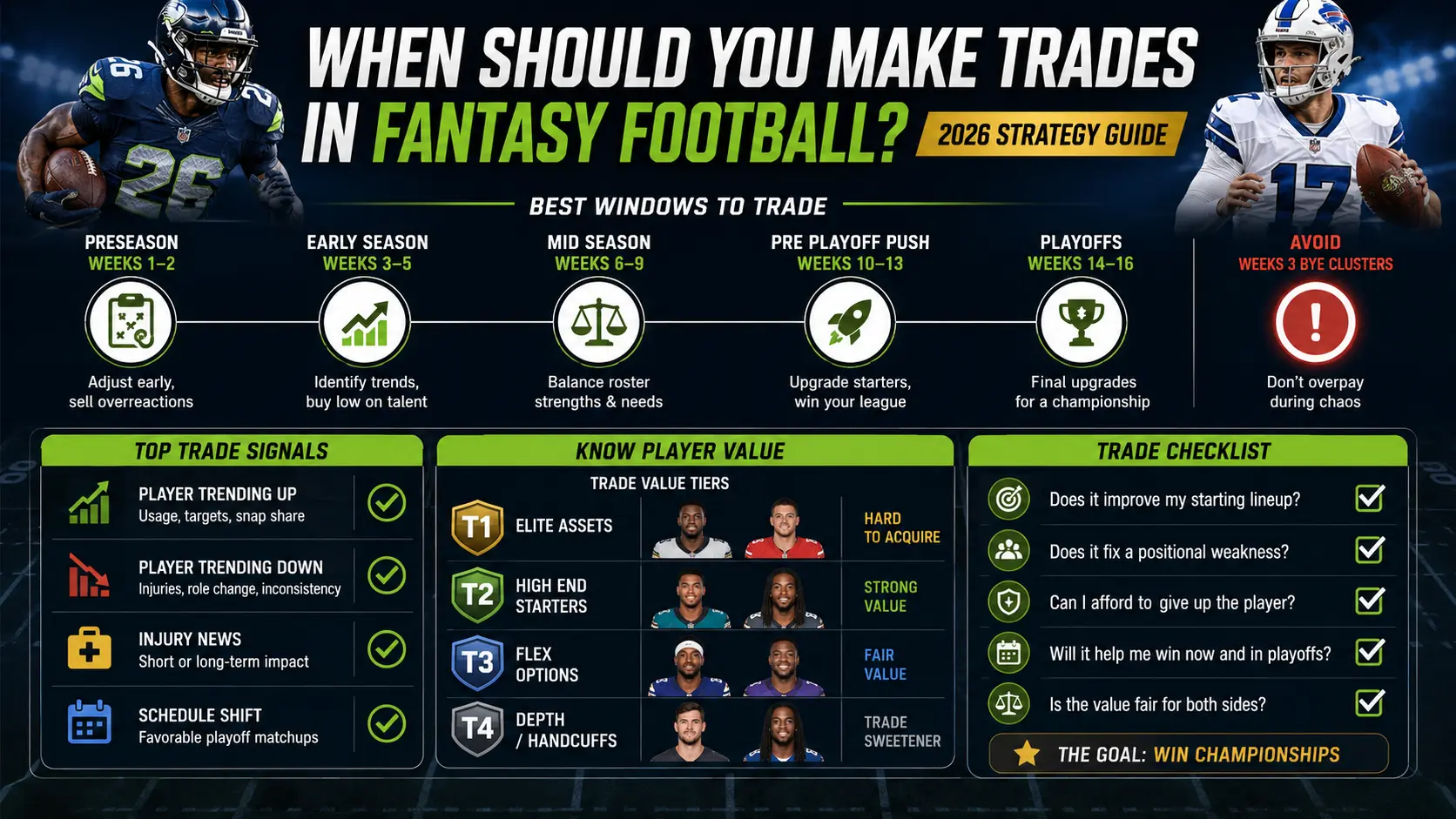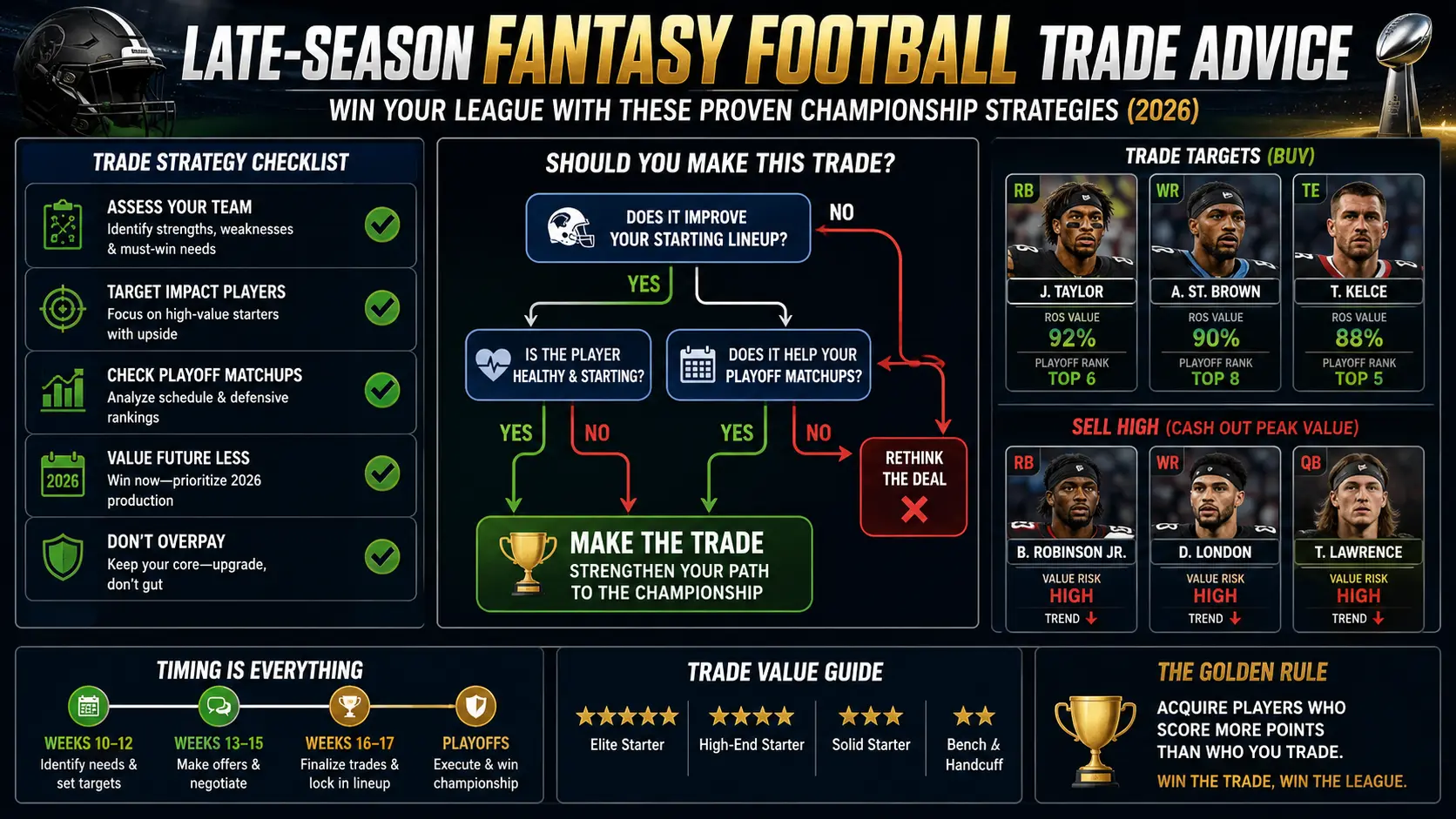
Introduction
Fantasy football championships are rarely won on draft day alone. More often, they’re won by managers who recognize value before everyone else and consistently make trades that strengthen their roster over the course of the season.
Yet evaluating a fantasy football trade is far more complicated than comparing projected fantasy points or plugging names into an online calculator. A trade that appears perfectly “fair” on paper can actually weaken your starting lineup once you account for roster construction, waiver-wire replacements, playoff schedules, positional scarcity, league format, and your current place in the standings.
According to industry research and historical fantasy league data, managers who actively improve their teams through smart in-season roster management, including strategic trades, typically outperform those who rely solely on their draft. The best fantasy managers treat their rosters like investment portfolios, continually reallocating assets as player values shift throughout the NFL season.
If you’ve ever wondered:
- Is this trade actually improving my team?
- Should I accept a 2-for-1 offer?
- Is my league mate trying to buy low?
- How much are draft picks really worth?
- Should I trust trade calculators?
You’re in the right place.
This guide explains how to evaluate fantasy football trades using the same decision-making frameworks employed by experienced fantasy managers, analysts, and high-stakes competitors. You’ll learn how to move beyond basic trade calculators and evaluate deals using advanced concepts like Value Over Replacement (VORP), Rest-of-Season (ROS) projections, positional scarcity, utilization metrics, playoff schedules, and league-specific strategy.
By the end, you’ll have a repeatable framework that helps you confidently evaluate any fantasy football trade, whether you play redraft, dynasty, keeper, Superflex, or Tight End Premium leagues.
Table of Contents
- TL;DR
- What Makes a Fantasy Football Trade Good?
- Why Most Fantasy Managers Evaluate Trades Incorrectly
- The Five-Step Fantasy Football Trade Evaluation Framework
- Understanding Positional Scarcity
- Why Trade Calculators Aren’t Enough
- Value Over Replacement (VORP) Explained
- The 2-for-1 Trade Illusion and Opportunity Cost
- Key Takeaways
TL;DR
Before accepting any fantasy football trade:
✅ Verify your scoring format.
✅ Compare Rest-of-Season value,e not season totals.
✅ Consider your starting lineup, not just total roster value.
✅ Account for players you’ll need to drop.
✅ Evaluate positional scarcity.
✅ Analyze playoff schedules.
✅ Consider your league standings.
✅ Never rely solely on trade calculators.
A trade is only successful if it improves your projected weekly starting lineup while supporting your long-term strategy.
What Does It Mean to Evaluate a Fantasy Football Trade?
Evaluating a fantasy football trade means determining whether the deal improves your team’s projected rest-of-season performance after accounting for league scoring settings, roster construction, positional scarcity, waiver-wire replacements, playoff schedules, and long-term team goals.
In other words, don’t ask:
“Who gets the better player?”
Instead ask:
“Will this trade help my starting lineup score more fantasy points between now and the championship?”
That subtle difference separates experienced managers from beginners.
Why Most Fantasy Managers Evaluate Trades Incorrectly
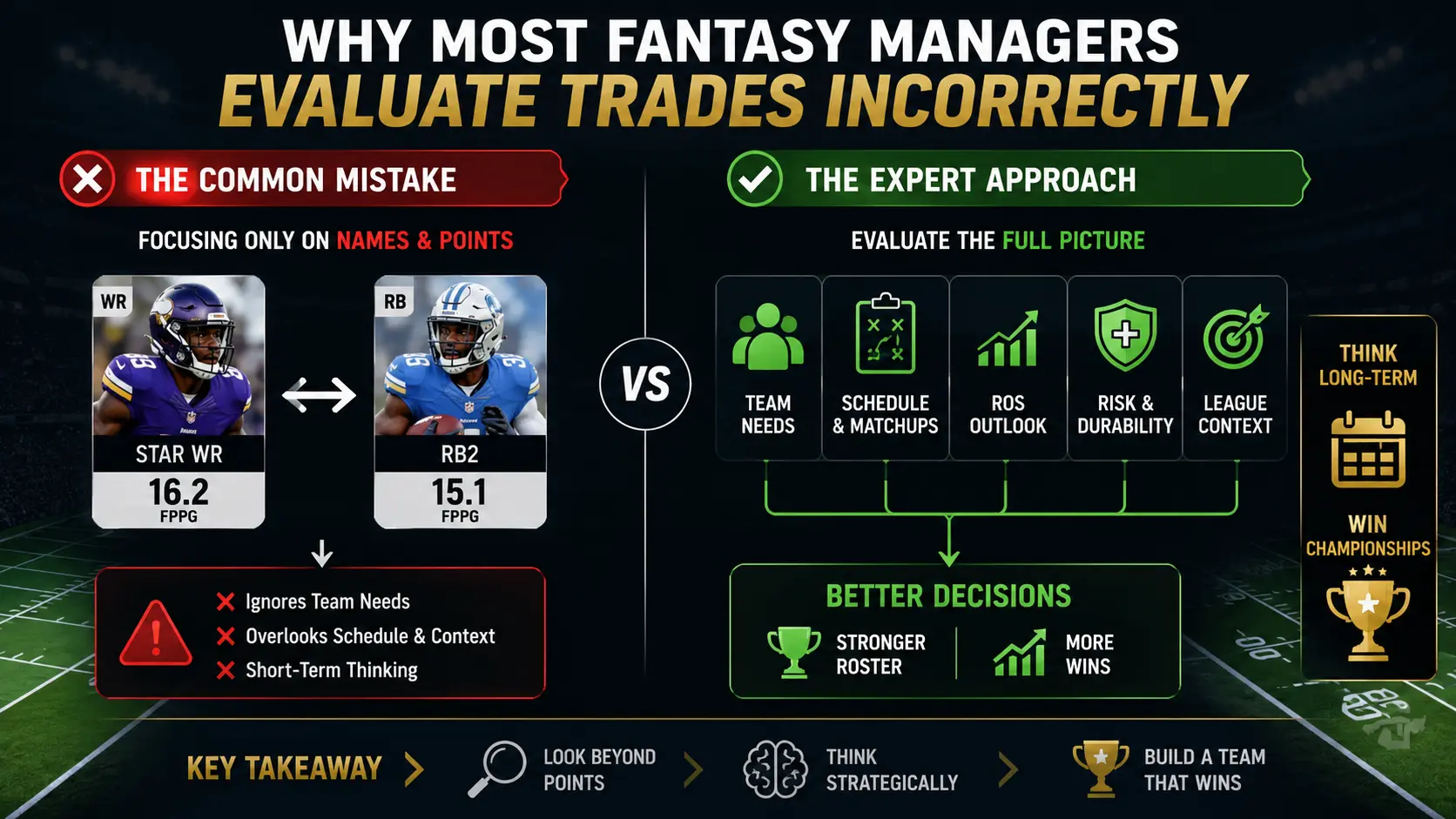
One of the biggest mistakes fantasy managers make is evaluating players instead of evaluating teams.
For example:
Team A receives
Christian McCaffrey
Team B receives
James Cook
Chris Olave
At first glance, many people immediately declare:
“The team getting McCaffrey wins.”
But that’s not necessarily true.
Suppose Team A now has to start a waiver-wire running back because they traded away depth.
Weekly lineup comparison:
| Before Trade | Points |
| James Cook | 16 |
| Chris Olave | 15 |
| Total | 31 |
After Trade:
| After Trade | Points |
| McCaffrey | 22 |
| Waiver WR | 7 |
| Total | 29 |
Although Team A acquired the best player, their starting lineup actually scores fewer projected points.
This is why experienced fantasy players evaluate lineup value, not just player value.
Fantasy Football Is Portfolio Management
A useful way to think about your fantasy roster is as an investment portfolio.
Professional investors rarely evaluate one stock in isolation.
Instead, they ask:
- Does this reduce risk?
- Does this improve expected returns?
- Does it diversify my portfolio?
- Does it match my long-term strategy?
Fantasy football works the same way.
Each player is an asset.
Each trade changes:
- Weekly scoring ceiling
- Weekly scoring floor
- Injury exposure
- Positional depth
- Future flexibility
The goal isn’t collecting famous names.
The goal is to maximize expected weekly points.
The Five-Step Fantasy Football Trade Evaluation Framework
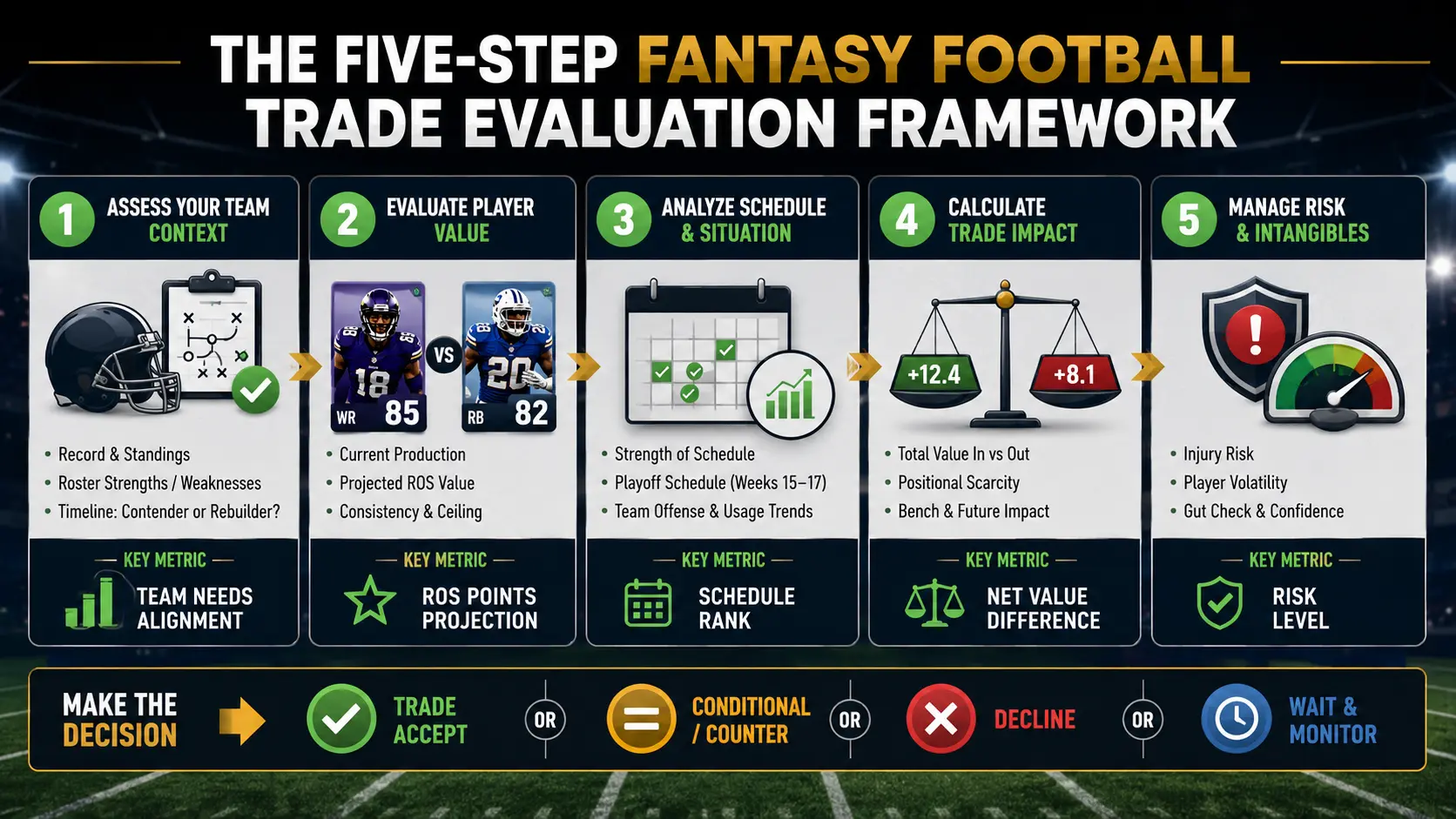
Whenever you receive a trade offer, follow these five steps before making a decision.
Step 1: Verify League Settings
No player has universal value.
Everything depends on your league settings.
Check:
- Standard scoring
- Half-PPR
- Full PPR
- Superflex
- 2-QB
- Tight End Premium (TEP)
- Keeper rules
- Dynasty settings
- Bonus scoring
- Starting lineup requirements
A running back who catches 80 passes is significantly more valuable in Full PPR than Standard scoring.
Similarly, quarterbacks become dramatically more valuable in Superflex leagues because two can be started each week.
Ignoring league settings is one of the fastest ways to lose a trade.
Step 2: Compare Rest-of-Season Value
Don’t compare season totals.
Don’t compare last week’s points.
Instead, compare:
Projected Rest-of-Season production.
Ask:
- Is this player healthy?
- What is their workload?
- Do they have favorable matchups?
- Are they trending upward?
- Will their role increase?
Future points, not past points win fantasy championships.
Step 3: Account for Roster Space (The 2-for-1 Trade Illusion)
One of the biggest content gaps in most trade advice is the hidden cost of roster spots.
Imagine this trade:
Receive:
- Garrett Wilson
- Rhamondre Stevenson
Give:
- CeeDee Lamb
Many managers simply compare:
Garrett Wilson + Stevenson
vs.
CeeDee Lamb
But that’s incomplete.
If your roster is already full, you must cut someone.
Suppose that player is projected for 8 points per week.
Your actual calculation becomes:
| Incoming Assets | Weekly Value |
| Garrett Wilson | 15 |
| Stevenson | 13 |
| Minus Dropped Player | -8 |
| Net Gain | 20 |
Now compare:
| Outgoing Asset | Weekly Value |
| CeeDee Lamb | 21 |
The trade actually loses value.
Formula
Trade Value = Incoming Players − Dropped Player + Waiver Replacement
Ignoring roster opportunity cost is one of the biggest reasons fantasy managers overvalue 2-for-1 trades.
Understanding Positional Scarcity
Not every fantasy point is equally valuable.
Suppose:
Quarterback A
20 PPG
Running Back B
20 PPG
Are they equal?
No.
Why?
Because replacement-level quarterbacks are much easier to find than replacement-level running backs.
For example:
| Position | Elite Average | Replacement Average | Difference |
| QB | 22 | 18 | +4 |
| RB | 18 | 10 | +8 |
| WR | 17 | 11 | +6 |
| TE | 15 | 8 | +7 |
This concept is called Value Over Replacement (VORP).
The scarcer the position, the more valuable elite players become.
Why Trade Calculators Aren’t Enough
Trade calculators are excellent starting points but poor final decision-makers.
Most calculators:
✔ Compare projected fantasy points
✔ Use consensus rankings
✔ Estimate player value
However, they usually ignore:
- Your specific roster needs
- Bench strength
- Waiver-wire quality
- League tendencies
- Upcoming playoff schedule
- Injury risk
- Trade psychology
- League standings
- Positional scarcity within your league
- Future roster flexibility
Think of a calculator as a GPS.
It shows one route.
It doesn’t know about traffic, road closures, or your destination preferences.
Similarly, fantasy trade calculators provide guidance, not certainty.
Value Over Replacement (VORP) Explained
Experienced fantasy managers rarely compare raw fantasy points.
Instead, they calculate Value Over Replacement Player (VORP).
Formula
VORP = Player’s Rest-of-Season Fantasy Points − Replacement-Level Fantasy Points
Example:
A running back projects:
250 ROS points
Best waiver RB:
170 ROS points
VORP
80
Meanwhile:
Wide receiver:
245 ROS
Best waiver WR:
195 ROS
VORP
50
Even though both players project similarly, the running back offers significantly greater trade value because replacing that production is much harder.
This is why VORP provides a much clearer picture of player value than raw projections alone.
Key Takeaways
- Evaluate trades based on your starting lineup, not individual player names.
- Always consider league scoring settings before comparing values.
- Use Rest-of-Season projections rather than past fantasy points.
- Include the hidden opportunity cost of any player you’ll need to drop.
- Account for positional scarcity using Value Over Replacement (VORP).
- Treat trade calculators as a helpful tool,s not final answers.
Advanced Fantasy Football Trade Evaluation
In Part 1, you learned how to evaluate trades using Rest-of-Season (ROS) projections, Value Over Replacement (VORP), positional scarcity, and roster opportunity cost. Now it’s time to move beyond basic trade calculators and evaluate trades the way experienced fantasy managers do by incorporating team context, predictive analytics, and advanced usage metrics.
Contextual Analysis: Your Team Context Matters More Than Trade Value
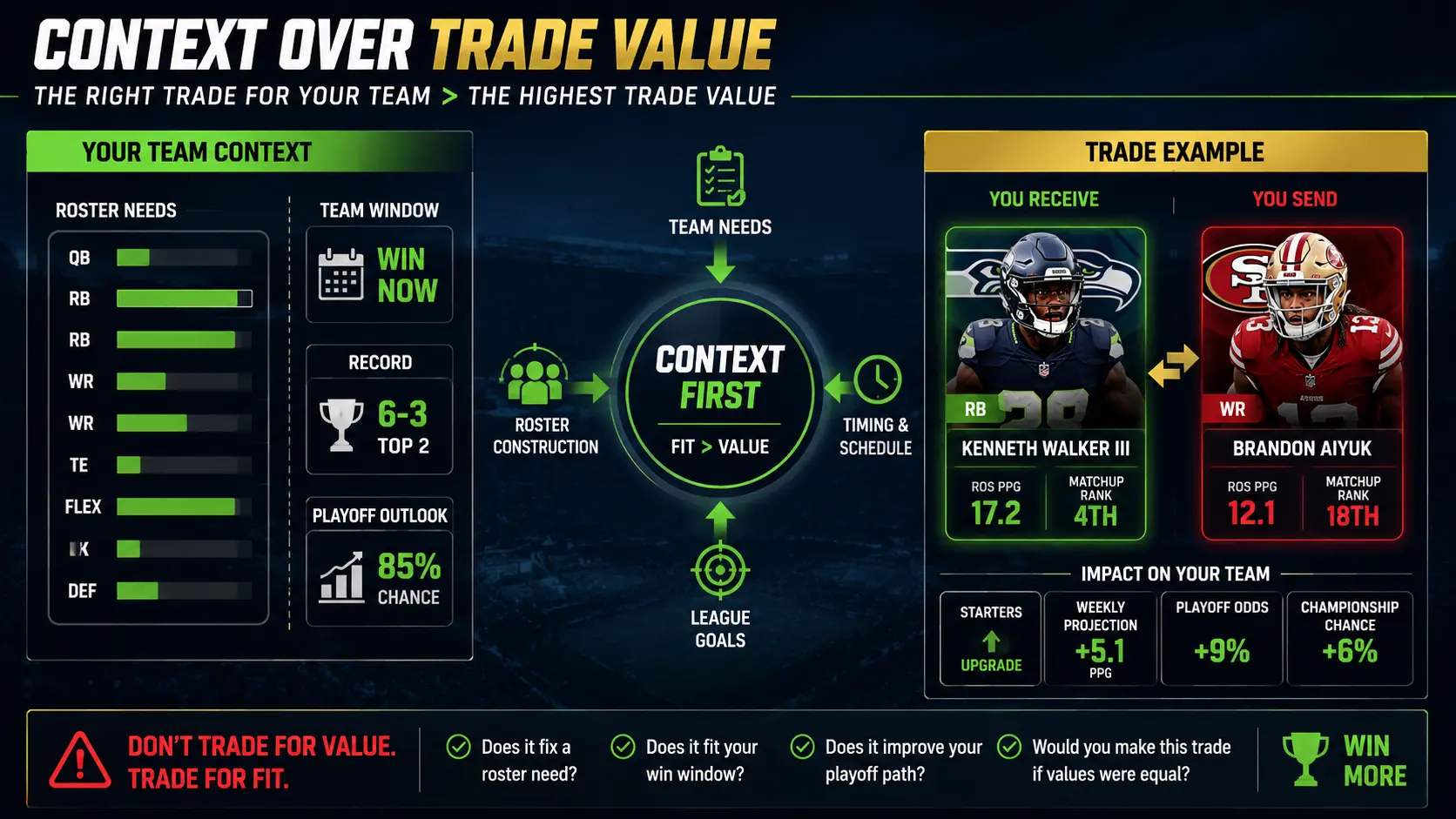
One of the biggest mistakes fantasy managers make is assuming a trade has the same value for every team. In reality, the same trade can be excellent for one manager and disastrous for another.
A trade should always be evaluated in the context of:
- Your current record
- Remaining schedule
- Starting lineup
- Bench depth
- Injury situation
- Playoff odds
- League format
Think of your fantasy roster as a business. A struggling business makes different decisions than one sitting comfortably at the top of the market.
Why League Standings Should Influence Every Trade
Imagine these two teams receive the same offer.
Receive
- Amon-Ra St. Brown
Give
- Terry McLaurin
- Jordan Addison
Team A (8–1)
This team has:
- Strong bench depth
- Healthy starters
- High playoff probability
Trading two good players for one elite player makes sense because maximizing weekly ceiling becomes more important than preserving depth.
Team B (2–7)
This team has:
- Multiple injuries
- Weak bench
- Must win every remaining game
Giving away depth would likely make the team even weaker.
Instead, Team B should prioritize acquiring reliable weekly starters.
The “better” trade depends entirely on team context.
Contender vs. Survival Strategy Matrix
| Team Record | Primary Goal | Preferred Trade Type | Avoid |
| 8–1 or 7–2 | Maximize championship upside | 2-for-1 consolidation | Selling elite talent cheaply |
| 6–3 or 5–4 | Balance risk and upside | Target playoff schedules | Overreacting to one bad week |
| 4–5 or 3–6 | Fix the weak starting lineup | Buy the immediate production | Waiting on injured stars |
| 2–7 or worse | Win now every week | Trade future upside for current points | Holding injured players too long |
Key Takeaway: Your league position changes how much risk you can afford. Contenders can gamble on upside, while struggling teams need immediate, dependable production.
Cross-Positional Trade Evaluation
One of the hardest questions fantasy managers ask is:
Is an RB2 worth more than a WR2?
Raw fantasy points don’t answer this because each position has a different replacement value.
Consider this example:
| Player | Position | Weekly Average |
| Player A | RB | 13.0 |
| Player B | WR | 15.0 |
At first glance, the wide receiver seems more valuable.
Now compare replacement players.
| Position | Replacement Average |
| RB | 8.5 |
| WR | 12.8 |
Now calculate VORP.
RB
13 − 8.5 = 4.5
WR
15 − 12.8 = 2.2
Although the receiver scores more points, the running back provides much greater value above replacement.
This is why experienced managers often pay a premium for reliable running backs, especially in leagues requiring multiple RB starters.
Stop Looking at Fantasy Points Alone
Fantasy points tell you what happened.
They don’t necessarily tell you what will happen.
Instead, evaluate how a player earned those points.
Elite managers focus on usage rather than outcomes.
The Advanced Statistics That Actually Matter
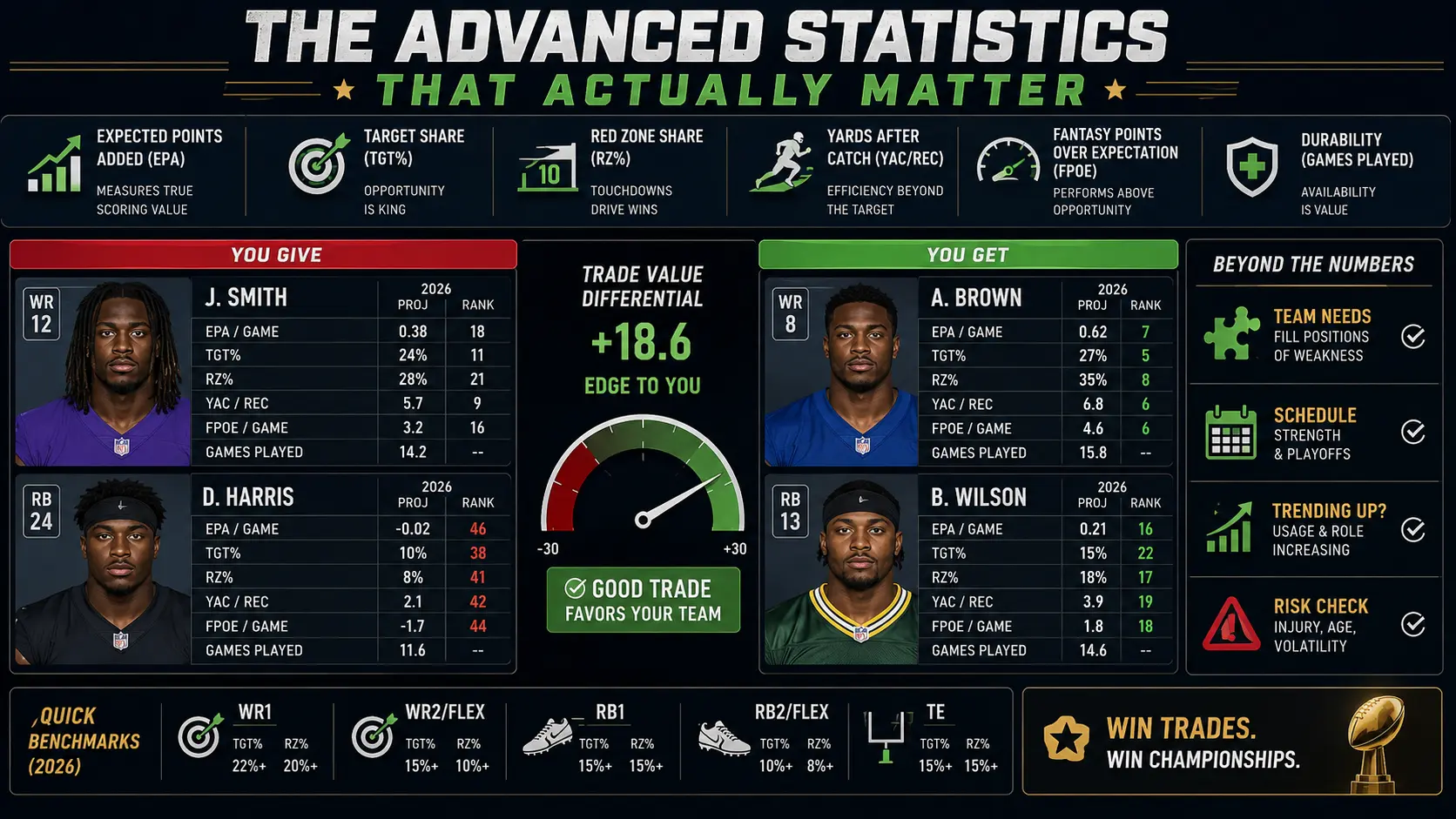
Snap Share
Snap Share measures how often a player is on the field.
High snap percentages usually indicate coaches trust that player regardless of the game script.
General guideline:
- 85%+ = Elite usage
- 70–85% = Reliable starter
- 50–70% = Committee role
- Below 50% = Volatile fantasy asset
A player consistently playing 90% of snaps but underperforming may become a strong buy-low candidate.
Target Share
Wide receiver fantasy production starts with opportunity.
Target Share measures the percentage of a team’s passing attempts directed toward one player.
Typical ranges:
- Above 30% = Elite WR1 usage
- 24–29% = Strong WR2
- 18–23% = Flex option
- Under 15% = Boom-or-bust player
A receiver with an elite Target Share but disappointing fantasy totals often has positive regression potential.
Air Yards
Air Yards measure how far downfield a player is targeted before making the catch.
High Air Yard totals often predict future production better than fantasy points alone.
Example:
Receiver A
6 catches
58 yards
Receiver B
2 catches
72 Air Yards
Receiver B may actually have greater upside if those deep targets begin connecting consistently.
High-Value Touches
Not every touch is created equal.
The most valuable touches include:
- Goal-line carries
- Targets inside the 10-yard line
- Red-zone receptions
- Designed screens
- Two-minute offense usage
Players consistently receiving high-value touches are more likely to sustain fantasy success than players relying on long, low-probability touchdowns.
Routes Run Per Dropback
For wide receivers and tight ends, running routes is more important than simply being on the field.
Blocking tight ends rarely score fantasy points.
Receivers running routes on nearly every passing play possess much higher fantasy ceilings.
Weighted Opportunity Rating (WOPR)
WOPR combines Target Share and Air Yards into one metric.
It answers an important question:
Is this player earning meaningful opportunities?
High WOPR players frequently become excellent buy-low candidates after a few disappointing weeks because their underlying role remains elite.
Predictive Modeling Look Beyond the Box Score
Winning trades depend on predicting future performance rather than reacting to past results.
That’s why experienced managers evaluate:
- Remaining strength of schedule
- Defensive matchups
- Offensive trends
- Injury reports
- Coaching changes
- Offensive line health
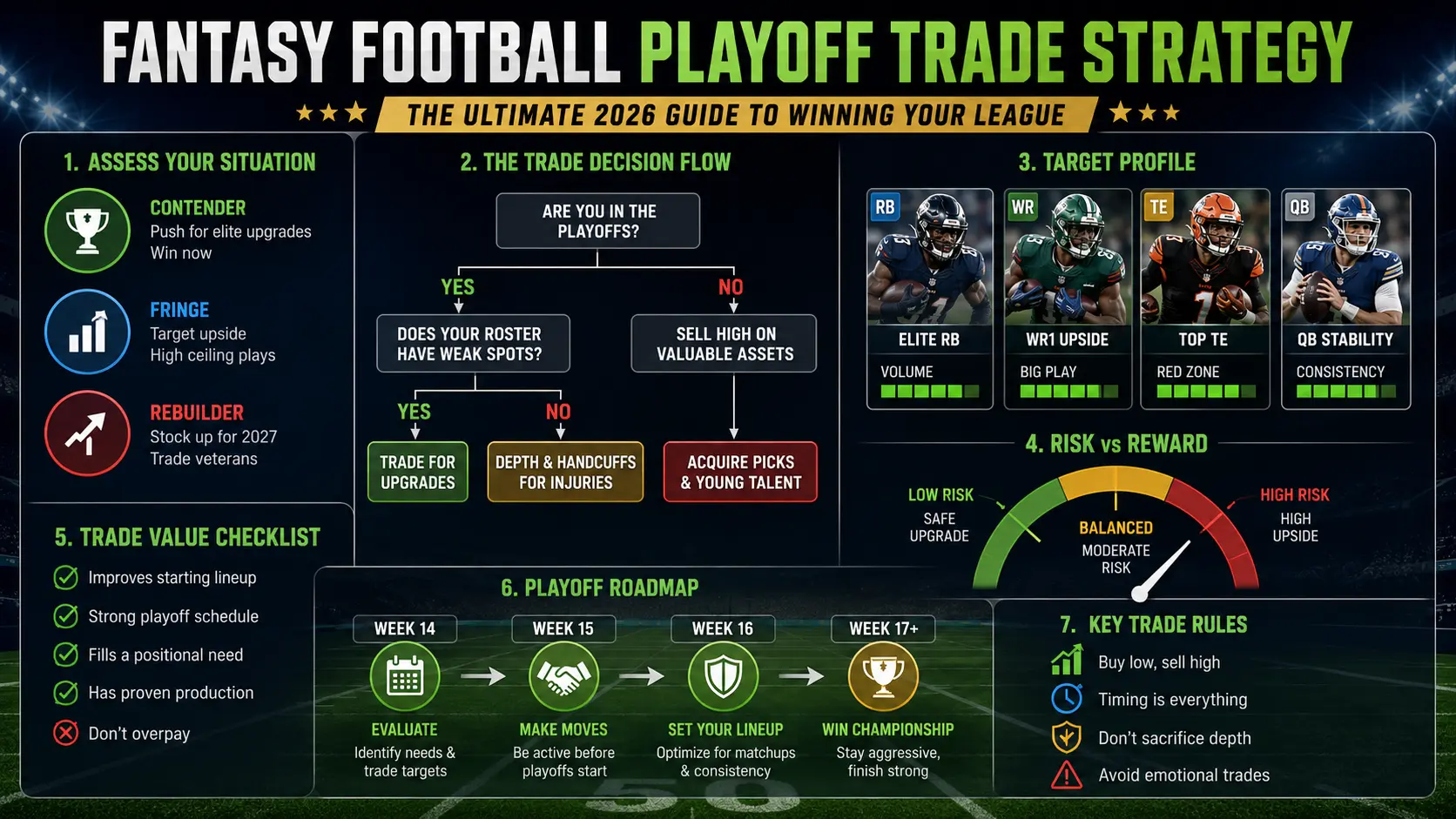
Playoff Schedule Matters More Than Early-Season Production
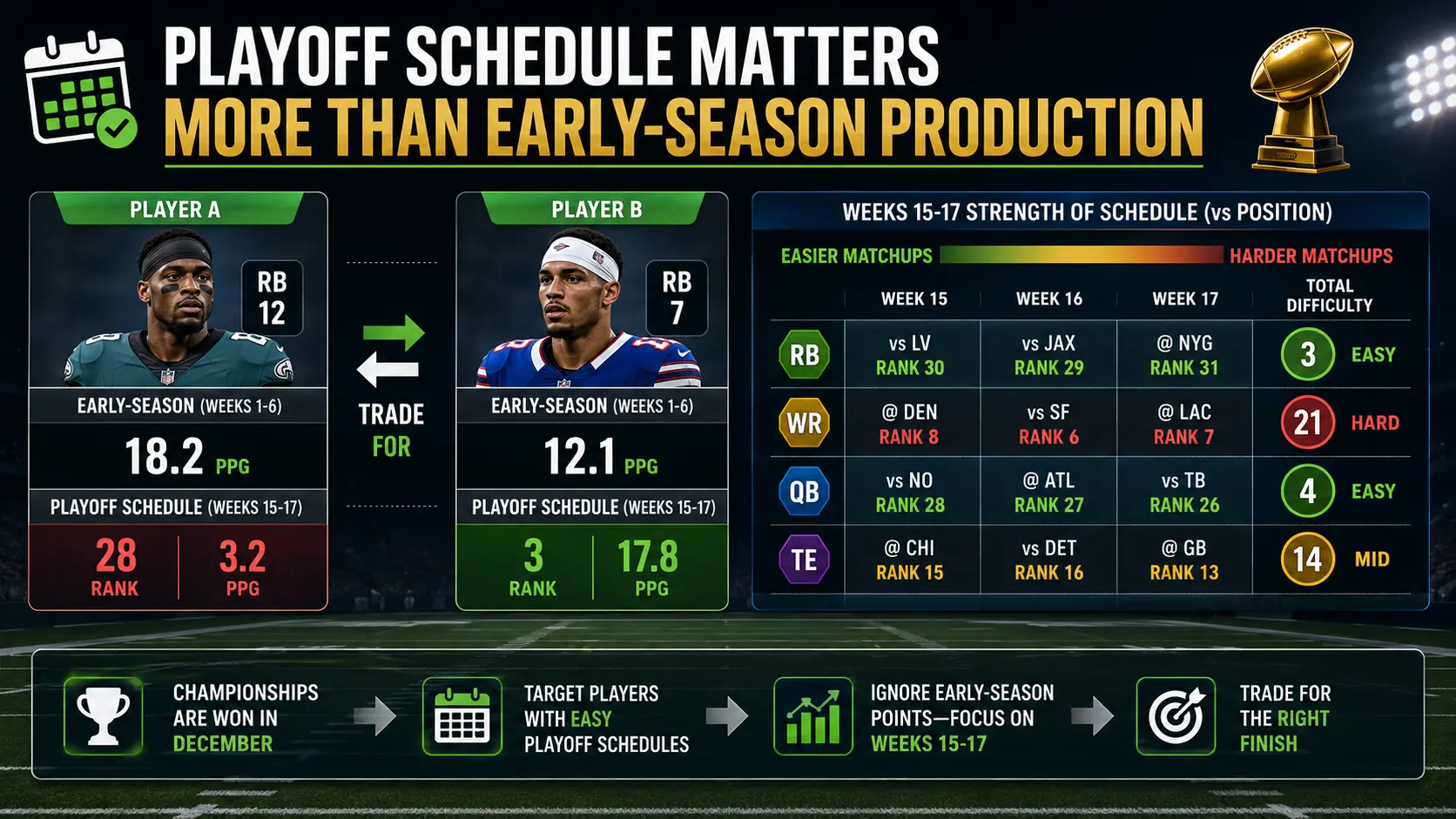
Fantasy championships are often decided during Weeks 15–17.
Suppose two running backs project similarly over the rest of the season.
One faces:
- Bottom-five run defenses during fantasy playoffs.
The other faces:
- Three elite defensive fronts.
Despite similar season projections, the first player may have significantly higher championship-winning potential.
Playoff Schedule Checklist
Before accepting a trade, ask:
✔ Does this player have favorable Weeks 15–17 matchups?
✔ Are they playing indoors during winter?
✔ Will weather likely affect passing volume?
✔ Will their team still have playoff motivation?
✔ Could they rest during Week 18?
Looking ahead instead of reacting to past scores creates a significant edge over your league mates.
Weather and Stadium Factors
Late-season conditions can dramatically affect fantasy production.
Outdoor games in December often involve:
- Heavy wind
- Snow
- Rain
- Extremely cold temperatures
Passing offenses generally become less efficient in poor weather.
Meanwhile:
- Indoor stadiums
- Dome teams
- Warm-weather venues
often provide more stable offensive environments.
This doesn’t mean you should avoid outdoor players entirely, but weather can be a useful tiebreaker when evaluating similarly valued trade targets.
Buy Low vs. Chasing Unsustainable Production
One of the hardest skills in fantasy football is distinguishing between a genuine breakout and a short-term hot streak.
Breakout Signals vs. Mirage Signals
| Breakout Signals | Mirage Signals |
| Increasing snap share | Declining playing time |
| Rising target share | Touchdowns masking low volume |
| Growing red-zone role | Unsustainably high yards per touch |
| Consistent weekly opportunities | One explosive game driving season totals |
| Stable offensive role | Production dependent on broken plays |
Imagine a running back who scores three touchdowns on only eight touches.
That stat line looks impressive, but unless the workload increases, the production is unlikely to continue.
Conversely, a player seeing 22 touches every week but scoring only one touchdown over a month may actually be the better long-term investment because volume is generally more stable than touchdown efficiency.
Regression to the Mean
Regression isn’t a negative concept; it simply means extreme outcomes tend to move back toward normal over time.
Common regression candidates include players with:
- Exceptionally high touchdown rates
- Very low touchdown rates despite strong usage
- Unsustainable yards per carry
- Extremely high catch rates on deep targets
- Unusually poor fantasy production despite elite opportunity
Savvy managers buy players whose usage remains strong but whose recent fantasy scores have disappointed.
Using Sports Betting Markets as Predictive Tools
Sportsbooks invest enormous resources into projecting NFL games.
Fantasy managers can benefit from this information by monitoring:
- Team implied point totals
- Player rushing props
- Receiving yard props
- Anytime touchdown odds
These market-based projections often provide a forward-looking perspective that complements fantasy projections, especially when comparing similarly ranked players.
Use betting markets as one input,t not the sole basis for a trade decision.
Key Takeaways
- Always evaluate trades within the context of your team’s record and playoff outlook.
- Compare players using Value Over Replacement (VORP), not raw fantasy points.
- Prioritize underlying opportunity metrics such as Snap Share, Target Share, Air Yards, Routes Run, and High-Value Touches.
- Focus on future production by analyzing playoff schedules, weather, and offensive trends.
- Separate true breakouts from unsustainable touchdown-driven hot streaks.
- Use predictive tools, including Rest-of-Season projections and market expectations, to make informed decisions rather than reacting to last week’s fantasy scores.
Specialized League Formats, Advanced Strategy, and Risk Management
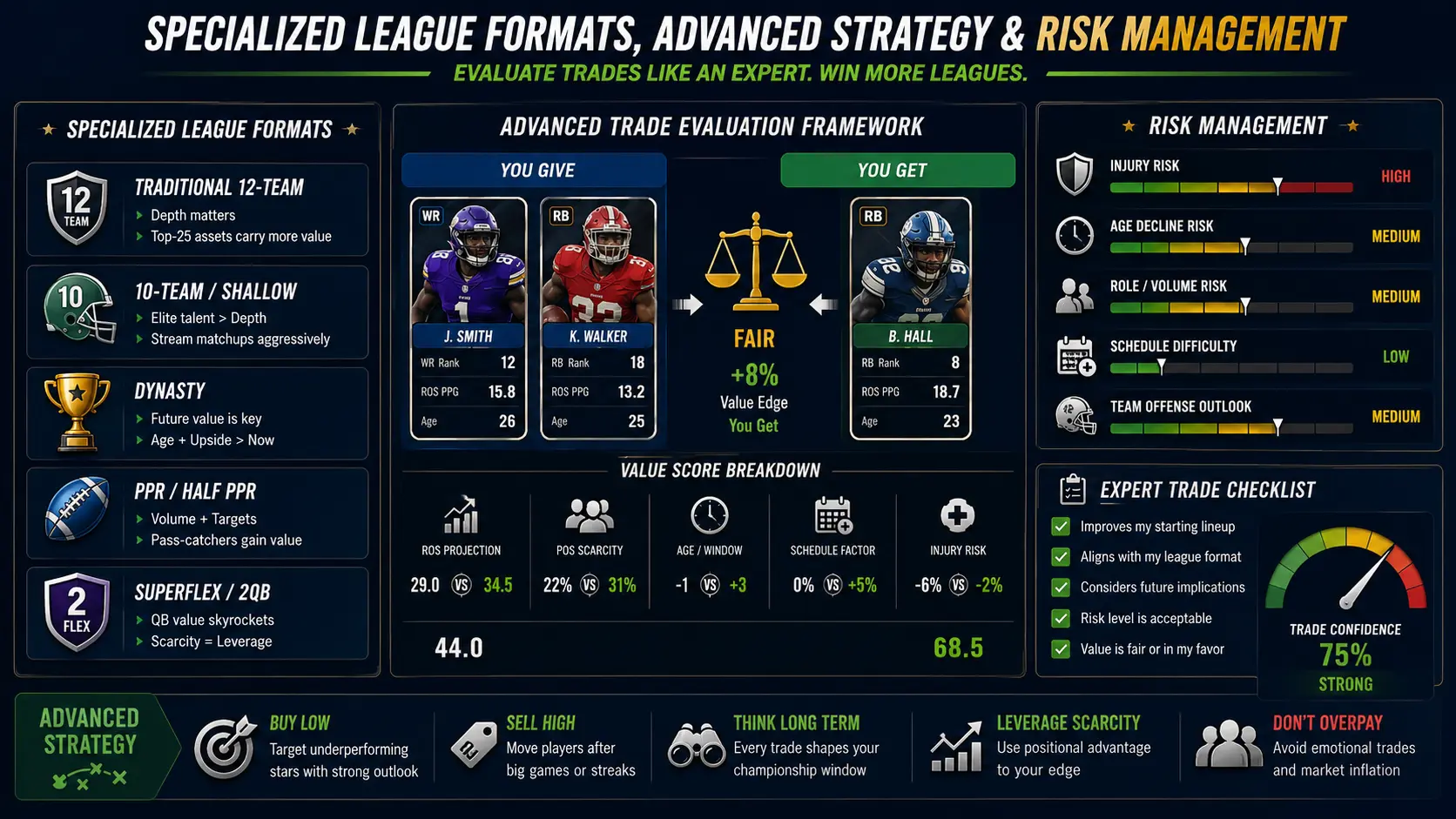
By now, you’ve learned how to evaluate player value, account for roster construction, and use predictive analytics to make smarter trade decisions. However, one critical factor remains: league format.
A trade that is perfectly fair in a standard redraft league might be terrible in a dynasty league or Superflex format. Understanding how scoring systems and roster rules change player value is one of the biggest advantages experienced fantasy managers have over casual players.
Specialized Formats – Why League Rules Change Everything
Before evaluating any trade, ask yourself:
- Is this a redraft or dynasty league?
- Can quarterbacks be started in a Superflex spot?
- Are draft picks tradeable?
- Is there a keeper system?
- Does the league use Tight End Premium (TEP) scoring?
- How many Flex positions are available?
The answers dramatically affect player values.
Dynasty League Trade Evaluation
Unlike redraft leagues, dynasty managers aren’t just building a team for one season; they’re managing assets over multiple years.
Every trade must balance present production against future value.
Dynasty Asset Evaluation Framework
When evaluating a dynasty trade, consider:
- Player age
- Injury history
- Contract situation
- Position longevity
- Future offensive environment
- Rookie draft pick value
- Team direction (contending vs. rebuilding)
Example
A 29-year-old elite running back may help you win a championship this season, but a 22-year-old wide receiver with WR1 potential could provide value for the next five years.
A rebuilding team should prioritize younger players and draft capital, while a contender may willingly trade future assets for immediate production.
Dynasty Trade Priorities
Contending Teams
- Elite veterans
- Proven weekly starters
- Favorable playoff schedules
- Reliable point production
Rebuilding Teams
- Young breakout candidates
- Future first-round picks
- Sophomore wide receivers
- Long-term quarterback stability
Dynasty Value Comparison
| Contender Focus | Rebuilder Focus |
| Weekly production | Future upside |
| Veterans | Young talent |
| Elite RBs | Rookie picks |
| Championship window | Long-term roster value |
How to Value Draft Picks in Fantasy Football Trades
Draft picks are among the most misunderstood trade assets.
In Redraft Leagues
Once the fantasy season begins, draft picks usually have no trade value because they don’t contribute points during the current season.
Your only concern is maximizing points between now and your league championship.
In Dynasty Leagues
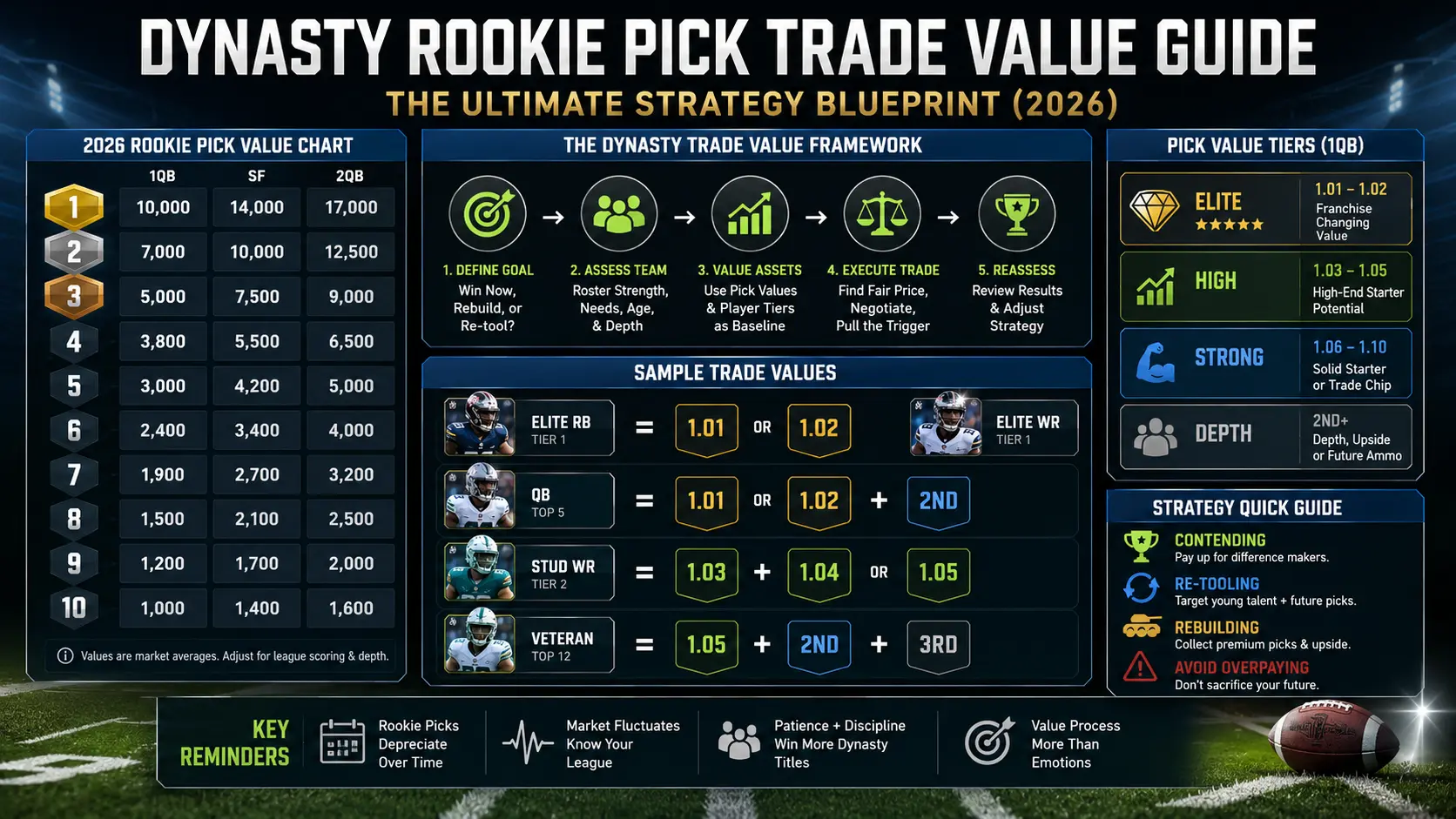
Draft picks become valuable long-term investments.
General value hierarchy:
- Early 1st Round Pick – Premium asset
- Mid 1st – High value
- Late 1st – Strong value
- Early 2nd – Solid developmental asset
- Later picks – Increasingly speculative
Remember:
Draft picks are probabilities, not guaranteed stars.
Never assume every first-round rookie becomes an elite fantasy player.
Keeper League Trade Strategy
Keeper leagues combine elements of both redraft and dynasty.
Player value depends on:
- Keeper cost
- Future draft round
- Contract length
- League rules
Example
Suppose you can keep:
Puka Nacua
for a 10th-round pick next season.
His keeper value is substantially higher than his current fantasy projections alone.
Always calculate both:
- Current-season production
- Future keeper advantage
Superflex and 2-QB Trade Evaluation
One of the biggest mistakes fantasy managers make is evaluating quarterbacks like they would in a traditional one-quarterback league.
In Superflex formats, quarterbacks become the most valuable position in fantasy football.
Why?
Because nearly every manager wants to start two quarterbacks every week, while the NFL only provides a limited number of reliable starters.
General Superflex Rules
Quarterbacks become:
- More difficult to replace
- More valuable in trades
- Worth paying premium prices for
Example
In standard leagues:
A QB12 might be worth less than an RB20.
In Superflex:
That same quarterback may become more valuable than an RB1.
Superflex Trade Guidelines
Prioritize:
- Young starting quarterbacks
- Long-term job security
- Stable offensive systems
Avoid selling quarterbacks cheaply simply because they have one disappointing week.
Tight End Premium (TEP)
Tight End Premium leagues award additional points per reception to tight ends.
Example:
Normal PPR
1 point per reception
TE Premium
1.5–2 points per reception
This dramatically changes player values.
Elite tight ends become legitimate first-round caliber assets.
TEP Comparison
| Standard PPR | Tight End Premium |
| Elite TE = Slight advantage | Elite TE = League-winning advantage |
| Mid-tier TEs replaceable | Quality TEs become scarce |
| WR depth preferred | Elite TE is worth a premium trade value |
Never evaluate tight ends using standard trade calculators unless they specifically support TEP scoring.
Risk Management and Portfolio Thinking
Experienced fantasy managers don’t just chase upside.
They manage risk.
Every trade should improve one or more of the following:
- Weekly floor
- Weekly ceiling
- Injury protection
- Playoff stability
- Positional flexibility
Handcuff Strategy
A handcuff is the backup running back behind your elite starter.
Example:
If your RB1 suffers a season-ending injury, the backup often inherits a massive workload.
Owning your own handcuff reduces catastrophic downside.
Should You Trade for Your Own Handcuff?
Usually, yes.
Benefits include:
- Protecting elite investments
- Reducing injury risk
- Maintaining lineup stability
- Preserving playoff chances
Trading for an opponent’s backup may offer higher upside, but acquiring your own handcuff often provides greater roster security.
Buy Low and Sell High Framework
Every fantasy manager hears these phrases, but few understand how to identify true opportunities.
Buy Low Candidates
Look for players with:
- High snap share
- Strong target share
- Heavy workload
- Difficult recent schedule
- Poor touchdown luck
- Positive regression potential
Avoid buying players who have lost their role within the offense.
Sell High Candidates
Look for players with:
- Low usage
- Unsustainably high touchdown rates
- Big fantasy totals driven by one explosive game
- Declining snap share
- Increasing competition for touches
Breakout vs. Mirage Comparison
| True Breakout | Statistical Mirage |
| Increasing usage | Declining opportunities |
| Consistent targets | Touchdown dependent |
| Stable snap share | Low snap percentage |
| Red-zone involvement | Long-play reliance |
| Growing offensive role | Unsustainable efficiency |
Usage is usually more predictive than fantasy points.
Market Sentiment vs. Real Player Value
Fantasy football has a market, just like the stock market.
Sometimes public opinion overreacts.
Examples include:
- One bad game
- A difficult matchup
- Temporary injuries
- Negative headlines
Instead of following public perception, compare market sentiment with actual player usage.
If usage remains elite while fantasy production declines, the player may represent a valuable buy-low opportunity.
Using Trade Calculators the Right Way
Trade calculators are useful but only when combined with your own analysis.
Use them to:
- Estimate baseline value
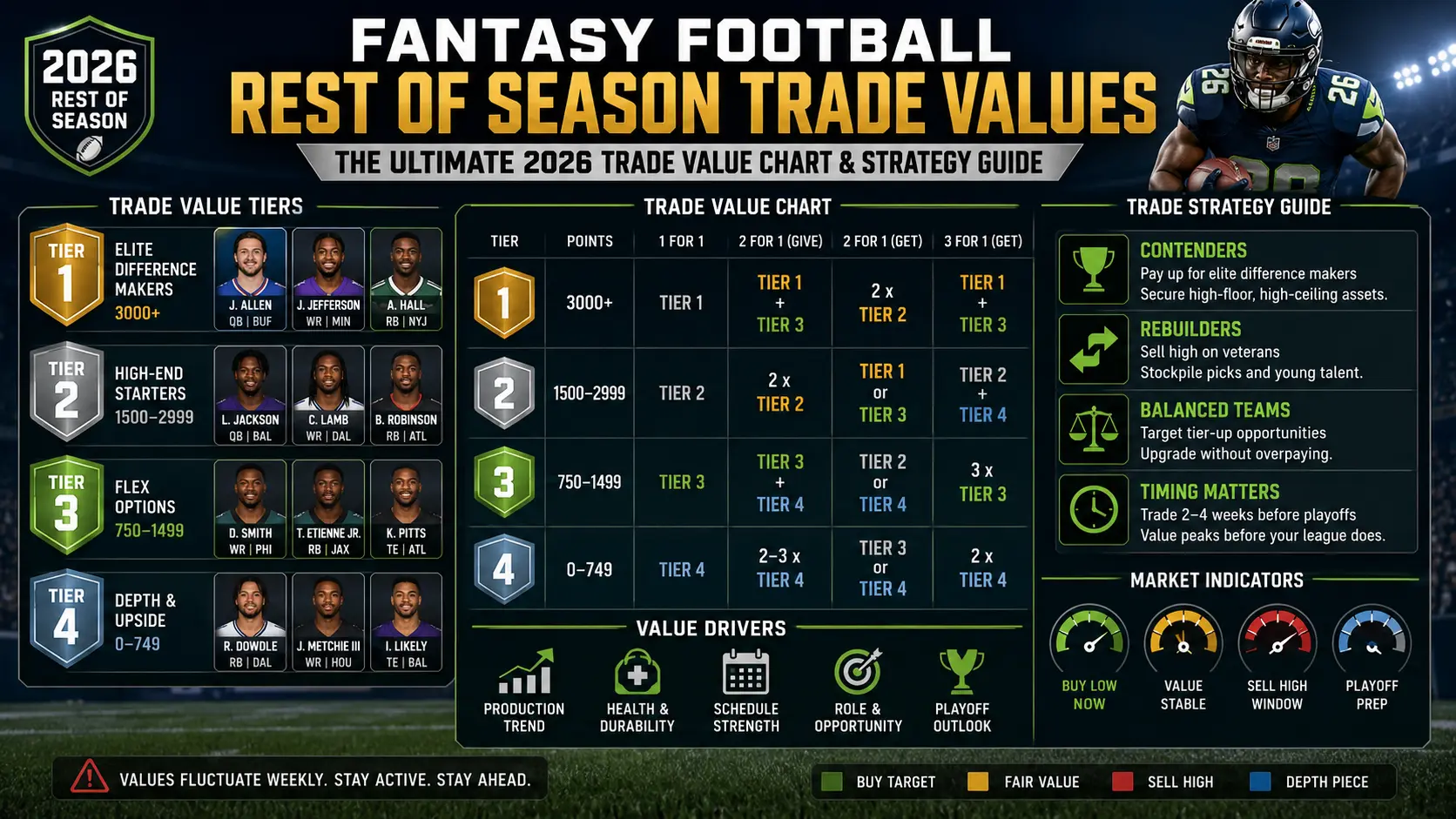
- Compare player tiers
- Identify obvious overpays
Don’t use them to decide trades automatically.
They cannot evaluate:
- Your roster construction
- League dynamics
- Manager tendencies
- Playoff schedules
- Injury timelines
- Championship strategy
Always apply human judgment after reviewing calculator results.
Recommended Fantasy Football Trade Tools
No single tool is perfect. Cross-checking multiple resources gives a more balanced view.
| Tool | Best For | Strengths | Limitation |
| FantasyCalc | Crowdsourced trade values | Based on thousands of completed trades | Market sentiment can lag behind breaking news |
| KeepTradeCut | Dynasty rankings | Excellent for dynasty and rookie pick values | Community-driven values may fluctuate quickly |
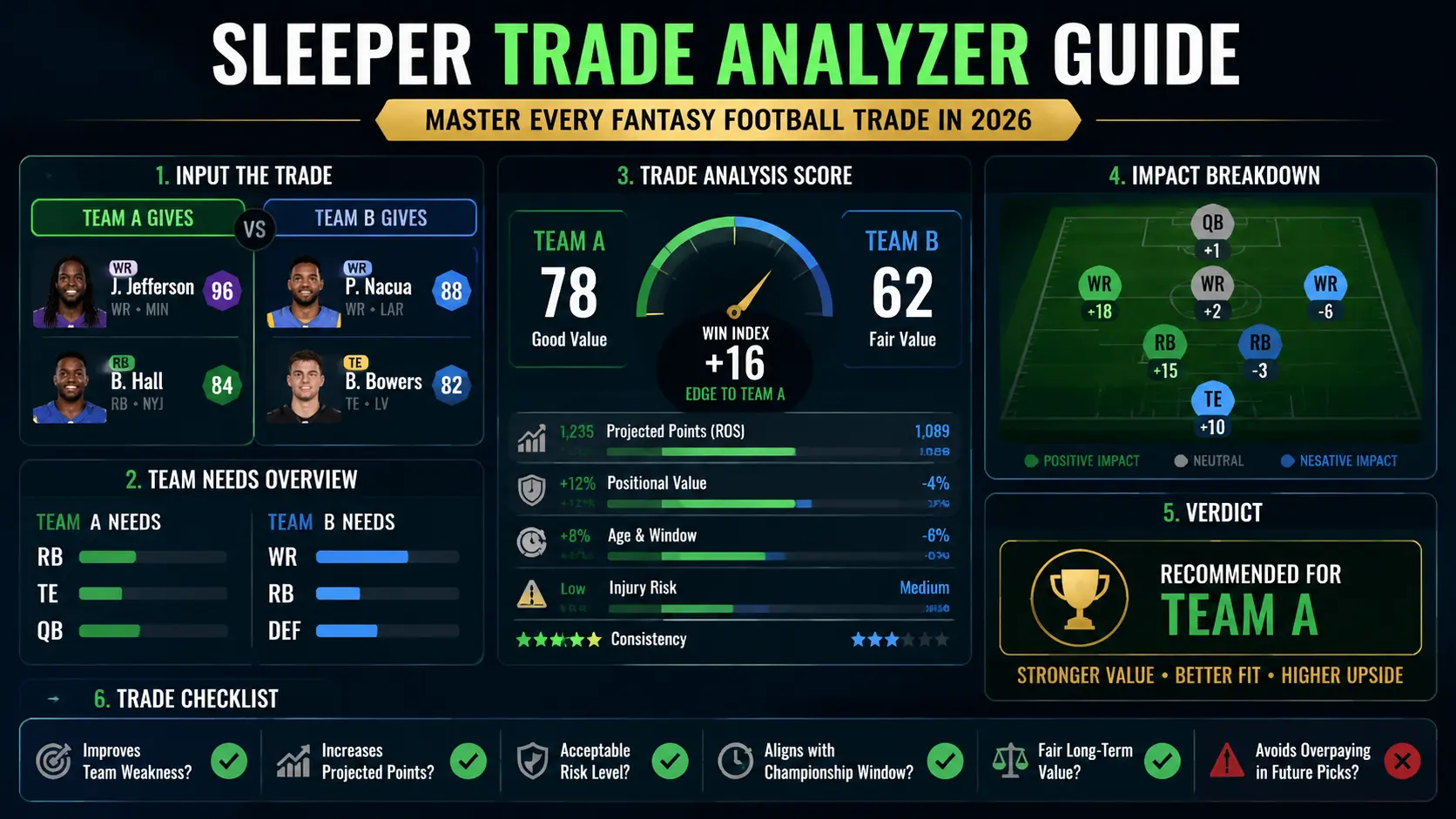
| Sleeper | League management | Integrated trade discussions and league communication | Doesn’t provide standalone valuation models |
| ESPN Fantasy | Casual leagues | Familiar projections and player news | Less customizable for advanced formats |
| Yahoo Fantasy | Public leagues | Easy trade interface and player updates | Advanced analytics are limited |
Tip: If multiple tools agree on player value and your roster analysis also supports the move, you’re generally making a well-informed decision.
Advanced Risk Management Checklist
Before accepting any trade, ask yourself:
- Does this improve my weekly starting lineup?
- Am I solving a positional weakness?
- What player will I have to drop?
- Am I buying sustainable usage or recent production?
- Does this help me during the fantasy playoffs?
- Is my team’s current record influencing the right strategy?
- Would I still make this trade if last week’s fantasy scores were removed?
If you answer “no” to most of these questions, reconsider the deal.
Key Takeaways
- League format dramatically changes player value. Always evaluate trades within your specific rules.
- Dynasty managers should balance age, production, and future draft capital.
- Superflex leagues place a premium on starting quarterbacks.
- Tight End Premium formats significantly increase the value of elite tight ends.
- Focus on underlying usage metrics rather than short-term fantasy points when identifying buy-low and sell-high opportunities.
- Trade calculators are helpful reference tools, but roster context, league dynamics, and long-term strategy should always guide your final decision.
Negotiation, Case Studies, Expert Insights, FAQs & Conclusion
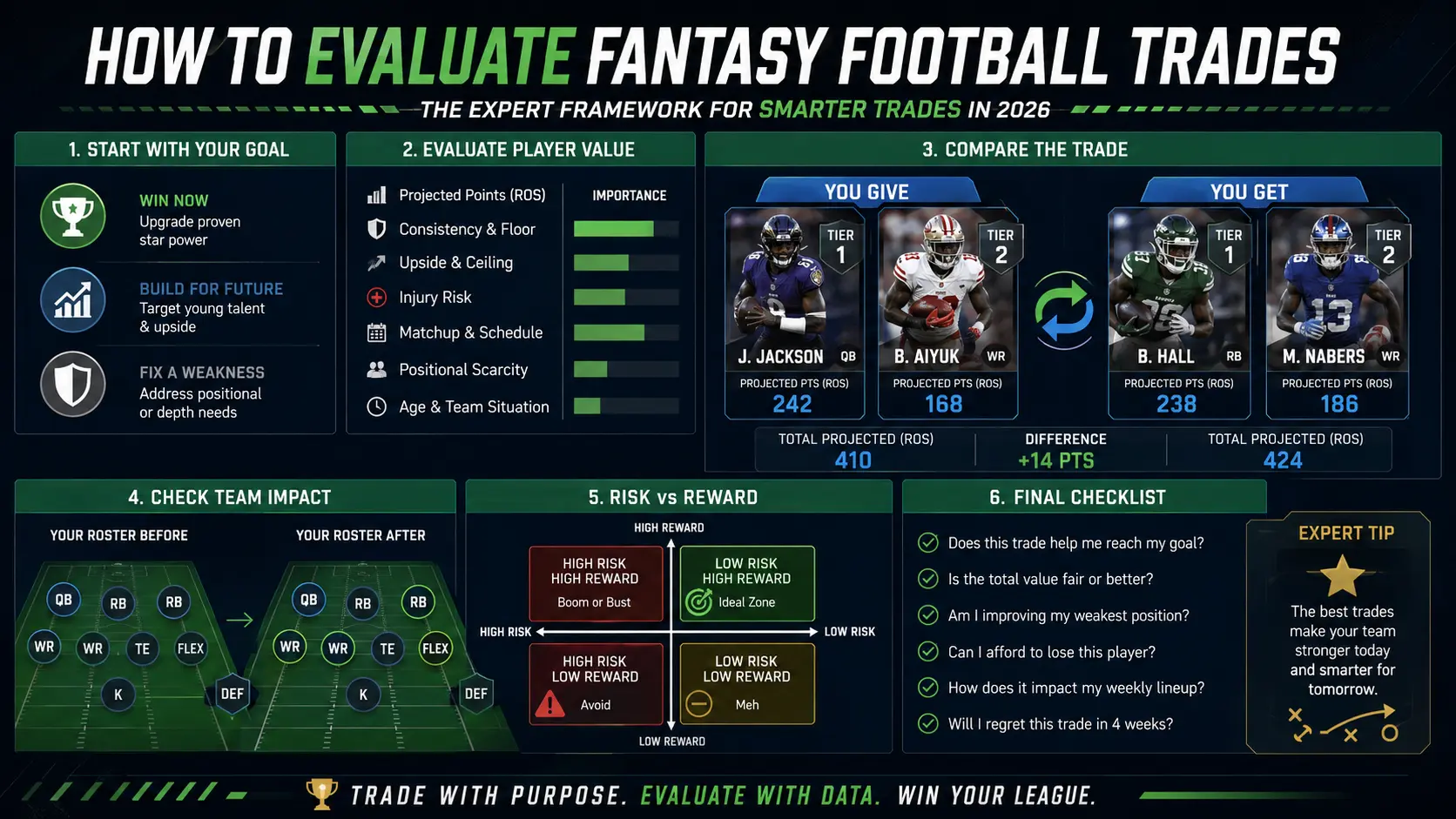
At this stage, you know how to calculate player value, adjust for league formats, and evaluate advanced metrics. But even the most accurate player valuation won’t help if you can’t negotiate effectively or avoid common trading pitfalls. In this final section, we’ll focus on turning sound analysis into successful deals while addressing the human side of fantasy football.
Mastering Trade Negotiation Psychology
Many fantasy managers assume a trade fails because it isn’t fair. In reality, most trades fail because they’re presented poorly or because managers become emotionally attached to players.
Successful negotiations require understanding both player value and human behavior.
The Anchor Effect
The first trade offer often sets the tone for the entire negotiation. This is known as the anchoring effect.
Poor Example
Offer:
- Backup WR
- Backup RB
For:
- Elite WR1
Most managers will instantly reject the offer and become less willing to negotiate further.
Better Approach
Start with an offer that is realistic, even if it’s slightly favorable to you. Explain your reasoning and remain open to adjustments.
A reasonable opening offer encourages discussion instead of ending it.
Communicate Before Sending Offers
Rather than sending a random proposal, ask questions like:
- “Are you looking for another running back?”
- “Would you consider moving your tight end?”
- “Are you rebuilding or trying to win now?”
Understanding another manager’s needs often leads to trades that benefit both teams.
When to Send Trade Offers
Timing can significantly influence trade success.
Good times include:
- After a player’s disappointing performance
- During a bye week
- Following a short-term injury to another position
- Before fantasy playoff schedules become obvious
- After favorable usage trends emerge, but before fantasy points follow
Avoid sending offers immediately after major NFL injury news unless you have complete information.
FAAB as a Trade Sweetener
Many leagues allow managers to trade Free Agent Acquisition Budget (FAAB).
Instead of arguing over a small value difference between players, adding FAAB can make both sides feel the deal is fair.
Example
Instead of:
Player A
for
Player B
Try:
Player A + $15 FAAB
for
Player B
This often closes negotiations without giving away another roster player.
When FAAB Makes Sense
Use FAAB to:
- Balance nearly equal trades
- Acquire playoff depth
- Add flexibility without sacrificing talent
Don’t overpay with FAAB early in the season unless you’re acquiring a clear difference-maker.
League Politics and Commissioner Vetoes
Few topics create more debate than trade vetoes.
When Should a Trade Be Vetoed?
A trade should only be vetoed when there is clear evidence of:
- Collusion
- Prize-sharing agreements
- Intentional league sabotage
- Managers acting together to unfairly influence league outcomes
When a Trade Should NOT Be Vetoed
Do not veto a trade simply because:
- One manager values players differently.
- Experts disagree with the trade.
- It appears uneven on paper.
- A team takes on more risk.
Fantasy football rewards different strategies. Managers should have the freedom to make their own decisions unless they are violating league integrity.
Case Study – Winning a Championship Through Smart Trade Evaluation
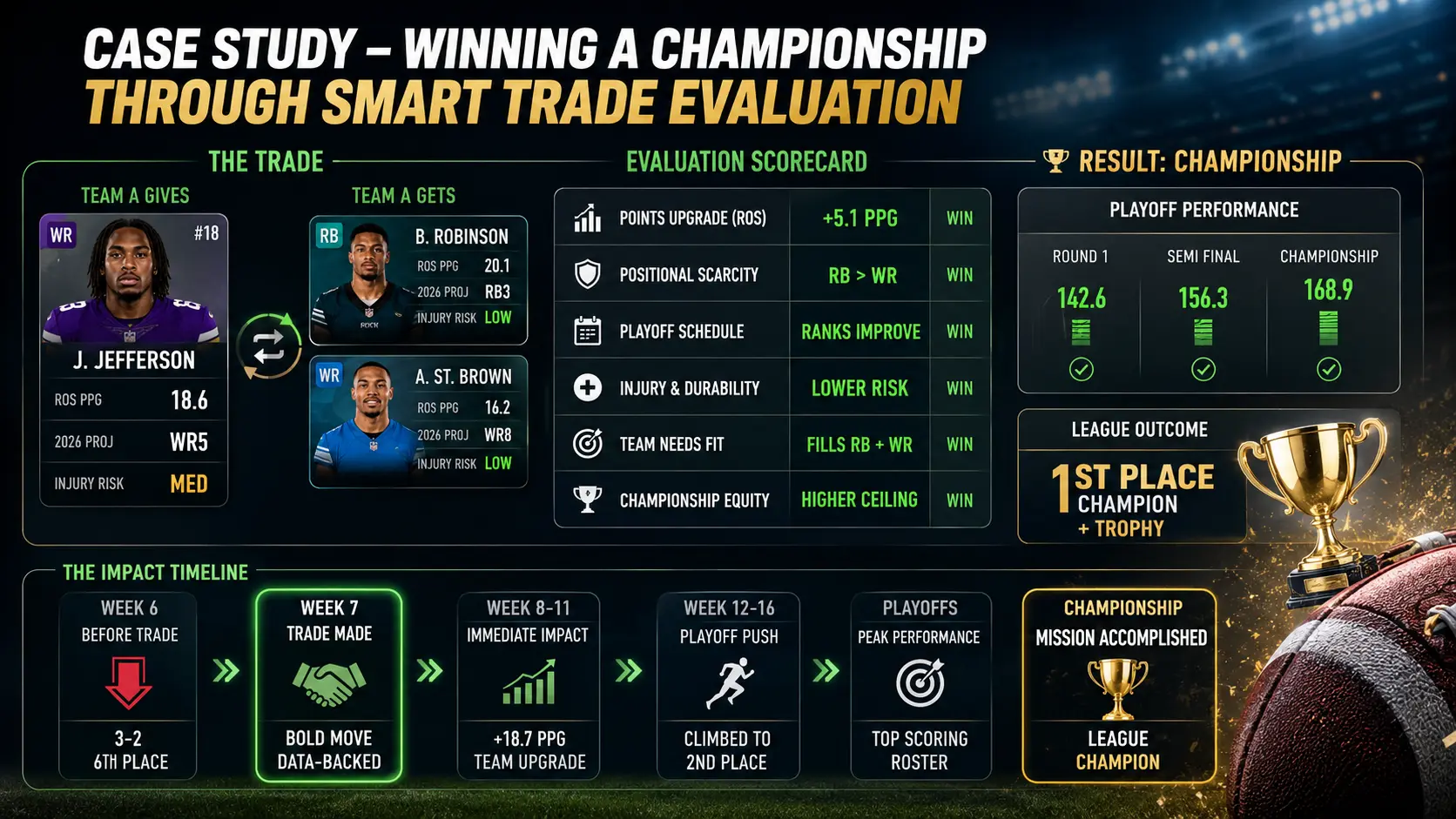
Scenario
Midway through the season:
Team Record: 6–2
Current Roster Needs:
- Elite WR
- Strong RB depth
- Average QB
- Weak playoff schedule
Trade Offer
Receive:
- CeeDee Lamb
Give:
- James Cook
- Chris Godwin
Many managers reject this because they’re giving away two productive starters.
Let’s evaluate the trade using the framework from this guide.
Step 1: League Format
- Full PPR
- Redraft
- Two Flex spots
Step 2: Opportunity Cost
Dropping the weakest bench player only costs about 5 projected points over the rest of the season.
Step 3: Playoff Schedule
Lamb faces three favorable secondaries during fantasy playoffs.
Step 4: Team Context
The manager already has excellent RB depth.
Replacing James Cook is easier than replacing elite WR production.
Step 5: Final Decision
Although the trade calculator rates the deal as nearly even, consolidating value into an elite weekly starter significantly increases the team’s championship ceiling.
The manager accepts the trade and reaches the league final.
Lesson: Great trades improve the starting lineup, not just the total value of the roster.
Expert Insights
Experienced fantasy analysts consistently emphasize one principle:
Prioritize opportunity over recent fantasy production.
Touches, targets, snap share, route participation, and red-zone usage are more stable indicators of future success than touchdowns scored in the previous week.
Another widely accepted principle is:
Trade calculators provide a starting point,t not the final answer.
The strongest fantasy managers blend projections with league context, roster construction, and playoff planning rather than relying on a single numerical value.
Future Trends in Fantasy Football Trade Evaluation
Fantasy football strategy continues to evolve as more advanced data becomes available.
Emerging trends include:
AI-Assisted Projections
Machine learning models increasingly analyze player usage, injuries, schedules, and historical performance to improve Rest-of-Season projections.
Market-Based Valuation
Crowdsourced trade data from thousands of public leagues provides a clearer picture of real-world player values than individual expert rankings alone.
Advanced Usage Metrics
Fantasy managers are paying greater attention to metrics such as:
- Expected Fantasy Points (xFP)
- Expected Points Added (EPA)
- Target Share
- Air Yards
- High-Value Touches
- Route Participation
These indicators often predict future fantasy performance more reliably than traditional box-score statistics.
Fantasy Football Trade Evaluation Checklist
Before accepting any trade, review this checklist:
✅ Confirm your league’s scoring settings.
✅ Compare Rest-of-Season projections instead of past fantasy points.
✅ Calculate Value Over Replacement (VORP).
✅ Account for the player you’ll need to drop.
✅ Evaluate your starting lineup, not just individual players.
✅ Consider positional scarcity.
✅ Review playoff schedules.
✅ Analyze usage metrics rather than recent touchdowns.
✅ Factor in your current league standings.
✅ Use trade calculators as references, not final decisions.
If a trade improves your projected weekly starting lineup while supporting your long-term strategy, it’s likely worth accepting.
Conclusion
Learning how to evaluate fantasy football trades isn’t about memorizing player rankings or blindly following trade calculators. It’s about understanding the bigger picture.
Every successful trade balances player talent with roster construction, positional scarcity, league format, playoff schedules, opportunity cost, and your team’s current goals.
The most successful fantasy managers think several weeks ahead. They focus on sustainable usage instead of short-term production, identify value before it becomes obvious, and make decisions based on evidence rather than emotion.
No evaluation method guarantees that every trade will succeed. Injuries, coaching decisions, and unexpected performances are part of fantasy football. However, consistently applying the framework outlined in this guide will help you make smarter, more informed decisions throughout the season.
Approach every trade with patience, context, and a clear understanding of your team’s needs. Over time, those disciplined decisions can be the difference between an early playoff exit and lifting your league’s championship trophy.
Frequently Asked Questions (FAQ)
1. How do you evaluate a fantasy football trade?
Evaluate a trade by comparing each player’s Rest-of-Season value, accounting for league scoring settings, positional scarcity, roster opportunity cost, and whether the deal improves your projected weekly starting lineup.
2. Are fantasy football trade calculators accurate?
Trade calculators are useful reference tools, but they cannot fully account for roster construction, league context, playoff schedules, or individual team needs. Use them as a starting point rather than a final decision-maker.
3. Should I accept a 2-for-1 fantasy football trade?
Only if the incoming elite player provides more value than the combined production of the players you’re giving up after accounting for the player you’ll need to drop to make room on your roster.
4. How do I know if I’m buying low?
Look for players with strong underlying usage, such as high snap share, target share, or red-zone opportunities, but disappointing recent fantasy results. Those players often have positive regression potential.
5. When should I sell high?
Consider selling players whose fantasy production has been driven by unsustainably high touchdown rates or unusually efficient performances despite limited opportunities.
6. How important is playoff strength of schedule?
Very important. Favorable matchups during fantasy playoff weeks (typically Weeks 15–17) can significantly increase a player’s championship-winning potential.
7. How should I value quarterbacks in Superflex leagues?
Quarterbacks carry a much higher premium in Superflex and two-quarterback leagues because managers can start two QBs each week. Reliable starting quarterbacks are often among the most valuable trade assets.
8. Should commissioners veto unfair trades?
No. Trades should only be vetoed in cases of clear collusion, league sabotage, or rule violations. Uneven trades are a normal part of competitive fantasy football.
9. How valuable are draft picks in dynasty leagues?
Draft picks are core dynasty assets. Their value depends on factors such as projected draft position, rookie class strength, team direction, and league settings. Contending teams often trade future picks for current production, while rebuilding teams accumulate draft capital.
10. What’s the biggest mistake fantasy managers make when evaluating trades?
The biggest mistake is focusing on individual player names instead of how the trade affects the entire starting lineup. A deal that looks “fair” on paper can still reduce your weekly scoring potential if it creates positional weaknesses or forces you to rely on low-value waiver-wire replacements.